Written by Jinna CAMERON, veterinary medical student and dog health researcher. Reviewed for factual accuracy against trusted veterinary sources by DVM ,Carla DONTESK
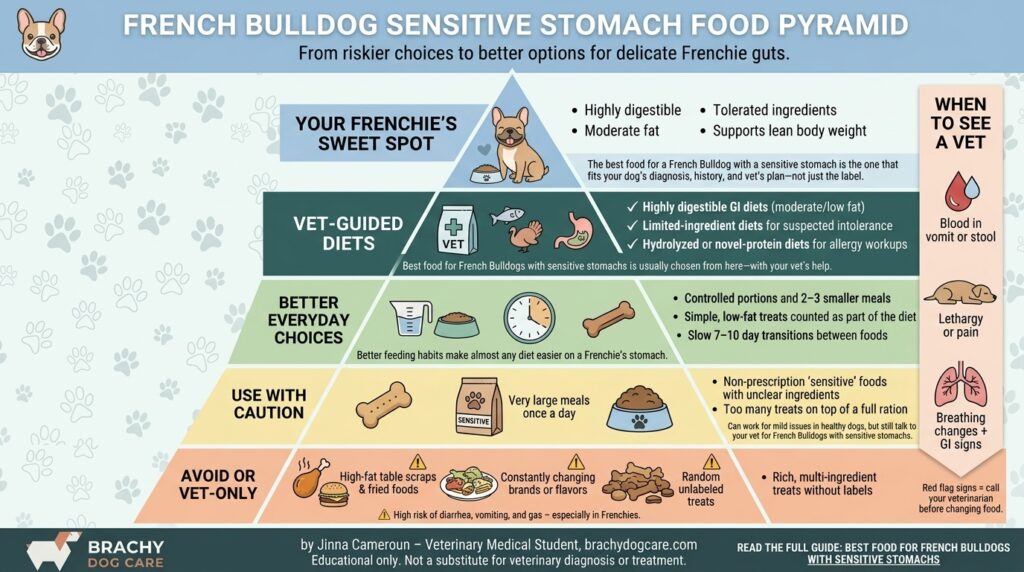
Best food for French Bulldogs with sensitive stomachs isn’t about finding one “magic” brand, it’s about matching your Frenchie’s diet to their unique anatomy, GI history, and symptoms in a safe, structured way. As a veterinary medical student and dog-health researcher, my goal in this guide is to help you understand why Frenchies are so prone to stomach issues, what realistic diet options exist, and how to work with your veterinarian to choose the best food for French Bulldogs with sensitive stomachs without guessing or constantly switching foods.
This guide is educational and is not a diagnosis or a substitute for professional veterinary care.
Why Sensitive Stomachs Are So Common in French Bulldogs
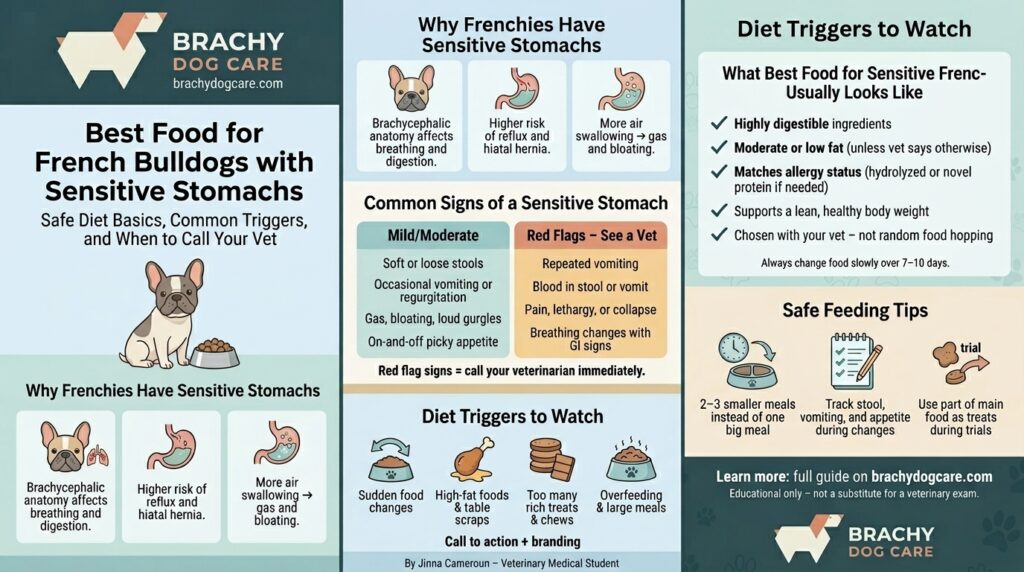
French Bulldogs genuinely have a higher risk of gastrointestinal problems than many other breeds. In several clinical datasets, Frenchies show increased odds of oesophageal, gastric, and intestinal disease even when compared with other brachycephalic breeds like Pugs and English Bulldogs. That means when a Frenchie has ongoing vomiting, loose stools, or “random” tummy upsets, we should treat it as a real medical pattern, not just fussiness or picky eating.
Their airway anatomy is a major reason for this. When a dog has brachycephalic obstructive airway syndrome (BOAS), each breath can require more effort, creating abnormal negative pressure inside the chest. That negative pressure encourages gastroesophageal reflux, hiatal herniation, and aerophagia (air swallowing). Over time, this can inflame the esophagus, stomach, and upper small intestine. In many brachycephalic dogs, surgical improvement of BOAS significantly improves digestive signs, which shows how tightly linked breathing and GI function are in this breed.
What “Sensitive Stomach” Actually Means in a French Bulldog
“Sensitive stomach” is an owner phrase, not a specific diagnosis. In a French Bulldog, that label can hide several different underlying problems, including:
- Food-responsive enteropathy (a common subtype of chronic inflammatory enteropathy)
- Non-immune food intolerance or dietary indiscretion
- Immunologic food allergy
- Gastroesophageal reflux disease
- Anatomical issues like sliding hiatal hernia or esophageal dysmotility
In practice, these often overlap. Some French Bulldogs with BOAS have documented chronic gastritis or duodenitis on biopsy even when owners only report mild, intermittent signs. Others have significant hiatal hernia or reflux with what owners describe as “just occasional spit-ups” or “bad gas.” That’s why best food for French Bulldogs with sensitive stomachs should always be chosen with the idea that anatomy and inflammation may be part of the picture, not just “delicate digestion”.
Because the term covers a spectrum, this article focuses on what you can reasonably influence with diet and feeding habits, while repeating where the line is for “this needs a vet now.”
Common Sensitive Stomach Symptoms Owners Notice
Everyday Signs That May Be Diet-Responsive
Owners usually describe a French Bulldog sensitive stomach using phrases like:
- Soft stools or loose stool / diarrhea after eating
Stools may be formed but soft, or swing between normal and loose, especially after certain foods, treats, or sudden diet changes. That pattern can fit food intolerance, dietary indiscretion, or food-responsive enteropathy.- Vomiting or regurgitation, especially after meals
Some dogs bring up undigested kibble shortly after eating or regurgitate small amounts of food and foam. In French Bulldogs, hiatal hernia and reflux are common, so regurgitation is a frequent complaint. Owners often say “he just spits up his food if he moves too soon after meals.”- Gas, bloating, and loud stomach gurgling
Aerophagia is more common in brachycephalic dogs. Swallowed air can cause visible bloating, “balloon” bellies, and the classic “Frenchie farts.” While people joke about it, recurrent gas is still telling you that digestion and air management are under strain.- Decreased appetite or on-and-off pickiness
A dog that eats well some days and refuses food on others may be dealing with fluctuating nausea or discomfort. That “picky” behavior can be an early sign of chronic GI disease.- Excessive drooling around meals
Drooling, lip licking, and swallowing motions can accompany nausea, reflux, or esophageal irritation, especially if they cluster around feeding times.
Best food for French Bulldogs with sensitive stomachs aims to reduce the frequency and intensity of these symptoms, but it does not replace diagnostics if signs are persistent or severe.
Red-Flag Signs That Need a Vet, Not Just a New Food
Certain signs should shift your focus away from diet experiments and straight to veterinary care:
- Repeated vomiting or inability to keep any food or water down
- Vomiting or diarrhea with visible blood
- Marked lethargy, weakness, or collapse
- Obvious abdominal pain (crying, restlessness, tense or hunched posture)
- Sudden abdominal distension, especially if the dog is uncomfortable
- Rapid weight loss or signs of dehydration (tacky gums, sunken eyes)
- Breathing difficulty along with vomiting or regurgitation
Because French Bulldogs are at higher risk of aspiration (breathing stomach contents into the lungs), any combination of GI and respiratory signs should be treated as urgent. In those cases, best food for French Bulldogs with sensitive stomachs still matters, but only after a vet has ruled out emergencies and major structural problems.
How French Bulldog Anatomy Affects Digestion
Understanding why best food for French Bulldogs with sensitive stomachs is so specific requires a quick look at their anatomy.
Aerophagia and Gas
Brachycephalic dogs often work harder to breathe, which means they can swallow more air while eating and drinking. That air travels into the stomach and intestines, contributing to:
- Distension of the stomach
- Flatulence and belching
- Stomach gurgling and discomfort
If the diet is also hard to digest or very high in fat, you get a double hit: difficult food plus lots of swallowed air.
French Bulldogs with recurring stomach sensitivity can sometimes develop loose stool or diarrhea, especially after diet changes, rich treats, or foods that are harder to digest. If your Frenchie’s symptoms are more severe or keep coming back, it helps to read our guide on French Bulldog diarrhea so you can better tell the difference between simple upset and a problem that needs more attention.
Gastro-oesophageal Reflux and Hiatal Hernia
Multiple studies in brachycephalic dogs show high rates of abnormal acid reflux and sliding hiatal hernia. In French Bulldogs, careful imaging like fluoroscopy reveals hiatal hernias far more often than traditional endoscopy alone. That means:
- The junction between esophagus and stomach can slide or loosen
- Stomach contents can more easily move back up into the esophagus
- Reflux, regurgitation, and oesophagitis become chronic problems
In that situation, best food for French Bulldogs with sensitive stomachs must be:
- Gentle on the esophagus
- Less likely to cause reflux and delayed emptying
- Paired with smaller, more frequent meals to reduce pressure spikes
Esophageal Dysmotility
In some French bulldogs, esophageal motility (the wave that pushes food down) is abnormal. Food lingers longer, increasing the chance of regurgitation, discomfort, and aspiration. Kibble size, shape, and texture can matter more than owners realise—some dogs handle certain formats much better than others.
All of this explains why “just buy a better brand” is not enough. The best food for French Bulldogs with sensitive stomachs has to work with their anatomy, not against it.
A sensitive stomach can show up in different ways, and soft stool is often one of the first signs owners notice. If your Frenchie is still eating normally but their poop is softer than usual, our article on French Bulldog Soft Stool can help you narrow down the likely food triggers.
Diet-Related Triggers for Sensitive Stomachs
Diet is still a big part of the story. Even in anatomically compromised dogs, what you feed and how you feed can make things significantly better or worse.
Rapid Diet Changes
One of the most common and preventable triggers is abrupt food switching. Swapping brands, protein sources, or formats overnight often leads to loose stools, vomiting, or both. Frenchies with sensitive stomachs usually handle change much better when new diets are phased in over at least 7–10 days.
High-Fat Foods and Table Scraps
High-fat diets are harder to digest and are associated with:
- Loose stools or diarrhea
- Increased risk of pancreatitis
- Worsening of chronic small bowel disease
Table scraps, fatty cuts of meat, rich gravies, and human snacks are frequent culprits. When we talk about best food for French Bulldogs with sensitive stomachs, reduced and controlled fat intake often sits near the top of the list unless your vet has a specific different goal.
Overfeeding and Meal Size
Large meals stretch the stomach, increasing pressure and the risk of reflux. Overfeeding also contributes to obesity, which increases intra-abdominal pressure and can push more stomach contents toward the esophagus. Smaller, more frequent meals are usually friendlier to a sensitive French Bulldog stomach.
Food Intolerance and Food Allergy
- Food intolerance often presents as GI signs alone (gas, loose stools, intermittent vomiting) and is usually non-immune. It can be triggered by specific proteins, additives, or even processing methods.
- Food allergy is an immune-mediated disease and often combines GI problems with dermatologic signs such as pruritus, paw licking, and recurrent ear infections.
Food-responsive enteropathy, a major chronic enteropathy category, means that diet changes can dramatically improve signs, but those changes need to be structured and supervised, not random trial and error.

Treats and Chews
Even if you choose the best food for French Bulldogs with sensitive stomachs, treats and chews can sabotage progress. Common issues include:
- High-fat treats
- Multi-ingredient biscuits with multiple potential triggers
- Long-lasting chews that are hard to digest
- Frequent “little extras” from the table
For sensitive Frenchies, treats should be simple, limited, and ideally accounted for as part of the overall diet.
Types of Diets Used for Sensitive Stomachs
There is no one “magic” diet that suits every French Bulldog sensitive stomach. Instead, veterinarians select from several diet categories based on history, physical examination, and sometimes diagnostic tests.
If you’re still at the stage of choosing a complete diet for your Frenchie and want to compare different formats, ingredients, and life-stage needs, you can also read my Best Dog Food for French Bulldogs: Complete Nutrition Guide 2026. That article zooms out to the whole diet picture, while this one stays focused on sensitive stomachs and GI signs.
Highly Digestible Gastrointestinal Diets
These diets are designed for easy digestion and absorption. Typically, they:
- Use highly digestible ingredients
- Have moderate or low fat content
- Include tailored fiber to support normal stool consistency
They are commonly used for dogs with chronic small-intestinal disease, mild-to-moderate chronic diarrhea, or intermittent vomiting when more serious causes have been ruled out. For many dogs, a veterinary gastrointestinal diet is a logical starting point for best food for French Bulldogs with sensitive stomachs, especially when true food allergy is not strongly suspected.
Limited-Ingredient Diets (LID)
Limited-ingredient diets aim to reduce the number of variables in the bowl. They typically:
- Feature one primary protein and one main carbohydrate
- Avoid long lists of additives, flavorings, and fillers
These diets can be useful when a dog’s history suggests potential reactions to certain ingredients. They also help some owners and vets identify patterns: for example, a dog that worsens on chicken-based foods but improves on fish-based or lamb-based formulations.
Hydrolyzed Protein Diets
Hydrolyzed diets contain protein that has been broken down into very small fragments. These fragments are less likely to trigger an immune reaction. Hydrolyzed diets:
- Are usually prescription-only
- Are often used when food allergy is strongly suspected
- Form the core of many elimination diet trials
For French Bulldogs with both GI problems and chronic skin or ear disease, hydrolyzed diets are often a key part of the plan. They are one of the clearest examples of how best food for French Bulldogs with sensitive stomachs can also serve as an allergy-management tool.
Novel Protein and Hypoallergenic Diets
Novel protein diets use protein sources your dog has not eaten before. Hypoallergenic diets are typically:
- Built around a single, high-quality protein
- Designed to avoid common allergens and unnecessary additives
They are widely used in elimination diets and in long-term management of confirmed food allergies. As with hydrolyzed diets, they require strict compliance to be diagnostically useful.
Non-Prescription Sensitive Stomach Diets
Many non-prescription diets are marketed for “sensitive stomachs.” Some are well-formulated; others are mostly marketing. They are best suited for:
- Dogs with mild, intermittent GI issues
- Dogs with normal vet exams and no red-flag signs
- Situations where a vet agrees that a cautiously chosen over-the-counter option is reasonable
In those cases, best food for French Bulldogs with sensitive stomachs might be a high-quality, non-prescription diet that meets criteria for digestibility, moderate fat, and appropriate nutrient balance. But it should still fit into a plan your vet is aware of.
If your French Bulldog’s tummy never seems quite right, even on “good” food, it may be time to look at diet through an allergy and sensitivity lens instead of just switching brands at random. In my guide to the best dog food for French Bulldogs with allergies, I explain which ingredients commonly cause trouble, how to tell allergy from simple sensitivity, and which types of formulas are usually gentler on Frenchie guts
How to Safely Change Your French Bulldog’s Diet
Diet changes are where owners have the most direct control. Done right, they can help significantly; done poorly, they can make things worse.
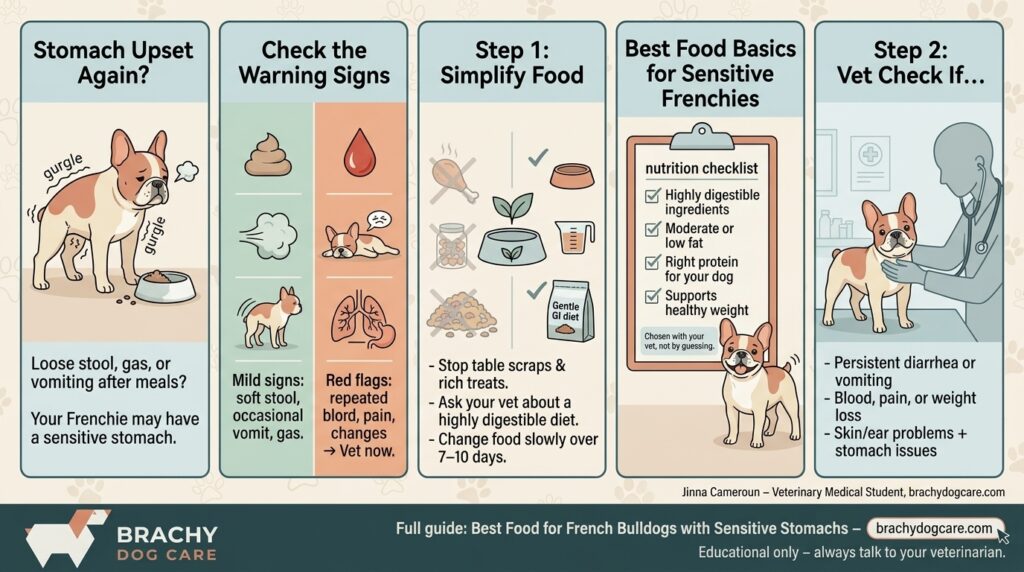
Step 1: Get Veterinary Input
Before changing food in a dog with chronic or severe GI signs, it is important to talk to your vet. They may recommend:
- Parasite testing
- Bloodwork to assess systemic health
- Imaging to look for structural problems such as hiatal hernia or foreign bodies
- Referral to a specialist if signs are severe or long-standing
Best food for French Bulldogs with sensitive stomachs is much easier to choose properly when you know what you’re dealing with.
Step 2: Use a Gradual Transition
For most Frenchies, a 7–10 day transition works well:
- Days 1–3: 75% old food, 25% new food
- Days 4–6: 50% old food, 50% new food
- Days 7–10: 25% old food, 75% new food
- Day 11 onward: 100% new food if tolerated
If your dog has a history of reacting badly to diet changes, your vet might suggest an even slower schedule.
Step 3: Feed Smaller, More Frequent Meals
Two to three smaller meals per day typically work better than one or two large meals for French Bulldogs with reflux, aerophagia, or hiatal hernia. Smaller meals:
- Lower stomach distension
- Reduce pressure on the esophagus
- May reduce regurgitation episodes
For many dogs, feeding routine is just as important as the food itself.
Step 4: Control Treats and Extras
During diet trials:
- Use part of the new food as treats
- Or choose very simple, single-ingredient treats approved by your vet
Avoid introducing new treats, chews, or table scraps. Otherwise, you lose the ability to tell whether improved or worsened signs are due to the main food or the extras.
Step 5: Track What Happens
Keep a basic log noting:
- Stool consistency and frequency
- Vomiting or regurgitation episodes
- Appetite and energy changes
- Any skin or ear changes
This log helps your vet see whether the chosen diet is working and whether further steps are needed.
Step 6: Avoid Constant “Food Hopping”
Frequent, unsystematic changes overwhelm the GI tract and make interpretation impossible. For elimination diets or therapeutic diets especially, a minimum of several weeks is normally needed to judge response unless your vet advises stopping earlier due to worsening.
When a French Bulldog has a sensitive stomach plus itchy skin, paw licking, or recurrent ear infections, food allergy becomes much more likely. In that situation, it’s worth reading my French Bulldog Food Allergies: Signs, Common Triggers, and How to Confirm It so you can see how GI signs fit into the wider allergy story before you and your vet decide on an elimination diet.
How Sensitive Stomachs Connect to Allergies, Skin, and Ears
Many French Bulldogs with sensitive stomachs also have:
When GI signs and skin/ear problems appear together, food allergy rises higher on the list of possibilities. In those cases, best food for French Bulldogs with sensitive stomachs often needs to be a truly hypoallergenic diet (hydrolyzed or novel protein) rather than a simple “sensitive” formulation.
A proper food allergy evaluation usually involves:
- A strict 8–12 week elimination diet
- Using a hydrolyzed or carefully chosen novel protein diet
- No other foods, treats, flavored medications, or table scraps
- Close supervision by a veterinarian or veterinary dermatologis.
FAQs about French Bulldogs with Sensitive Stomachs
Practical Picture: What “Best Food” Really Means in Daily Life
Putting everything together, best food for French Bulldogs with sensitive stomachs is not one specific product. It is a diet that:
- Is highly digestible
- Has moderate or low fat (unless your vet specifies otherwise)
- Uses a protein and carbohydrate source your dog tolerates
- Fits your dog’s allergy status (non-allergic vs confirmed/suspected allergy)
- Supports a healthy, lean body condition
- Works with your dog’s airway and esophageal situation (texture, kibble shape, moisture content)
For some dogs, that means a veterinary gastrointestinal diet. For others, a hydrolyzed or novel protein diet is more appropriate. For milder cases, a carefully chosen non-prescription sensitive stomach food can work—if used within a structured plan and with veterinary input.
Diet is one of your most powerful tools, but it is only one part of supporting a French Bulldog sensitive stomach. Airway management, weight control, safe activity, and careful monitoring all matter just as much.
If you’d like to read a more technical, vet-written overview of how diet and chronic gastrointestinal disease interact in dogs, you can check this owner-friendly guide from the Merck Veterinary Manual on dog and cat foods and nutrition in disease management. It explains how veterinarians think about highly digestible diets, elimination trials, and prescription gastrointestinal foods, and it’s a useful complement to any discussion about the best food for French Bulldogs with sensitive stomachs.


French Bulldog Luxating Patella: Signs, Grades, and Surgery Costs
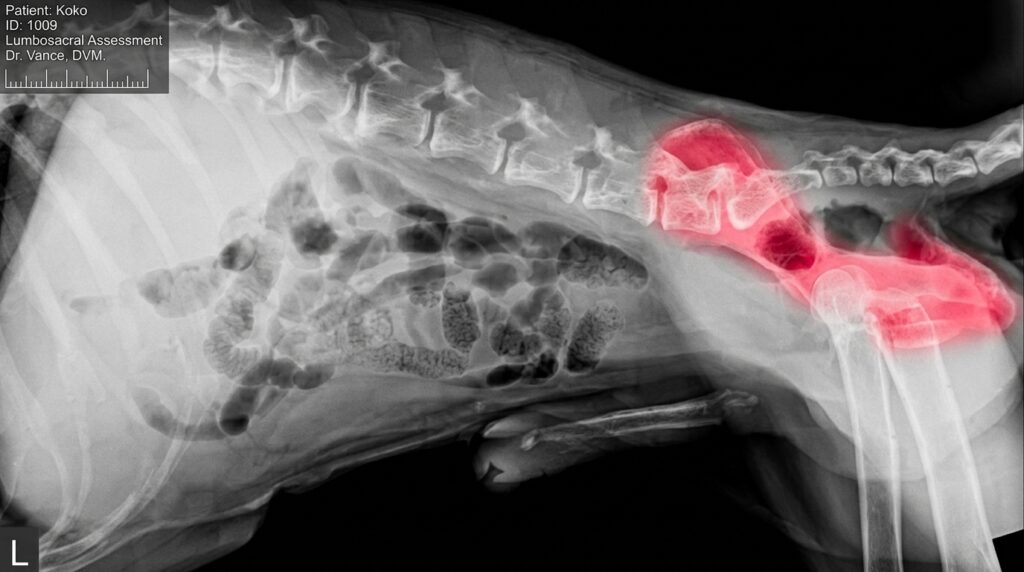
French Bulldog Hip Dysplasia: Signs, Causes, and What It Really Means
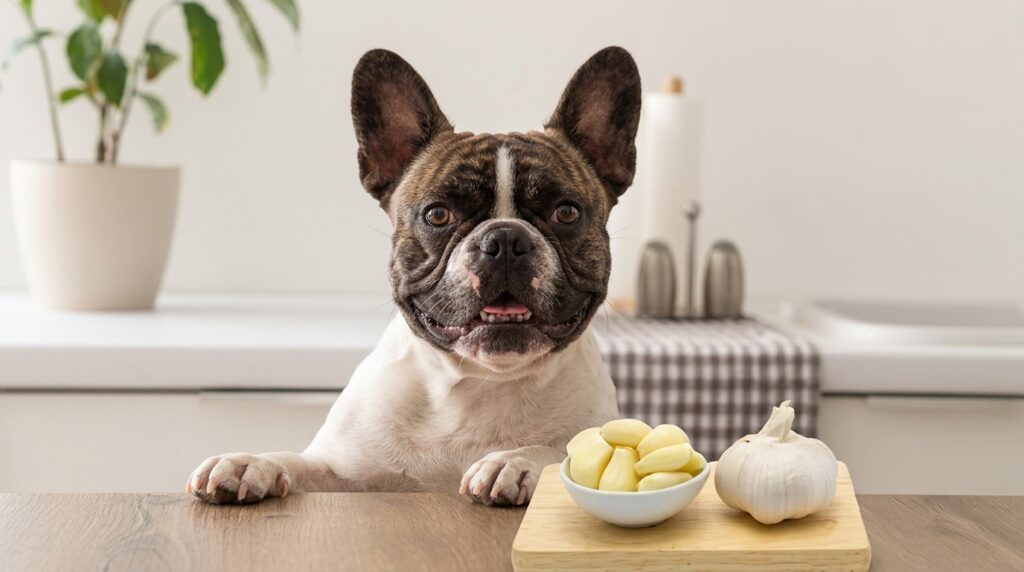
Can French Bulldogs Eat Onions or Garlic? Why Both Are Dangerous

Can French Bulldogs Eat Bananas? How Much Is Safe and How Often

Can French Bulldogs Eat Peanut Butter? Safety, Amounts, and the Xylitol Warning