Written by Jinna CAMERON, veterinary medical student and dog health researcher. Reviewed for factual accuracy against trusted veterinary sources by DVM Carla DONTESK
Educational note: this article is written from a veterinary medical student perspective to help owners understand the topic carefully. It is for education only and does not replace a veterinary exam.
French Bulldog food allergies can be confusing because they often look like several other problems at once. A dog may seem “just itchy” at first, but the real pattern can involve paw licking, ear irritation, red skin, or repeated flare-ups that never fully settle. In many cases, French Bulldog food allergies are not obvious until owners step back and look at the full picture.
That is one reason this topic matters so much. French Bulldog food allergies are often discussed online as if they can be identified by a single ingredient or fixed with a quick food switch. In reality, the picture is more careful than that. Some dogs do react to food, but others have environmental allergies, skin infections, flea-related itching, or a mix of more than one problem.

If you want the broader overview first, you can also read our main guide to French Bulldog allergies.
What French Bulldog food allergies usually look like
French Bulldog food allergies most often show up as skin and ear problems rather than as dramatic digestive illness. Owners usually notice chronic itching, repeated paw licking, face rubbing, or redness around the belly, groin, feet, and ears. Some dogs also develop recurrent ear infections that seem to improve and then return again.
Common signs of French Bulldog food allergies include:
- persistent scratching or biting at the skin
- licking or chewing the paws
- rubbing the face on furniture, carpets, or hands
- red, inflamed skin
- recurrent ear infections
- head shaking or ear scratching
- licking the belly, groin, or paws
- small rashes or irritated patches
- hair loss from repeated licking or rubbing
- skin odor if infection is involved
- occasional vomiting, soft stool, or diarrhea in some dogs
The digestive signs matter, but they are not the whole story. A French Bulldog can have French Bulldog food allergies with no obvious stomach problem at all. On the other hand, a dog with loose stool may not have a food allergy. That is why pattern recognition is more useful than guessing from one symptom.
It also helps to remember that the skin and ears often tell the story first. If a Frenchie keeps getting itchy feet, red skin, and ear inflammation, French Bulldog food allergies become more plausible than if the dog has only a one-off stomach upset.
When food is suspected, the signs are not always obvious at first, and many dogs just seem generally uncomfortable or itchy. For a closer look at the symptom side of that problem, see our guide on French Bulldog itchy skin, which covers common causes, safe relief steps, and when it is time to see a vet.
What French Bulldog food allergies actually are
A food allergy in dogs is more accurately called an adverse food reaction or food hypersensitivity. In simple terms, the dog’s immune system reacts to something in the diet, usually a protein source. This is different from a food intolerance, which is not primarily immune-based and is more likely to cause digestive upset than itchy skin.
That distinction matters because many owners use the words “allergy” and “intolerance” interchangeably. In veterinary medicine, they are not the same thing.
French Bulldog food allergies are also different from environmental allergies. Environmental allergies, often called atopy or atopic dermatitis, are triggered by things like dust mites, grass, pollen, or mold. Those cases can look very similar because the symptoms overlap: itching, recurrent ear issues, and inflamed skin. The difference is in the trigger and in how the condition is confirmed.
French Bulldogs are not proven to be uniquely “food-allergy prone” in a simple, universal way. What we do see is that they are a breed with a strong tendency toward skin and ear problems, so French Bulldog food allergies may be easier to notice and more frustrating to live with. Skin folds, facial anatomy, and recurrent inflammation can make the signs more obvious and can make secondary infection more likely.
So when people say a Frenchie is “allergic to everything,” that is usually an oversimplification. French Bulldog food allergies are real, but they are only one part of the bigger skin-and-ear picture in this breed.
Once you’ve identified your French Bulldog’s food allergens through elimination or testing, the next step is choosing the right diet that avoids those triggers while still meeting their nutritional needs. Not all limited-ingredient or hypoallergenic foods are created equal—your Frenchie still needs the right balance of protein, fat, and calories for their life stage. For a complete breakdown of nutrient ratios, life-stage feeding guides, and how to read labels to avoid hidden allergens, check out our best dog food for French Bulldogs nutrition guide to find safe, breed-specific options that support digestion and long-term health.
Common food triggers and what the evidence actually shows
This is the part most owners want to know first: what ingredients are most often involved?
The answer is not as neat as internet lists make it seem. In published veterinary studies, the ingredients most often implicated in canine adverse food reactions include beef, dairy, chicken, wheat, egg, soy, lamb, corn, and sometimes fish. The exact ranking changes depending on the study design, the population, and whether the diagnosis was confirmed by a true elimination diet or based on owner report.
That difference matters a lot.

Owner reports often overestimate certain foods, especially chicken and grains, because those ingredients are common in pet food and because they are easy to suspect. But when cases are confirmed properly, the picture is more mixed. French Bulldog food allergies are not usually caused by one universal ingredient that every dog reacts to. A dog may react to chicken, another to beef, another to dairy, and another to something less expected.
A few practical points are worth keeping in mind:
- beef, chicken, and dairy appear repeatedly in the literature
- wheat is often discussed, but grains are not the automatic villain people assume
- multiple food triggers can happen in the same dog
- “limited ingredient” does not always mean truly hypoallergenic
- the ingredient list on a bag is not the same thing as a confirmed allergy diagnosis
This is why the phrase “top 3 food allergies in dogs” usually refers to beef, dairy, and chicken. That shorthand is useful only if it is treated as a rough summary, not a diagnosis. French Bulldog food allergies should never be assumed from that list alone.
Another important nuance: some dogs are reacting to proteins, not carbohydrates. So the idea that “grain-free” automatically solves the problem is not supported by the evidence. French Bulldog food allergies need a more careful approach than simply removing one popular ingredient category.
Food allergies do not always show up only as itching or ear problems; some French Bulldogs also get digestive signs like loose stool or diarrhea. If you are trying to figure out whether your dog’s symptoms are mainly skin-related or also affecting the gut, our guide to French Bulldog diarrhea can help you connect the digestive side of the picture.
Food allergies vs environmental allergies, fleas, and infection
French Bulldog food allergies are easy to confuse with other common causes of itching. That is one reason the condition often takes time to sort out.
Food sensitivities don’t only show up as itching or soft stool. In some dogs, a poorly tolerated ingredient also triggers nausea, regurgitation, or vomiting after meals. If your Frenchie is reacting to something in the bowl, our guide to why French Bulldogs throw up walks through the food-related causes alongside the breed-specific ones worth ruling out with your vet.
Food allergy vs environmental allergy
Food allergies are usually evaluated with a diet trial. Environmental allergies are usually suspected when the pattern is seasonal, year-round, or linked to exposures like dust, grass, or pollen. Environmental allergy also tends to affect the feet, face, armpits, and ears.
A dog with French Bulldog food allergies may look very similar to a dog with atopy, especially if the signs are chronic and not obviously seasonal. That is why the history and the response to a strict diet trial matter so much.
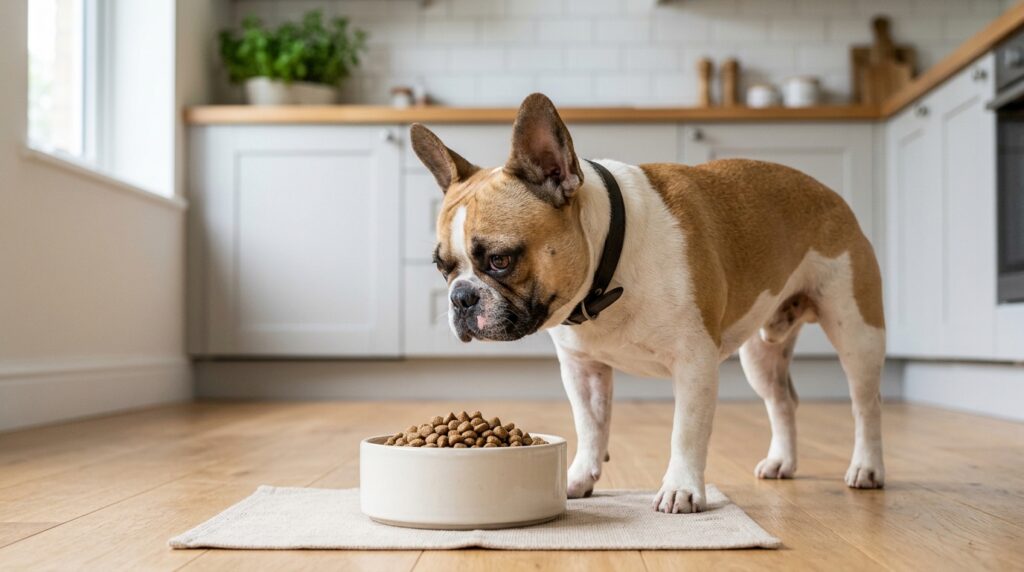
Allergies in French Bulldogs often affect the paws, ears, and face at the same time, which is why some dogs keep licking or chewing their feet for weeks at a time. If you’re trying to figure out whether the behavior is caused by irritation, infection, or something else, our article on French Bulldog paw licking explains the most common causes and warning signs.
Food allergy vs food intolerance
Food intolerance is not the same thing as a food allergy. Intolerance may cause gas, vomiting, loose stool, or general digestive upset. French Bulldog food allergies are more likely to cause immune-type skin signs, often with itching and ear problems.
Some French Bulldogs with food allergies show mostly skin and ear symptoms, while others have a lot of gut issues like diarrhea, gas, or vomiting after eating. If your dog’s main problem is tummy trouble, you might find it helpful to read my guide on best food for French Bulldogs with sensitive stomachs, which focuses on diet options and feeding plans when digestion is the main concern.
Food allergy vs flea allergy dermatitis
Flea allergy dermatitis often shows up more on the back end, base of the tail, and hindquarters. If a Frenchie is itchy there, fleas should stay on the list even if you do not see any. Fleas can also make other skin issues seem worse than they are.
Food allergy vs yeast or bacterial infection
Infection can muddy the picture quickly. Yeast and bacteria thrive in moist, irritated skin, especially in skin folds and ears. A dog may have French Bulldog food allergies and a secondary infection at the same time. In that case, the infection may be what makes the itch obvious, while the allergy is the reason it keeps coming back.
French Bulldog food allergies are often overdiagnosed by guesswork and underdiagnosed when owners assume every flare-up is “just skin trouble.” The truth is usually somewhere in between.
How to confirm French Bulldog food allergies
This is the section where careful method matters most.
The gold standard for confirming French Bulldog food allergies is a strict elimination diet trial. In practice, that means feeding one diet only, usually for about 8 weeks or longer, while avoiding everything else that could interfere with the result. That includes treats, flavored chews, table scraps, flavored medications, and leftover bits from other foods.
A proper trial usually uses either:
- a hydrolyzed protein diet, or
- a novel protein diet that the dog has not eaten before
The reason this works is simple: if the immune trigger is removed completely and the dog improves, that gives useful diagnostic information. If the dog then flares again when the original food is reintroduced, the suspicion becomes much stronger.
This is also why random food switching is not a reliable test. Changing from one over-the-counter kibble to another does not tell you much unless the trial is controlled and strict. French Bulldog food allergies are not confirmed by guessing. They are confirmed by process.
If you want a good general veterinary explanation of this approach, VCA Hospitals has a clear overview here: food allergies in dogs.
A few common mistakes can invalidate the trial:
- giving flavored treats
- using chewables or medications with flavoring
- offering table scraps “just once”
- switching foods before the trial is finished
- trying too many diets at the same time
- assuming improvement after 3 or 4 days means the diagnosis is settled
French Bulldog food allergies may improve before the full trial is done, but early improvement is not proof by itself. Some dogs need more time. Others improve because something else changed at the same time. That is why the trial should be strict and patient.
Also, blood tests are not reliable for diagnosing food allergies in dogs. They may be discussed online, but they do not replace a proper diet trial. That is a common owner trap, and it can waste a lot of time.
Food allergies in French Bulldogs do not always appear only as itching or ear problems. Some dogs also develop softer stool when their food does not agree with them, which is why our article on French Bulldog Soft Stool can be a useful next step if digestive signs are part of the picture.
What owners can safely do at home while waiting for a vet visit
There are a few safe, practical steps you can take before a veterinary appointment. The goal is to reduce noise in the picture, not to diagnose the problem at home.
Keep a symptom log
Track:
- when the itching started
- where the itching is worst
- whether ears, paws, belly, or face are involved
- what foods, treats, and chews the dog has had
- whether symptoms are seasonal or year-round
- stool changes
- whether the dog seems better or worse after certain exposures
A symptom log is one of the best tools for French Bulldog food allergies because it helps the vet see patterns you may miss in daily life.

Keep flea control consistent
Even if fleas are not the main cause, they can make the itch worse. Consistent flea prevention helps keep French Bulldog food allergies from being confused with flea-related irritation.
Keep skin folds clean and dry
French Bulldogs are prone to fold-related irritation. Clean gently and dry well. If the skin is already inflamed or smelly, do not keep scrubbing it. That can make things worse.
Avoid obvious trigger foods if you know them
If a dog has a clearly repeated reaction to one ingredient, it is reasonable to avoid that item until you speak with your vet. But do not start rotating foods in a way that makes the diagnosis harder to confirm.
Do not self-treat with random products
Avoid starting human allergy medicines, oils, herbal mixes, or over-the-counter pet products without guidance. Even well-meant home treatment can blur the diagnosis or worsen skin irritation.
French Bulldog food allergies are best managed by making the dog’s environment and diet simpler, not more complicated.
Once you’ve ruled out things like fleas and obvious environmental triggers, the next big piece of the puzzle is what’s in your dog’s bowl. Instead of guessing bag after bag, it’s worth following a structured approach to diet changes. I break this down step‑by‑step in my full guide to the best dog food for French Bulldogs with allergies, including how to choose between limited‑ingredient, novel protein, and hydrolyzed diets.
Treatment and management overview
Once French Bulldog food allergies are confirmed, treatment is mostly about removing the trigger and controlling any secondary problems.
That may include:
- staying on the elimination diet that worked
- later reintroducing foods in a controlled way if your vet wants to confirm the exact trigger
- treating yeast or bacterial infection if present
- using medicated wipes or shampoos if the skin needs support
- managing ear inflammation carefully
- using anti-itch medication only when a vet decides it is appropriate
- supporting skin barrier health when the dog needs it
If the dog also has environmental allergies, food management alone may not fully solve the issue. That is common. French Bulldog food allergies can exist on their own, but they can also appear alongside atopy, which means the dog may need a multi-part plan.
Omega-3 fatty acids are sometimes used as supportive care, but they are not a substitute for diagnosis. They may help some dogs, but they do not identify the trigger and they do not replace a proper diet trial.
The main idea is this: French Bulldog food allergies are not treated by one universal product. They are managed by finding the trigger and then building a plan around the dog’s real needs.
subscribe for a free checklist
Enter your email address below and subscribe to our website
Can French Bulldog food allergies be cured?
The short answer is no, not in the simple sense people usually mean.
French Bulldog food allergies are generally managed by avoiding the trigger, not cured permanently. If the trigger is found and removed, many dogs improve a lot, sometimes dramatically. But that does not mean the underlying tendency has disappeared.
That is why it helps to think in terms of control rather than cure.
For some dogs:
- the right diet makes a huge difference
- itching drops sharply
- ears settle down
- the skin barrier improves
- quality of life gets much better
For other dogs:
- food is only part of the story
- environmental allergy is also present
- infections keep recurring unless they are treated too
French Bulldog food allergies often need long-term awareness, but that does not mean long-term misery. It usually means being careful, consistent, and realistic.
When French Bulldog food allergies need a vet
See a veterinarian sooner rather than later if you notice:
- intense or persistent itching
- repeated ear infections
- bad skin odor
- pus, crusts, or open sores
- hair loss from constant licking or scratching
- swelling of the face, paws, or muzzle
- vomiting or diarrhea along with itching
- sudden worsening
- clear discomfort
- breathing difficulty
Breathing trouble always deserves extra caution in French Bulldogs. Even if the main concern seems skin-related, any sign of respiratory distress should be treated seriously.
French Bulldog food allergies can be uncomfortable on their own, but they can also hide infection or overlap with another condition that needs prompt treatment.
FAQ
Final thoughts
French Bulldog food allergies are common enough to take seriously, but they are also easy to misunderstand. The key is not to guess too early. Watch the pattern, keep the diet simple, and use a strict elimination trial if your vet recommends it. That is the most reliable way to separate true food-related problems from environmental allergies, infection, or flea-related itch.
If you approach French Bulldog food allergies carefully, you give yourself a much better chance of finding the real cause and making life more comfortable for your dog.
A food reaction does not always show up as stomach upset. Some dogs mainly develop skin signs such as redness, scratching, or a recurring French Bulldog skin rash that keeps coming back. Because food-related skin issues can look similar to other allergy problems, it helps to look at the full pattern rather than one symptom alone. You can read more about French Bulldog skin rash here.
French Bulldog Cost in 2026: Price, Vet Bills, and the True Lifetime Cost
French Bulldog Temperament: Personality, and Are They Good Family Dogs?

Best Dog Toothpaste for French Bulldogs: A Vet-Guided Guide
Do French Bulldogs Shed? Coat, Grooming, and When to Worry

Why Your French Bulldog Chews Everything (and How to Stop It)