Written by Jinna CAMERON, veterinary medical student and dog health researcher. Reviewed for factual accuracy against trusted veterinary sources by DVM Carla DONTESK
If you’ve watched your Frenchie trotting happily along, suddenly skip a step with one back leg held up, then carry on as though nothing happened, you’ve probably just seen a luxating patella in action. It’s one of the most common causes of back-leg trouble in small dogs, and it’s one of the three things that should be on your mind whenever a French Bulldog’s hind legs stop working properly.
I run this site after losing my own French Bulldog, Pearly, and one thing I’ve learned is that mobility problems in this breed get misattributed constantly. The hips get blamed for what’s actually the knee. The knee gets blamed for what’s actually the spine. This guide covers what a luxating patella is, how vets grade it from one to four, what treatment actually costs, and how to tell it apart from the other two culprits. I’m a veterinary medical student and dog-health researcher, so nothing here replaces an exam. But knowing the framework will make that exam far more useful.
What Is a Luxating Patella?
The patella is the kneecap. In a healthy knee it sits in a groove at the end of the thigh bone, called the trochlear groove, and glides smoothly up and down as the leg bends and straightens. A luxating patella is one that slips out of that groove.
Which direction it slips matters. When the kneecap dislocates toward the inside of the leg, it’s called a medial luxating patella, and that’s overwhelmingly the most common form in small dogs. Lateral luxation, where it slips outward, is seen more often in larger breeds. If your Frenchie has one, medial is the overwhelming likelihood.
The other thing worth understanding is where it comes from. In most dogs a luxating patella isn’t an injury at all. It’s a developmental problem, meaning the knee simply didn’t form quite right, and it’s frequently inherited. Blunt trauma can cause it, but that’s the rare exception. Because it’s developmental, it usually shows up early, typically becoming apparent between four and six months of age, and it’s often bilateral: roughly half of affected dogs eventually have both knees involved, though one side is usually worse than the other. Obesity is a recognised contributing factor, which is worth filing away for later.
One small terminology note that saves confusion at the vet. You may hear someone describe your dog as having a “loose knee.” That isn’t a medical term, and it isn’t interchangeable with a luxating patella, so if a vet uses it, it’s fair to ask exactly what they mean.
Do French Bulldogs Get Luxating Patella?
Yes, and this is where honesty matters more than a confident-sounding statistic. A luxating patella is a common condition in dogs generally, and it’s particularly associated with small and toy breeds, which is the category a Frenchie falls into. Veterinary specialists who work extensively with bulldog-type breeds specifically name medial patellar luxation as a prime suspect when one of these dogs suddenly won’t put weight on a back leg.
What I won’t do is give you a French Bulldog prevalence figure, because I couldn’t find a reliable one, and inventing a number would be worse than useless. The honest picture is this: small-breed predisposition, a specific flag from bulldog specialists, and a breed that gains weight easily when obesity is a known contributing factor. That’s enough to take a luxating patella seriously as a possibility in your dog without pretending to a precision the research doesn’t support.
The Classic Sign: The Skip
If there’s one image to hold in your head, it’s this one, because it’s remarkably distinctive.
Your dog is running along normally. Suddenly they skip, hopping for a step or two with one hind leg held up off the ground. Then, just as suddenly, they put it down and carry on running on all four legs as if nothing occurred. This can repeat over and over. What you’re watching is the kneecap slipping out of its groove and then slipping back in. Many dogs will actively help the process, giving the leg a little shake or a stretch backward to pop the patella back where it belongs.
That skip-and-carry-on pattern is the signature of a luxating patella, and it’s often the only thing an owner notices for months. It’s also easy to dismiss precisely because the dog looks fine immediately afterward. If your Frenchie does this even occasionally, it’s worth mentioning at your next appointment.
Other Signs to Watch For
Beyond the skip, the picture varies with severity. Some dogs limp intermittently, favouring one back leg for a while. Others become reluctant to jump, climb stairs, or hop onto the sofa, and some simply become less enthusiastic about play without any obvious lameness. You might notice swelling around the knee, or your dog licking or fussing at it.
At the severe end, a dog with a permanently dislocated kneecap can’t fully straighten the knee, which produces a distinctive crouched, bow-legged walk. That’s a very different presentation from the intermittent skip, and it usually means the problem has been progressing for some time.
And here’s a genuinely important one: some dogs show no symptoms at all. A luxating patella is quite often discovered by accident, during a routine physical exam or an insurance check, in a dog that has never appeared bothered. Finding one doesn’t automatically mean your dog is in pain, which is a theme that runs through this breed’s orthopaedic problems.
The Four Grades of Luxating Patella
Vets grade a luxating patella from one to four, and understanding the scale is genuinely useful because it drives every treatment decision. The Merck Veterinary Manual sets it out clearly.

Grade 1 means the signs are mild and infrequent, or absent entirely. The vet can push the kneecap out of its groove during an exam, but it pops straight back on its own. In normal life, the knee mostly behaves.
Grade 2 means the kneecap luxates on its own or with manipulation and can stay out temporarily, returning either manually or when the dog extends the leg. This is the classic skipping-lameness grade, the one most owners are watching when they search for answers.
Grade 3 means the kneecap sits out of the groove most of the time. It can be pushed back manually, but it slips out again easily. Lameness is consistent rather than intermittent at this point, and bone deformities start to become evident.
Grade 4 is the most severe and, thankfully, the rarest. The kneecap is permanently dislocated and can’t be manipulated back into place at all. Lameness and limb deformity are marked, and this is where you see that crouched, can’t-straighten-the-knee walk.
Two things about the grades that matter for real decisions. First, they can progress: a grade 2 luxating patella can wear down the edge of the groove over time and become a grade 3. Second, even a mild grade predisposes a dog to other knee injuries, particularly cranial cruciate ligament tears, because a kneecap that keeps slipping puts the whole joint under abnormal strain. Over years, that abnormal movement erodes cartilage and can produce a genuinely arthritic, painful joint. A grade 1 dog may sail along untroubled for years, but arthritis later in life is a real possibility.
Is It the Knee, the Hip, or the Spine?
This is the section I most want Frenchie owners to read, because in this breed there are three plausible explanations for the same set of signs, and they need completely different treatment.
The knee is one, and a luxating patella is the leading candidate there, along with cruciate ligament tears, which frequently accompany it.
The hip is another, and this is where it gets interesting. Flat-faced small breeds top the hip dysplasia charts, so a Frenchie’s X-ray will often show dysplastic hips. But bulldog specialists make a pointed observation: signs that look like hip problems in these breeds are frequently caused by knee problems instead. A dysplastic hip on film doesn’t prove the hip is what hurts, which is exactly why our guide to French Bulldog hip dysplasia argues for finding the cause rather than assuming it.
The spine is the third, and in French Bulldogs it’s the best-documented mobility problem of all. This breed carries roughly three times the odds of spinal cord disorders compared with other dogs, and intervertebral disc disease is the single most common neurological diagnosis in Frenchies by a wide margin. Our guide to French Bulldog IVDD covers the signs that separate a disc problem from a joint problem.

The practical rule is straightforward. An intermittent skip that resolves in a step or two points toward the knee. A gradual stiffness, especially rising after rest, could be either the knee or the hip. But sudden hind-leg weakness, wobbliness, dragging, or a dog that can’t stand is a spinal red flag and an emergency, not a knee problem to manage at home. When in doubt, ask your vet what is actually causing the lameness rather than which of these your dog has.
How a Luxating Patella Is Diagnosed
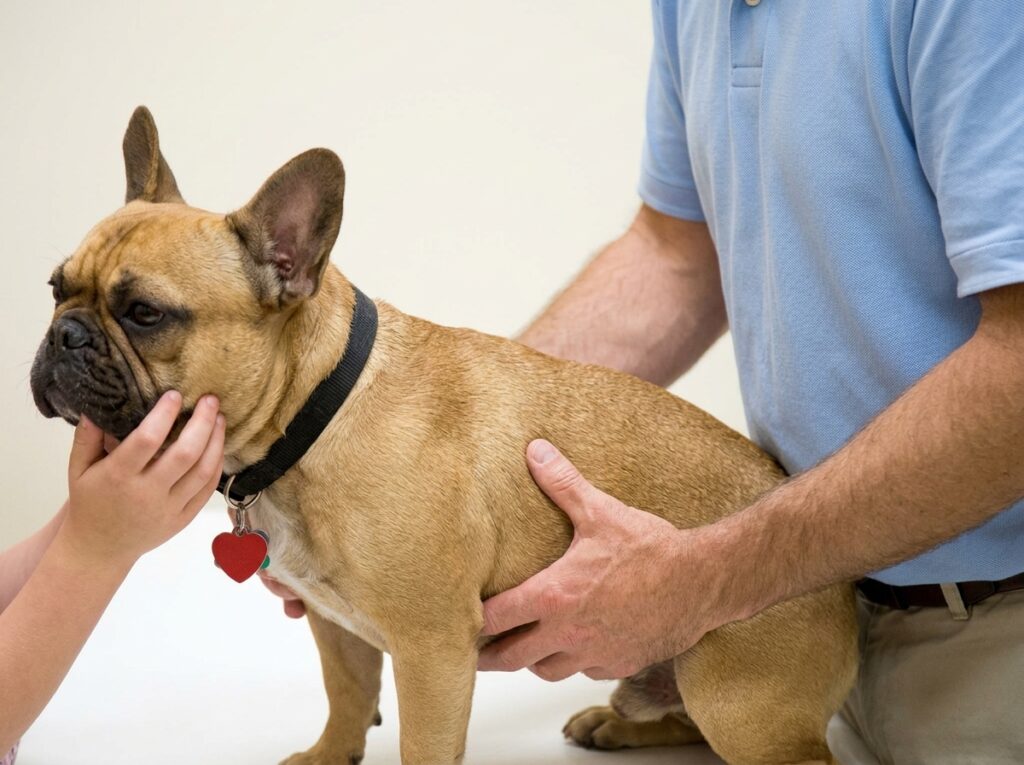
Diagnosis is refreshingly hands-on. The core of it is palpation: your vet feels the knee while manipulating the kneecap to see whether it slides out of the groove and how easily it goes back. That single examination is usually what establishes both the diagnosis and the grade.
Imaging fills in the rest. Radiographs of the knee, and often the tibia and pelvis too, check the integrity of the surrounding structures, and advanced imaging such as CT is increasingly used to assess soft tissues like tendons and ligaments alongside the bones. Many dogs need sedation or anaesthesia for a thorough assessment, which for a brachycephalic dog is worth a conversation about airway risk beforehand.
Two details are worth asking your vet about. If they feel grinding, what’s called crepitus, while manipulating the joint, that indicates cartilage loss and matters for prognosis, since it points toward arthritis already underway. And because a luxating patella and cruciate ligament failure so often travel together, a good assessment checks for both, frequently while the dog is asleep and the muscles are relaxed.
Managing a Luxating Patella Without Surgery
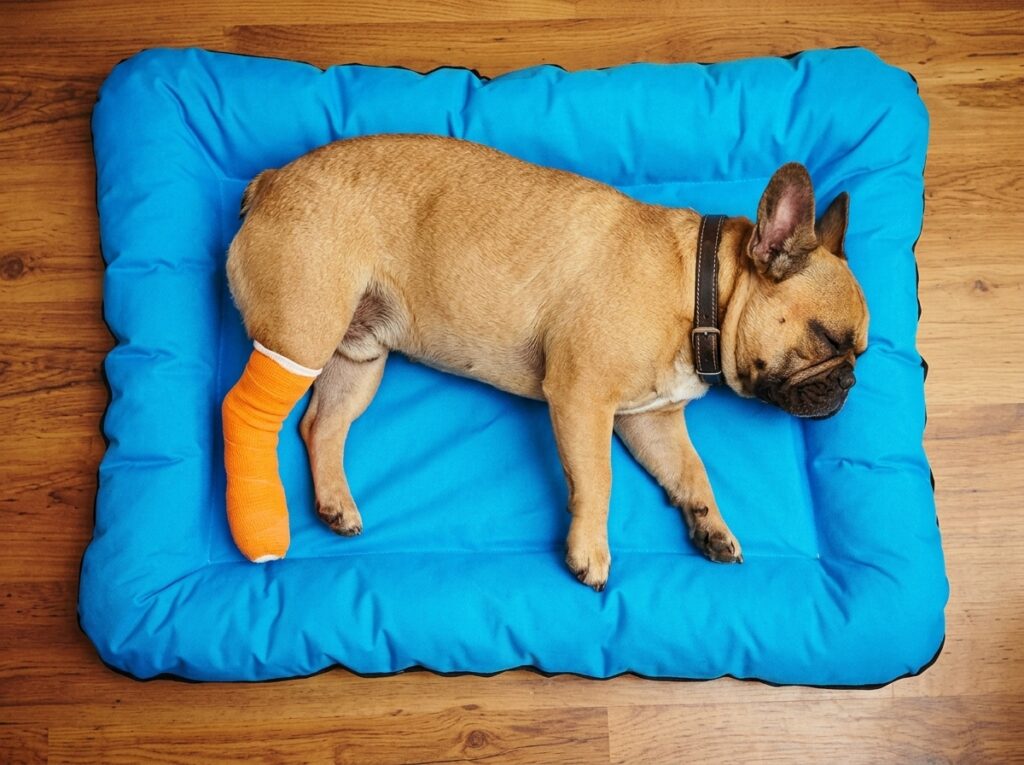
Not every dog needs an operation, and conservative management does real work for the right patients. It generally involves weight management, controlled exercise, physical therapy, and anti-inflammatory pain relief, all aimed at reducing inflammation and keeping the dog comfortable.
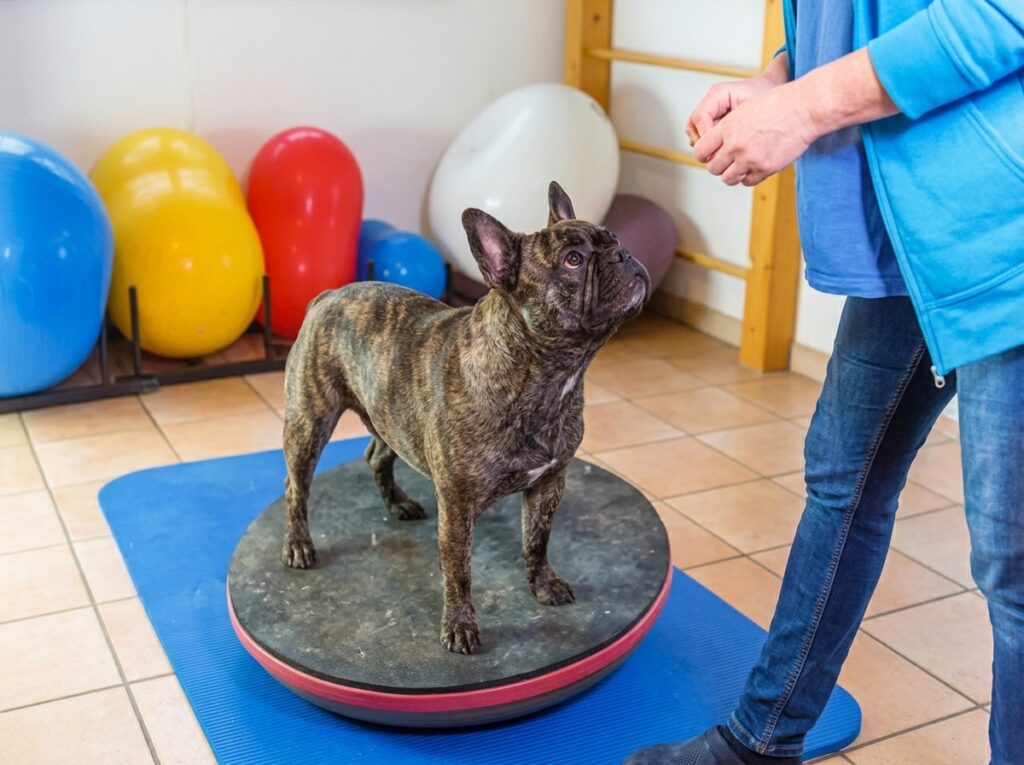
Weight is the piece you control most directly. Every extra pound loads a joint that’s already unstable, and since obesity is a recognised contributor to a luxating patella in the first place, keeping your Frenchie lean is both treatment and prevention. Our guide to the overweight French Bulldog covers how to do that in a breed that can’t exercise hard. Alongside that, controlled exercise builds the muscle that helps stabilise the knee, physical therapy can be tailored to your dog, and hydrotherapy is particularly elegant here because it strengthens muscle without loading the joint. Rehabilitation typically runs somewhere around forty to a hundred dollars per session.
Now the honest limitation, and it’s an important one. Conservative treatment does not correct the underlying anatomical problem. The groove is still too shallow or the alignment is still off, so the luxation can continue to progress even while your dog seems comfortable. Merck is explicit about this. Conservative care is generally reserved for dogs with mild signs, meaning grade 1 and some grade 2 cases with little or no lameness, for older dogs, or for dogs where surgery isn’t feasible.
While we’re being honest: you’ll see knee braces marketed for this condition. There’s no evidence that a brace or rehabilitation alone can correct a grade 2, 3, or 4 luxating patella. They may offer some support and comfort, but they don’t fix the anatomy, and it would be misleading to suggest otherwise.
For milder cases managed without surgery, joint support is often part of the long-term plan, though it’s worth knowing which ingredients earn their place and which don’t. We cut through the marketing in our honest guide to the best joint supplements for a French Bulldog, including why omega-3s and green-lipped mussel tend to beat the glucosamine everyone buys.
Surgery: What’s Involved and How Well It Works
Surgery is typically recommended for dogs with grade 2 to 4 luxation, for those with marked lameness, or for any dog whose signs are progressively worsening. It’s the only way to actually correct the abnormalities that let the kneecap slip.
The procedure is usually a combination of techniques chosen for the individual dog. Surgeons commonly deepen the trochlear groove so the kneecap has somewhere secure to sit, a procedure called a trochleoplasty, done as either a wedge or block recession. They may reconstruct the soft tissues around the patella to rebalance the pull on it, and in some dogs they reposition the tibial tuberosity, the bony attachment point below the knee, to correct alignment.
Recovery involves restricted activity for six to eight weeks, which for a Frenchie means short lead walks for bathroom breaks and no running, jumping, or stairs. The results are genuinely encouraging: roughly 95 percent of dogs function very well afterward and return to their former level of activity. A board-certified veterinary surgeon quoted in one owner-facing article put it plainly, saying the vast majority of dogs have a good outcome, particularly those in grades one to three. Even grade 4 dogs, who usually need physical rehabilitation to regain mobility, tend to do well.
Major complications are infrequent, though the main one to know about is reluxation, which typically occurs within the first twelve weeks after surgery. And timing genuinely matters: the sooner surgery is performed after diagnosis, the better the chance of a complete recovery, which is an argument against indefinitely watching and waiting once the case is clearly surgical.
What Does Luxating Patella Surgery Cost?
This is the question that keeps owners awake, so let’s be direct about it. Across veterinary sources, luxating patella surgery in the United States commonly runs between $1,000 and $5,000 per knee. More recent 2025 and 2026 figures put the practical range at roughly $1,500 to $5,500 per knee, with a national average of somewhere around $3,200 to $3,300. Straightforward cases can come in near the bottom of that range, while complex referral cases can exceed $10,000.
What drives the variation is fairly predictable. Where you live matters. Who performs the surgery matters a great deal, since a board-certified veterinary surgeon with advanced orthopaedic training will typically charge more than a general practice vet. The grade matters, because a grade 4 with bony deformity is a bigger job than a straightforward grade 2. And complications like existing arthritis or a concurrent cruciate tear add to both the complexity and the bill.
Two things owners often miss when budgeting. First, those figures are per knee, and about half of affected dogs eventually need both done, so the realistic total for a bilateral case can be double what the initial quote suggests. Second, the headline surgical fee usually isn’t the whole picture: pre-operative bloodwork, imaging, anaesthesia monitoring, medications, and follow-up rechecks all add up, which is part of why quoted ranges have crept upward. Ask for an itemised estimate specific to your dog’s grade rather than working from a number you read online, including this one.
If surgery is genuinely out of reach, rehabilitation at roughly forty to a hundred dollars a session is a legitimate fallback for building the muscle that supports the joint, with the honest caveat that it manages rather than corrects. Pet insurance is worth considering, though as always the catch is that a luxating patella diagnosed before you take out a policy will almost certainly be excluded as pre-existing.
Can You Prevent It?
Partly, and the biggest lever sits upstream of you. Because a luxating patella is largely developmental and often inherited, breeding is the real intervention, and asking a breeder about the knees of both parents is an entirely reasonable question.
What you control is everything after that. Keep your Frenchie lean from puppyhood, since obesity contributes to the condition and worsens it once present. Encourage regular, gentle activity that builds supporting muscle rather than sporadic bursts of intense play. And reduce the repetitive impact that a small, front-heavy dog inflicts on its own knees, most of which comes from jumping on and off furniture. A set of pet steps or a ramp for the sofa and the bed is a genuinely worthwhile change, and it protects the spine as much as the knees in a breed this prone to disc disease. Non-slip rugs on slippery floors help too, since a dog scrabbling for grip on laminate is twisting the knee in exactly the way it doesn’t like.
Frequently Asked Questions
The Bottom Line
A luxating patella is one of the most common and most manageable orthopaedic problems a French Bulldog can have. The grading system tells you where you stand, the outcomes after surgery are genuinely good, and for milder cases weight control and sensible exercise carry a lot of the load. What it isn’t is a diagnosis to accept by assumption, because in this breed the knee, the hip, and the spine all produce similar signs and demand different answers.
Having lost a Frenchie myself, I’ve come to believe that the most valuable thing an owner brings to the vet’s office is a clear description and a good question. Watch for the skip. Note when it happens. Keep your dog lean and off the furniture. And when the back legs aren’t right, ask what’s actually causing it rather than which label fits best. That’s how these dogs get the treatment they actually need.
This article is educational and is not a substitute for veterinary care. If your dog is limping, in pain, or suddenly weak in the back legs, contact your veterinarian promptly, as sudden hind-limb weakness can be a spinal emergency.
French Bulldog Cost in 2026: Price, Vet Bills, and the True Lifetime Cost
French Bulldog Temperament: Personality, and Are They Good Family Dogs?
Best Dog Toothpaste for French Bulldogs: A Vet-Guided Guide
Do French Bulldogs Shed? Coat, Grooming, and When to Worry

Why Your French Bulldog Chews Everything (and How to Stop It)