Written by Jinna CAMERON, veterinary medical student and dog health researcher. Reviewed for factual accuracy against trusted veterinary sources by DVM Carla DONTESK
If you’re trying to work out whether a French Bulldog is the right dog for your home, the temperament matters more than almost anything else, more than the looks that probably drew you in, and more than any single fact about the breed. The good news is that the French Bulldog temperament is one of the most consistently loved in the small-dog world: affectionate, funny, easy-going, and devoted to its people. But like any breed, they come with genuine quirks and a few real downsides worth understanding before you commit, and this guide gives you the honest picture rather than the rose-tinted one.
I run this site after losing my own French Bulldog, Pearly, and I care about giving prospective and new owners the truth, warts and all. I’m a veterinary medical student and dog-health researcher, not a certified behaviourist, so for a specific behavioural concern a professional is the right call. But for understanding who these dogs really are, what follows is an honest, well-grounded portrait.
The French Bulldog Personality in a Nutshell
To understand this breed, you have to know that they were created for one job above all others: companionship. French Bulldogs weren’t bred to herd, guard, or hunt, they were bred to be with people, and that history shapes everything about how they behave today. The result is a dog whose whole personality is oriented around its family.

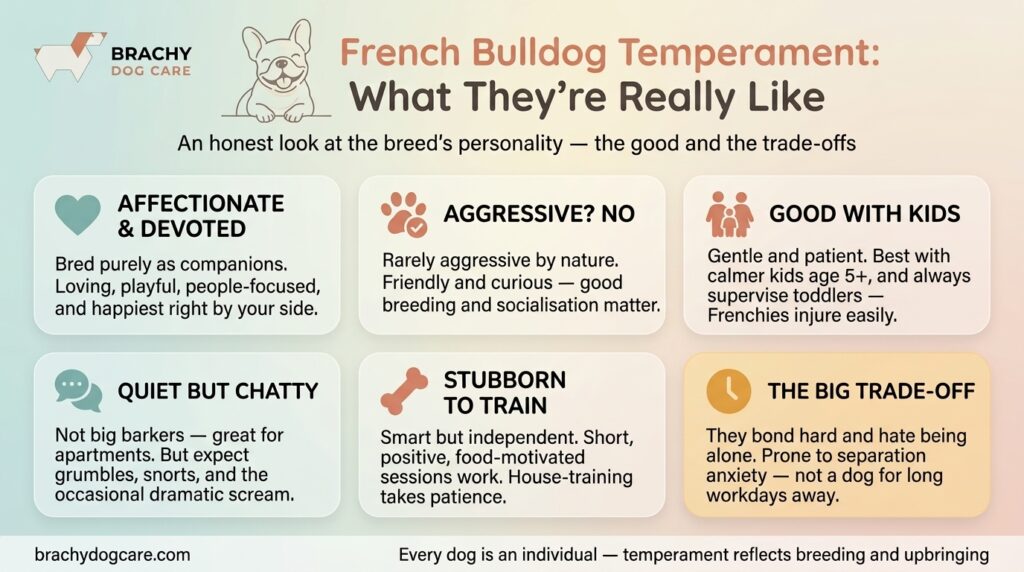
In practice, that makes for an affectionate, playful, people-focused little dog that forms intensely strong bonds and genuinely thrives on human company. They’re adaptable and relatively low-energy, happy to match the rhythm of your household, whether that’s a lively family or a quiet flat. They tend to be curious and confident rather than nervous or defensive, and many owners find them endlessly entertaining, with a clownish, charming streak. The overall French Bulldog temperament is often described as about the best you’ll find in a small companion dog, and for most of the people who fall for them, that reputation holds up. The flip side of all that devotion, as we’ll come to, is that these dogs really do not like being left alone.
Are French Bulldogs Aggressive?
This is one of the most common worries from prospective owners, and the honest answer is reassuring: no, French Bulldogs are not an aggressive breed. By temperament they’re rarely aggressive, they aren’t guard-oriented or territorial in the way some breeds are, and their confidence tends to show up as friendly curiosity rather than suspicion or defensiveness. A well-raised Frenchie is typically outgoing and sociable with people.
That said, honesty requires a few caveats, because no dog is aggression-proof and temperament is never guaranteed by breed alone. Puppies, especially while teething, can be nippy, and that needs gentle redirection rather than alarm. More importantly, poor breeding combined with a lack of early socialisation can shift a dog’s temperament toward reclusive, anxious, or reactive, and that’s true of any breed, not just this one. Overindulged Frenchies can also become possessive or jealous, sometimes guarding food, toys, or even a favourite person, which is really a training and boundaries issue rather than an inherent mean streak. The takeaway is that the breed’s baseline is gentle and non-aggressive, and whether an individual dog lives up to that comes down to breeding, socialisation, and how they’re raised, not the breed label.
Are French Bulldogs Good With Kids?
For families, this is often the deciding question, and here the French Bulldog temperament genuinely shines. Frenchies have the sort of temperament that suits children well: they’re gentle, patient, affectionate, and even-tempered, and they’re sturdy enough to handle family life without being fragile, yet small enough not to overwhelm little ones. They tend to enjoy playtime without being overly rough or hyperactive, which is exactly the balance most families want.
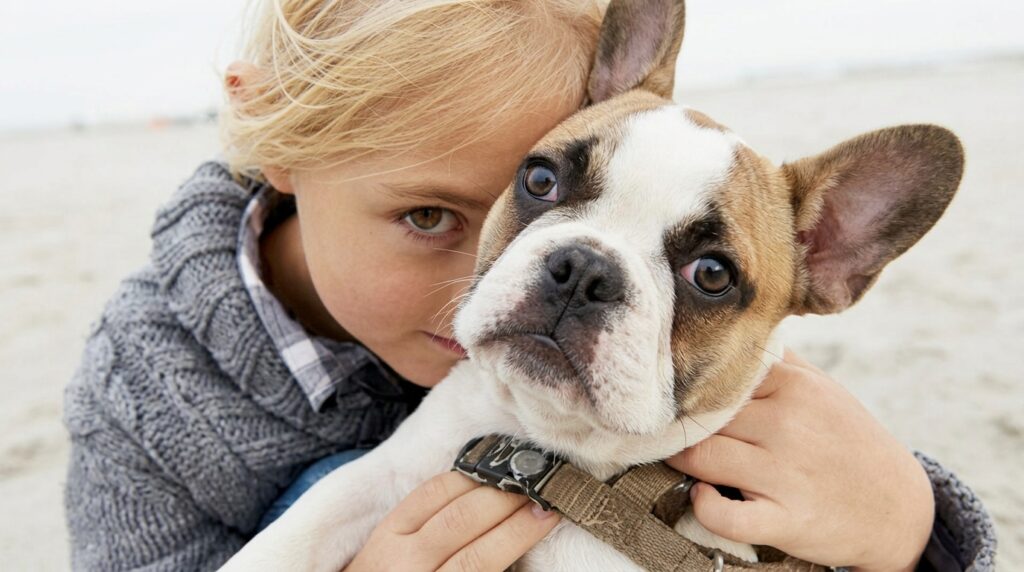
There’s an important caveat that every responsible source agrees on, though. French Bulldogs are usually best suited to homes with older or calmer children, roughly five and up, and interactions with younger children and toddlers should always be supervised. This protects both the child and the dog, because Frenchies can actually be injured fairly easily by rough or clumsy handling. It’s also worth teaching children to read and respect the dog’s signals: if your Frenchie gives a warning growl or moves away, that’s them asking for space, and kids should learn to let them have it rather than pursue. Get that mutual respect right, and a French Bulldog can be a wonderful, empathetic family companion, often forming a particularly sweet bond with the children in the home.
Do French Bulldogs Get Along With Other Dogs and Cats?
Generally, yes, with the right introductions. French Bulldogs have a sociable temperament and often enjoy the company of other pets, and many happily share their home with another dog or a cat. They’re not typically dog-aggressive, and they’ll frequently be the ones initiating play, though it’s fair to say they usually prefer human company to canine company given the choice.
The key, as with most things involving this breed, is early socialisation and gradual, positive introductions. A Frenchie raised around other animals from puppyhood tends to take them in stride, and cats in particular usually go well when the two are introduced young. The honest caveats are worth noting: an overindulged or possessive Frenchie may show jealousy over attention or resources, and when it comes to canine playmates, they generally do best with dogs of a similar size and temperament rather than being paired with a boisterous giant who might accidentally hurt them. With sensible introductions and a bit of management, though, most French Bulldogs settle happily into a multi-pet household.
Do French Bulldogs Bark a Lot?
If you’re worried about noise, whether for neighbours, an apartment, or your own sanity, you’ll be pleased to hear that French Bulldogs are not big barkers. They’re generally quiet dogs who bark mainly to alert you to something, which makes them decent little watchdogs even though they’re hopeless as guard dogs. For most of daily life, a Frenchie will give the occasional yap rather than a constant racket.

What they lack in barking, however, some make up for in other sounds, and it’s part of their charm. French Bulldogs are famous for being “talkers,” producing an entertaining repertoire of grumbles, snorts, and dramatic yodels, and some are prone to a comical high-pitched screaming when they’re excited, passionate about something, or not getting their way. These noises are usually harmless and hilarious, though it’s worth knowing that a Frenchie who’s suddenly vocalising more than usual might be bored or anxious rather than just being theatrical. On the whole, though, this is a quiet breed by barking standards, which is one reason they suit apartment living.
Are French Bulldogs Easy to Train?
Here’s where the French Bulldog temperament gets a little more complicated, and where honesty about the breed’s temperament helps set expectations. Frenchies are intelligent and, at heart, they’re people-pleasers, which works in your favour. But they’re also famously stubborn and independent-minded, with fairly short attention spans, so they’re not the effortless, eager-to-obey students that breeds like retrievers can be. Many owners find training takes more patience than they expected.
The approach that works is well established: short, consistent, positive sessions built around reward, with food as a powerful motivator for this famously food-loving breed. Harsh methods backfire badly, because a Frenchie that feels pushed simply digs in. Patience and consistency genuinely win out, and this stubborn streak shows up most visibly in house-training, which tends to take longer in this breed than many, as our guide to house training a French Bulldog explains in detail. Crate training, done kindly, can also make a real difference to a young Frenchie’s manners and security, and our guide to crate training a French Bulldog walks through it step by step. Go in expecting a clever but slightly obstinate pupil, and you won’t be caught out.
The Clingy Side: Separation Anxiety
Every wonderful trait has its shadow, and for the French Bulldog, the shadow of that intense, loving devotion is a real tendency toward clinginess and separation anxiety. This clingy streak is written into the breed’s temperament: because they were bred purely for companionship and bond so deeply with their people, many Frenchies genuinely struggle to be left alone, and this is probably the single most important downside for any prospective owner to weigh honestly.
A French Bulldog is not a dog you can leave home alone for long stretches every day without consequences. Left alone too much, they can become bored, anxious, or depressed, and that distress often shows up as destructive chewing, house-soiling, or excessive noise. If you work long hours away from home or travel frequently, this clingy personality can be a genuine challenge rather than a charming quirk. The good news is that it’s manageable with the right approach, gradual training to build independence, a predictable routine, and sometimes professional help, all of which our guide to French Bulldog separation anxiety covers thoroughly. But it’s an honest consideration that should shape whether this breed fits your lifestyle in the first place.
Are French Bulldogs Good for First-Time Owners and Apartments?
On both counts, French Bulldogs tend to do well, which is a big part of their popularity. Their easy-going, adaptable nature and modest exercise needs make them a manageable choice for first-time dog owners, and their quiet, compact, low-energy temperament suits apartment living about as well as any breed. You don’t need a big garden or hours of daily hiking to keep a Frenchie content.
The honest caveats here are less about temperament and more about the breed’s physical realities, though the two are linked, and they matter. French Bulldogs are brachycephalic, which makes them genuinely sensitive to heat and prone to breathing difficulties, so they can’t handle strenuous exercise or hot weather the way other dogs can, as our guides to French Bulldog breathing problems and the best temperature for French Bulldogs explain. They also can’t swim and must be supervised around water, since their build makes them sink rather than float, a risk we cover in our guide to whether French Bulldogs can swim. And the can’t-be-left-alone trait means even the most apartment-friendly Frenchie needs an owner who’s around a good deal. Weigh those realities honestly, and for the right person or family, a Frenchie is a genuinely excellent first dog and apartment companion.
Male Versus Female Temperament
Owners often ask whether to choose a male or a female, and while an individual’s temperament always matters more than sex, there are some loose tendencies worth knowing. As a rough rule of thumb rather than a guarantee, males are often a little more rambunctious, playful, and assertive, and they can take somewhat longer to house-train. Females are sometimes described as more affectionate and docile overall, though they can be a touch nippier and more temperamental in their early youth before settling as they mature.
None of this should be the deciding factor, because a well-bred, well-socialised dog of either sex has a lovely temperament, and the variation between individuals dwarfs the average difference between the sexes. Meet the actual dog and its parents if you can, and judge the temperament in front of you rather than relying on generalisations.
It’s Nature and Nurture Both
The most important thing to understand about the French Bulldog temperament is that it isn’t fixed at birth by breed alone. It’s shaped by two things working together: what the dog inherits from well-chosen parents, and how it’s raised and socialised in those crucial early months. A responsible breeder selects breeding pairs not just for health and appearance but for a stable, friendly temperament, and a good owner builds on that foundation with early, positive exposure to new people, animals, places, and experiences.
This is why you can’t simply assume any French Bulldog will automatically be the perfect gentle family dog. The breed’s baseline is wonderful, but a poorly bred or under-socialised Frenchie can end up anxious, reactive, or difficult, while a well-bred, well-socialised one grows into the affectionate, confident companion the breed is famous for. If you’re buying a puppy, meeting the parents and choosing a breeder who prioritises temperament is one of the best predictors of the dog you’ll end up with, and once your dog is home, thoughtful socialisation is the single biggest thing within your control.
Honest Downsides Worth Knowing
Because I’d rather you go in with clear eyes, here’s a quick, honest roundup of the trade-offs that come with this delightful breed. They’re prone to separation anxiety and truly can’t be left alone for long. They can be stubborn to train and slow to house-train. Their flat-faced build brings real health considerations, from heat sensitivity and breathing limitations to an inability to swim, and this is a breed with a genuine set of health needs worth researching properly. They can be injured relatively easily, so they need gentle handling and supervision around small children. And a few are dramatic little screamers when they don’t get their way. None of these should necessarily put you off, but a good match is an informed one, and a Frenchie rewards an owner who understands what they’re taking on.
Frequently Asked Questions
The Bottom Line
The French Bulldog temperament is, for the right home, close to ideal in a small companion dog: affectionate, funny, gentle with children, sociable with other pets, quiet, adaptable, and utterly devoted to its family. Those qualities are exactly why the breed has become so beloved, and why so many owners can’t imagine life without their Frenchie. They genuinely can make wonderful family dogs.
Having lost a Frenchie myself, though, I’d always rather you fall for the real dog than an idealised one. That devotion comes with a need for company that not every household can meet, a stubborn streak that tests your patience, and a flat-faced build that brings real health considerations. Understand those honestly, commit to good socialisation and gentle, consistent training, and choose a well-bred dog, and you’ll get the affectionate, charming companion the breed is famous for, one who’ll want nothing more than to be right beside you.
This article is educational and reflects general breed tendencies, not a guarantee about any individual dog. For specific behavioural or health concerns, consult your veterinarian or a certified behaviourist.

French Bulldog Cost in 2026: Price, Vet Bills, and the True Lifetime Cost
French Bulldog Temperament: Personality, and Are They Good Family Dogs?

Best Dog Toothpaste for French Bulldogs: A Vet-Guided Guide

Do French Bulldogs Shed? Coat, Grooming, and When to Worry

Why Your French Bulldog Chews Everything (and How to Stop It)