Written by Jinna CAMERON, veterinary medical student and dog health researcher. Reviewed for factual accuracy against trusted veterinary sources by DVM Carla DONTESK
If the idea of putting your Frenchie in a crate sits uneasily with you, I understand completely, and I want to address that head-on before anything else, because the worry is the first thing standing between you and a tool that genuinely helps. Done properly, a crate isn’t a cage you lock your dog away in. It’s a den, a small, safe space your dog chooses to rest in, and for a breed as attached and as accident-prone as this one, crate training is one of the kindest, most useful things you can teach.
I run this site after losing my own French Bulldog, Pearly, and I care about getting the welfare of this right, not just the mechanics. So this guide to crate training is built on positive, gradual methods, and it’s honest about the times a crate is the wrong choice. I’m a veterinary medical student and dog-health researcher, not a certified trainer, so for serious behavioral difficulty, please bring in a professional. But for teaching a happy, confident relationship with the crate, everything you need is here.
Is Crate Training Cruel?
Let’s deal with the question that stops so many owners from ever starting crate training, because the honest answer matters. No, crate training is not cruel when it’s done correctly. Breeders, vets, and behaviourists recommend crate training, and the reason is rooted in how dogs are wired: dogs are den animals by instinct, drawn to small, enclosed spaces where they feel sheltered and safe. A properly introduced crate taps directly into that instinct, becoming a place of security rather than confinement.

The distinction that matters is entirely in how you use it. A crate becomes cruel when it’s misused, when a dog is left in it for excessive hours, when it’s used as punishment, or when a dog is forced inside before they’ve learned to feel comfortable there. Used the right way, gradually, positively, and never as a prison, a crate actually reduces a dog’s anxiety rather than causing it. Everything in this guide to crate training is aimed at that right way, so that your Frenchie comes to see the crate as their own safe corner of the world. Keep that one rule above all others: the crate is a happy place, never a place of punishment.
Do French Bulldogs Need to Be Crate Trained?
They don’t strictly need crate training, but the benefits are substantial enough that most owners find it well worth doing. The biggest is house-training. Dogs have a strong instinct not to soil the place they sleep, so a correctly sized crate paired with a potty routine teaches bladder control faster than almost any other method.
Beyond that, a crate keeps a curious young Frenchie safe when you can’t watch them, away from electrical cords, toxic foods, and the countless hazards a bored puppy finds. It gives your dog a consistent, calming place to rest and decompress from household chaos, which matters for a breed that can get overstimulated. It makes travel and vet visits far less stressful, since a crate-comfortable dog carries their safe space with them. And, handled carefully, it supports safe alone time.
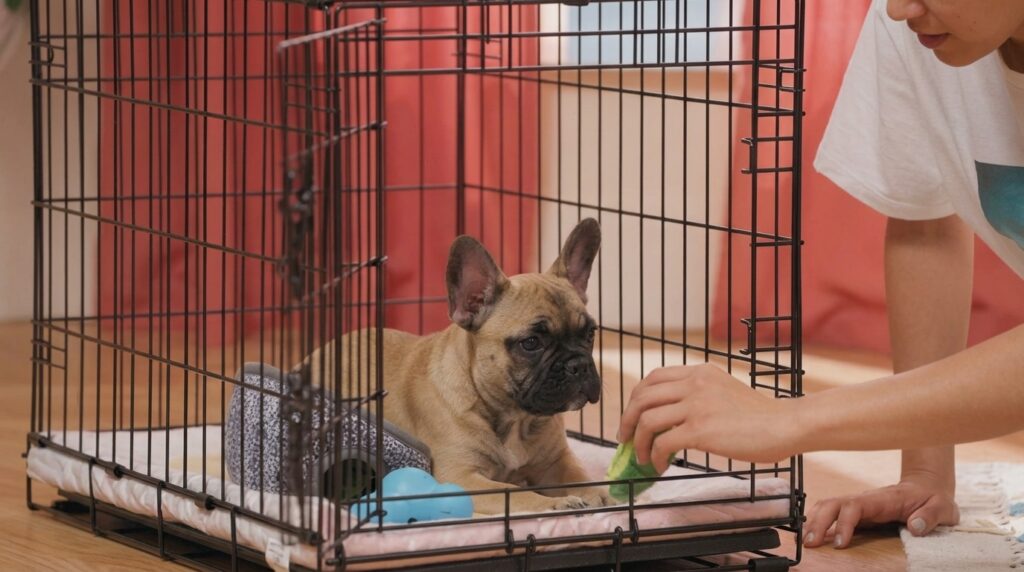
That last point comes with an important caveat that ties into this breed’s biggest behavioural challenge. Crate training done gradually does not cause separation anxiety, but for a dog that already has genuine, panic-level separation anxiety and hasn’t been properly conditioned to the crate, confinement can make the panic dramatically worse, sometimes to the point of self-injury. If your Frenchie already struggles badly with being alone, please pause the crate training and read our guide to French Bulldog separation anxiety first and consider professional help, because the crate is not a fix for panic and can deepen it in the wrong situation.
The crate isn’t just about safe rest, it’s also the single most powerful house-training tool you have, because dogs instinctively avoid soiling the place they sleep. The two skills are really learned side by side, and a crate without a proper potty routine only does half the work. Our full guide to house training a French Bulldog covers the schedule, the accidents, and why this breed takes longer than most to get reliable.
Choosing the Right Crate and Size
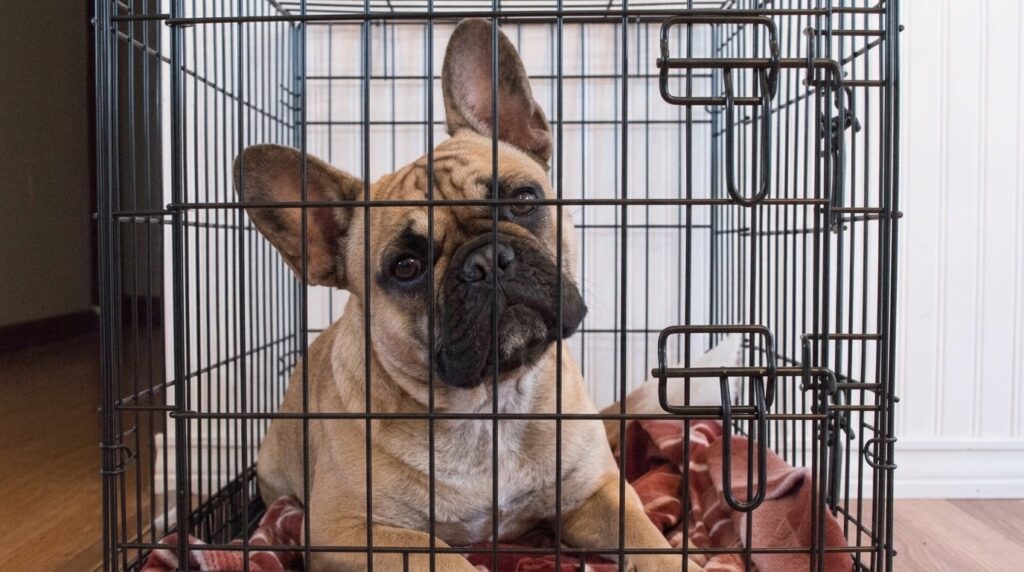
Getting the crate itself right matters more than people expect in crate training, and size is where owners most often go wrong. The crate should be just big enough for your dog to stand up, turn around, and lie down comfortably, and no bigger. That last part is counterintuitive, so it’s worth explaining: if the crate is too large, your dog can happily soil one end and sleep at the other, which completely undermines the house-training benefit you’re crating for in the first place.
For a French Bulldog, a crate somewhere in the range of 24 to 30 inches usually fits an adult well, though it’s the dimensions relative to your individual dog that matter, not the number on the box. If you’re crate training a French Bulldog puppy, here’s a money-saving trick: buy the crate sized for your dog’s expected full-grown dimensions, then use a divider panel to shrink the usable space while they’re small, moving it back as they grow. That way you buy one crate instead of three.
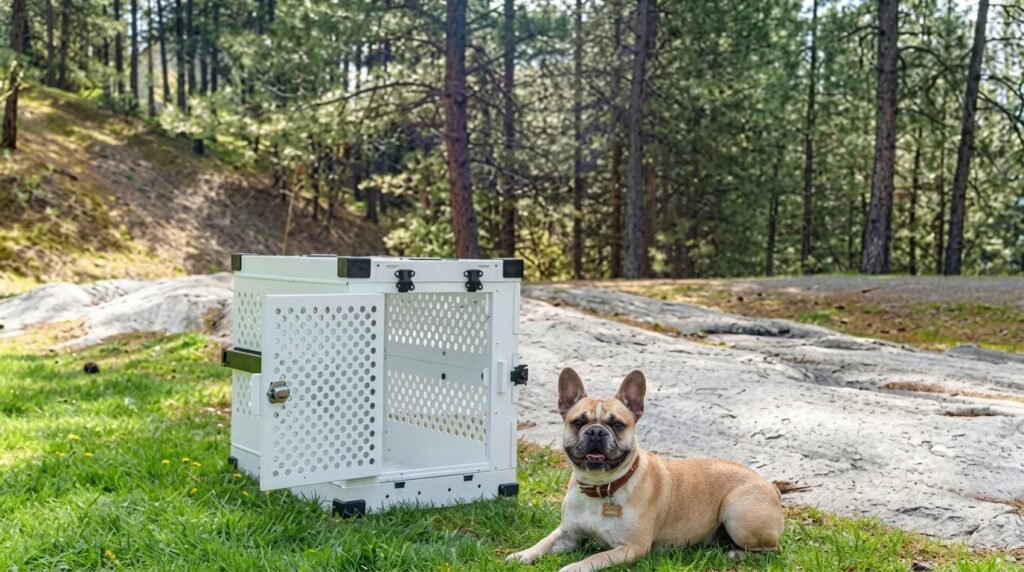
One consideration is genuinely more important for this breed than for most: ventilation. French Bulldogs are brachycephalic and prone to overheating and the breathing difficulty that comes with it, so a well-ventilated crate with plenty of airflow isn’t optional during crate training, it’s a safety issue. A well-ventilated wire crate with a divider suits most Frenchies well, giving the airflow they need while letting you adjust the space as a puppy grows. Whatever you choose, make the inside cozy with soft bedding, and never place the crate somewhere that gets hot, like near a radiator or in direct sun.
How to Crate Train Your French Bulldog, Step by Step
The entire crate training method rests on one principle: build a positive association, patiently, so your dog wants to go in rather than being made to. Rushing any stage is the surest way to set yourself back, so let your dog’s comfort set the pace.
Start by simply letting your dog get comfortable with the crate as an object. Put it in a room where the family spends time, prop the door open so it can’t swing and startle them, and let them investigate it on their own terms. Toss a few treats near and then just inside the entrance so that approaching the crate always pays off. There’s no rush to get them all the way in yet.
Once they’re happily going near it, start feeding meals inside. Place the bowl a little way in at first, then further back over successive meals until they’re eating comfortably at the back of the crate. Nothing builds a good association faster than daily meals in a space. You can reinforce this between meals with treat trails leading inside and, especially, a Kong or similar toy stuffed with something tasty and frozen, which gives your dog a genuinely enjoyable reason to settle in the crate for twenty absorbing minutes.
When your dog is relaxed going in and out, begin closing the door for very short periods while they’re occupied with that stuffed toy, staying nearby and opening it again before they get anxious. Extend the time in small increments, then start stepping out of the room briefly, then for longer. The progression from door-closed-while-you’re-there to genuinely-alone should be gradual, always keeping your dog under the threshold where they start to panic. Finally, add a cue like “crate” or “kennel up” as they go in, luring rather than pushing, and reward it, so eventually you can simply ask. Never force your dog inside, and never bang the door or startle them, because a single frightening moment can undo weeks of patient work.
Surviving the First Night
The first night is the one everyone dreads in crate training, and the 2am crying is so common it’s almost a rite of passage. It usually happens for one reason: the puppy feels isolated and alone in a strange new place. The single most effective fix is proximity.
For the first several nights, put the crate right next to your bed, or at least in your bedroom. A puppy who can see, hear, and smell you settles far more easily than one shut away alone downstairs, and being close by lets you hear when they genuinely need a toilet break. This closeness dramatically reduces the crying, and you can gradually move the crate to its permanent spot over the following weeks once your puppy is confident.
Set expectations realistically for those first nights. Expect frequent potty breaks in the first few days, since a young puppy simply can’t hold their bladder for long. By days four to seven the stretches lengthen, and many puppies are sleeping six to eight hours by the second week. A frozen stuffed toy at bedtime helps them settle, and for a very young puppy it’s reasonable to have water available overnight, while for an older puppy you can lift the water about an hour before bed to reduce nighttime trips. It’s hard going for a few nights, but it passes quickly if you stay calm and consistent.
Should the Crate Be in Your Bedroom?
For a puppy, yes, at least to begin with, for exactly the reasons above. The bedroom is the ideal first location because your presence is the strongest comfort your puppy has, and it turns the crate from a lonely box into a safe spot near their family.
As your dog matures and grows confident, you can decide where the crate lives longer-term. Some owners keep it in the bedroom permanently, and many dogs love sleeping near their people. Others transition it to a quiet corner of a living area. Either is fine, provided the spot is calm, draft-free, and never too warm. The key is to make any move gradually rather than suddenly relocating a dog who’s just gotten comfortable.
Crying in the Crate: Do You Ignore It?
This is where good intentions often go wrong, so the nuance matters. The general guidance is not to open the door while your dog is actively crying, because letting them out mid-cry teaches a simple, unhelpful lesson: crying gets me released. Instead, wait for a brief pause in the noise, even a couple of seconds, and calmly open the door then, so the lesson becomes that quiet gets me out.
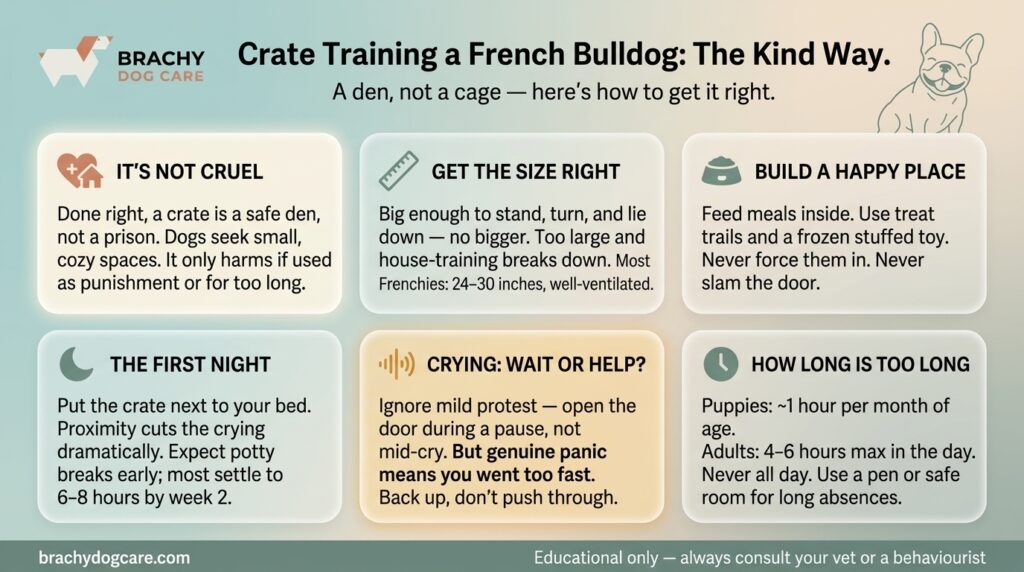
But, and this is the crucial part, that advice applies to mild protest whining, not to genuine distress. If the crying is relentless, escalating, and your dog seems truly panicked rather than simply complaining, that’s not a dog to wait out. It’s a sign the introduction moved too fast, and the right response is to back up a few steps in the process, not to push through and hope they settle. Ignoring genuine panic doesn’t build tolerance, it builds fear of the crate, and for a breed already prone to anxiety that’s a road you don’t want to start down. Learning to tell protest from panic is the most important judgment call in the whole of crate training, and when in doubt, err on the side of comforting your dog and slowing down.
How Long Can a French Bulldog Stay in a Crate?
There are real limits in crate training, and they’re about welfare as much as bladders. For puppies, a rough guideline is that they can hold their bladder for roughly one hour per month of age, up to a maximum of about three to four hours during the day. So a three-month-old shouldn’t be crated much beyond three hours at a stretch while awake.
For an adult Frenchie, aim to keep daytime crating to no more than about four to six hours, plus overnight, and never make it all day, every day. If your working day means your dog would be alone for eight or nine hours, the crate is the wrong tool for that stretch, use a puppy-proofed room, a pen, or a dog sitter instead. This isn’t just kindness, it’s practical: a dog forced to soil their crate because they were left too long becomes significantly harder to house-train, so over-crating actively works against you. The crate is for rest and safety, not for warehousing a dog through a long absence.
How Long Does Crate Training Take, and What Goes Wrong
Most puppies adjust to crate training within about two to four weeks of gradual, consistent effort, and some settle in a matter of days. The two factors that decide the pace, more than anything else, are consistency and patience, and older or rescued dogs generally take longer. As a loose map, expect comfort-building in the early weeks, increasing duration through three to four months, real independence around five to six months, and supervised freedom beyond the crate developing from six to twelve months.
A few common mistakes derail people during crate training. Moving too fast is the big one, closing the door too soon or leaving a dog too long before they’re ready. Using the crate for punishment, even once, poisons the association you’ve worked to build. And startling a dog at the crate, with a slammed door or a bump, can undo real progress in an instant. If you notice regression, and it’s common during teething and adolescent fear periods, don’t panic and don’t push harder. A short reset, going back a step or two to easier, shorter sessions, restores your dog’s comfort far faster than forcing them through resistance.
Crate Training an Older or Rescue Frenchie
If you’ve adopted an adult, the same crate training principles apply, just more slowly and gently. An older or rescued dog may have no experience of a crate at all, or worse, a bad history with confinement, so patience matters even more. Go at their pace, lean heavily on meals and treats inside the crate to build a fresh positive association, and never force the issue.
Rescue dogs are also, as a group, more prone to separation anxiety given the upheaval they’ve often been through, which brings us back to the earlier caveat. If your adopted Frenchie shows real panic around confinement or being alone, don’t push the crate, get a professional behaviourist involved and address the underlying anxiety first. For many rescues the crate becomes a beloved safe haven in time, but that time has to be given, not demanded.
Frequently Asked Questions
The Bottom Line
Crate training a French Bulldog isn’t about confining your dog, it’s about giving them a safe, calm place of their own, and doing it in a way that builds trust rather than fear. Introduced gradually and kept firmly as a happy place, crate training speeds up house-training, keeps a curious puppy safe, and gives your Frenchie somewhere secure to rest for life. The whole thing comes down to patience, positive association, and respecting your dog’s pace.
Having lost a Frenchie myself, I’ve learned that the kindest training is almost always the slowest, the kind that never frightens the dog and never forces the moment. Take the crate at your Frenchie’s speed, make it a place of good things and never of punishment, and you’ll end up with a dog who trots into their den willingly and settles there happily. That’s the whole goal, and it’s entirely achievable.
This article is educational and is not a substitute for professional training or veterinary advice. If your dog shows severe distress around confinement, consult a certified behaviourist or your veterinarian.

French Bulldog Cost in 2026: Price, Vet Bills, and the True Lifetime Cost
French Bulldog Temperament: Personality, and Are They Good Family Dogs?

Best Dog Toothpaste for French Bulldogs: A Vet-Guided Guide

Do French Bulldogs Shed? Coat, Grooming, and When to Worry

Why Your French Bulldog Chews Everything (and How to Stop It)