Written by Jinna CAMERON, veterinary medical student and dog health researcher. Reviewed for factual accuracy against trusted veterinary sources by DVM Carla DONTESK.
French Bulldog IVDD (intervertebral disc disease) is one of the most serious health problems you may ever face with your Frenchie. It can start as a small change – a bit of reluctance to jump, a yelp when picked up, and in some dogs it progresses to dragging the back legs or sudden paralysis in hours rather than days. Recognising what is really going on and knowing how to respond gives your dog the best possible chance.
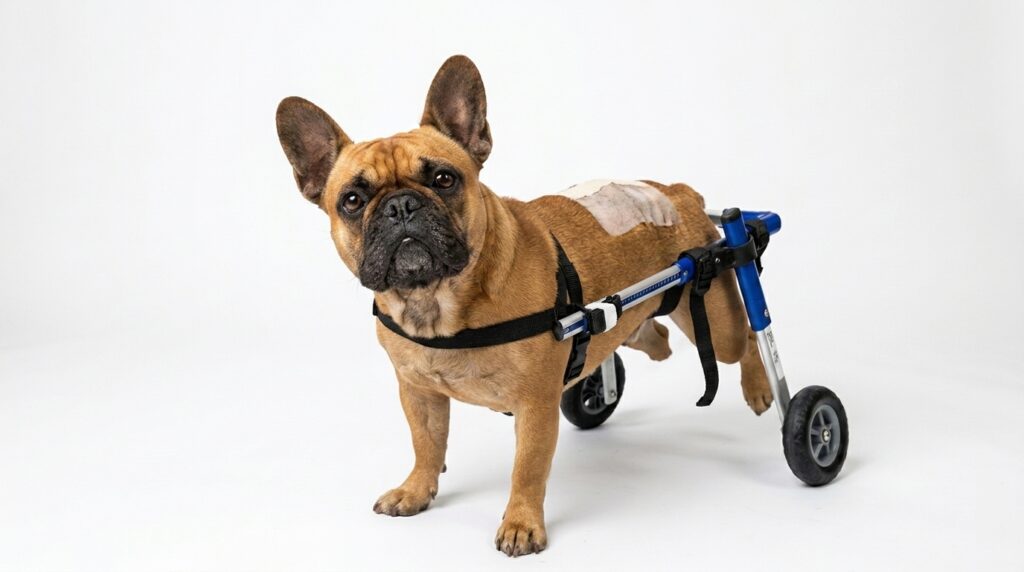
This guide explains what IVDD is in French Bulldogs, the early and emergency signs, how vets diagnose it, the main treatment paths, what recovery and recurrence look like, and how everyday decisions around weight, harnesses, ramps, and exercise can support your Frenchie’s spine over the long term.
What Is IVDD in French Bulldogs?
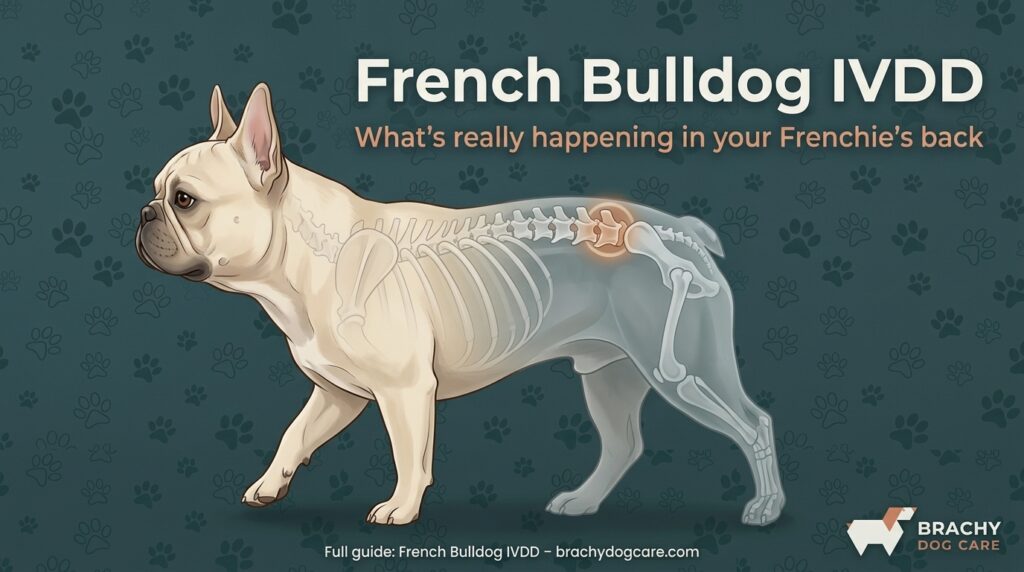
Intervertebral discs are small, shock‑absorbing cushions that sit between the vertebrae in your dog’s spine. In many French Bulldogs those discs degenerate and harden earlier in life than in other breeds. When a weakened disc suddenly ruptures, its inner material shoots into the spinal canal and compresses the spinal cord – that is intervertebral disc disease.
In Frenchies, this is usually Hansen type IV IVDD, an acute, explosive disc extrusion rather than a slow bulge. The result is often sudden, significant pressure on the spinal cord that can cause intense pain, wobbliness, weakness, or complete loss of function in the back legs.
French Bulldogs are particularly vulnerable because the following are true:
- They are chondrodystrophic – bred with altered cartilage and shortened limbs, and that same biology affects discs.
- They tend to develop IVDD young, often between 1 and 4 years old rather than only in old age.
- They more commonly have disc extrusions in the lower back (lumbar), where the spinal cord is tightly packed and damage can be catastrophic.
- They appear to have a higher risk of serious complications such as progressive myelomalacia, a rare but fatal spinal cord condition after severe injury.
IVDD is not rare bad luck for the breed; it is one of the core structural diseases French Bulldogs live with. That is why learning to spot early and emergency signs is so important.
Spinal surgery is one of the larger vet bills a Frenchie owner can face, which is part of why this breed costs so much more to own than to buy. If the financial side is on your mind, our guide to French Bulldog cost and lifetime vet bills puts conditions like IVDD into the wider budgeting picture, from puppy price to insurance.
Early IVDD Symptoms in French Bulldogs (Before It’s an Emergency)
Not every French Bulldog IVDD episode looks dramatic from day one. Many begin with subtle, easy‑to‑explain‑away changes that owners mistake for “just a tweak” or “a bit of stiffness.” These early signs usually match mild neurological grades, where your dog is in pain but still walking.
Spinal disease isn’t the only reason a Frenchie struggles with its back legs, and telling the causes apart genuinely matters, because the treatments look nothing alike. Hip and knee problems produce many of the same signs, and hip dysplasia in particular is common on X-ray in this breed while frequently not being the actual source of pain. If your dog’s mobility has changed and you’re weighing the possibilities, our guide to French Bulldog hip dysplasia explains how it’s diagnosed and why the obvious answer often isn’t the right one.
Early IVDD symptoms to watch for
You may notice one or more of these:
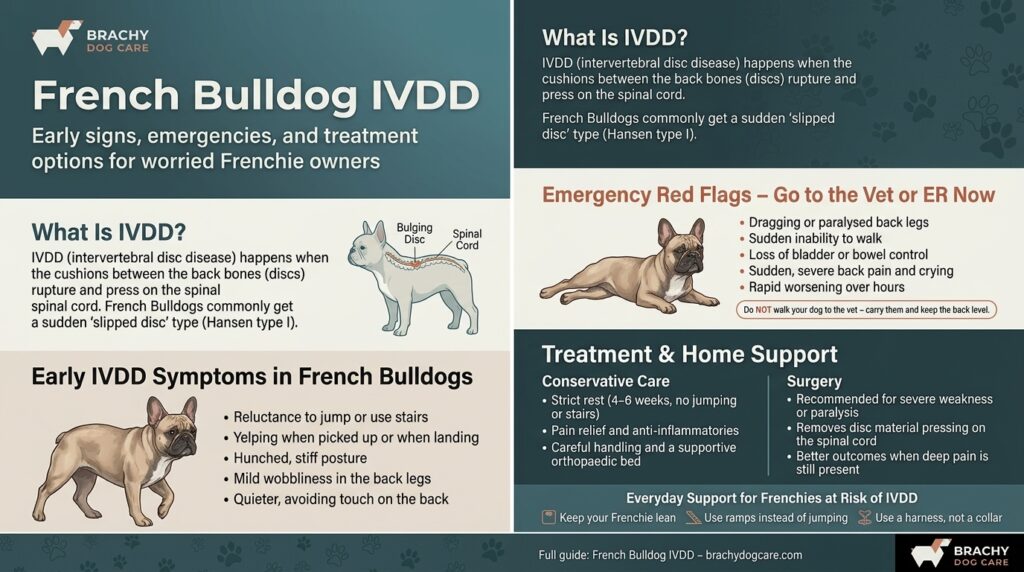
- Reluctance to jump or use stairs A Frenchie who used to hop on the sofa or bed suddenly hesitates, needs encouragement, or refuses altogether. They may pause at the bottom of the stairs or go up slowly one step at a time.
- Yelping when picked up or when landing: A sharp cry when you lift them under the chest, put on their harness, or when they land after jumping down is a big warning sign. Some dogs yelp once and then carry on, which makes it easy to shrug off.
- Hunched posture and guarded movement Your dog may stand with a rounded back, hold their head lower, or move stiffly. They may seem “tight” through the spine and reluctant to twist or turn.
- Stiffness or “old dog” movement in a young Frenchie: A two‑ or three‑year‑old French Bulldog moving like a much older dog – slow to get up, careful on turns, stiff in the back – deserves attention.
- Mild wobbliness in the hind legs You might see the back legs crossing over occasionally, slipping slightly on turns, or looking a bit uncoordinated even though your dog is still able to walk.
- Behaviour changes around touch and activity A normally enthusiastic Frenchie might start hiding, avoiding play, refusing walks, or pulling away when you stroke their back. With neck (cervical) IVDD, they may hold the head low and resist turning it.
Why “wait and see” is dangerous with a Frenchie
All of these can look like minor aches. With French Bulldogs and IVDD, “minor aches” can be the only warning before a disc ruptures harder and causes severe spinal cord damage. The step from “reluctant to jump” to “dragging back legs” may be much shorter than you expect.
If you notice these early IVDD symptoms in your Frenchie:
- Restrict activity immediately – no jumping, no stairs, no rough play, leash walks only.
- Call your vet the same day and describe what you are seeing, especially reluctance to jump, yelps, and back pain.
Catching French Bulldog IVDD at this stage is not about overreacting; it is about buying time before something irreversible happens.
Not every back-leg problem is spinal, and telling them apart genuinely matters. A knee that intermittently gives way, with your dog skipping a step then carrying on normally, points somewhere very different from a disc problem, even though both show up as hind-limb trouble. Our guide to the luxating patella in French Bulldogs covers how the knee version presents and how vets grade its severity.
IVDD Emergencies: Dragging Back Legs, Sudden Pain, and Paralysis
Some French Bulldog IVDD episodes progress from subtle to catastrophic quickly. These are medical emergencies. Delaying action can permanently change your dog’s outcome.
Emergency red flags in a French Bulldog
Seek immediate veterinary or emergency clinic help if you see:
- Dragging back legs or inability to walk Your Frenchie’s hind legs suddenly buckle, drag, or will not support their weight. They may try to stand, take a step, and collapse.
- Sudden, severe back pain with intense crying, repeated yelping or screaming, refusal to move, tense muscles, or a rigid posture indicates significant spinal pain.
- Loss of bladder or bowel control: Sudden incontinence or inability to urinate points to serious spinal cord involvement.
- Back legs feel floppy or extremely weak Even if your dog can just about stand, a clear, sudden drop in strength is not something to monitor at home.
- Rapid worsening over hours A dog that was shaky in the morning and cannot stand in the afternoon needs to be seen right away.
In the most severe French Bulldog IVDD cases, dogs lose deep pain sensation in their toes. That is one of the most serious neurological signs and changes both prognosis and how urgently surgery is needed. Only a vet or specialist can assess deep pain properly, but if your dog cannot feel firm pinches or seems unaware of their own limbs, treat it as critical.
What to do in the first hour
If you suspect an IVDD emergency:
- Do not walk your dog to the clinicCarry them using a crate, trolley, or makeshift stretcher. Keep their back as level as possible.
- Do not massage or “test” their legsExtra bending, stretching, or forcing them to stand can worsen spinal cord damage.
- Support the spine when lifting one arm under the chest and one under the hind end, lifting in one unit so the back stays straight.
- Call aheadPhone your vet or the emergency hospital, explain you have a French Bulldog with possible acute spinal injury, and confirm where to go.
In a French Bulldog IVDD crisis, fast, calm action is far more valuable than hours of frantic googling. If you are even half‑convinced it is more than a sore leg, assume it is serious and move.
How Vets Diagnose IVDD in French Bulldogs
Once you arrive at the clinic, your vet’s priority is to confirm that the problem is in the spine and to understand how badly the spinal cord is affected.
Neurological exam and grading
Your vet will:
- Check reflexes and muscle tone in all four limbs.
- Pinch toes to see whether your dog consciously responds (deep pain) or just withdraws reflexively.
- Palpate along the spine to localise pain in the neck, mid‑back, or lower back.
- Watch your dog stand and walk, if they can.
From this, they assign a neurological grade, which roughly runs from the following:
- Back/neck pain only, walking normally.
- Weakness and wobbliness but still ambulatory.
- Unable to walk without support (non‑ambulatory).
- Paralysed but still has deep pain.
- Paralysed with no deep pain sensation.
This grading is not academic; it heavily influences prognosis and how urgent surgery is.
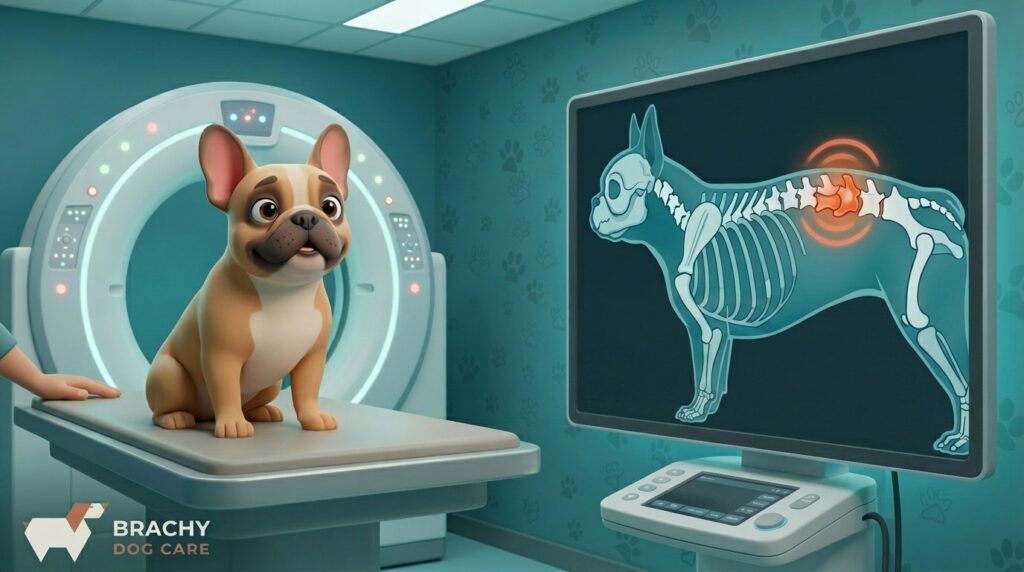
Imaging: X‑ray, CT, or MRI
To plan treatment in a French bulldog IVDD case, vets often recommend imaging:
- X‑rays Good for spotting fractures, some bony changes, and disc space narrowing, but they do not show disc material inside the spinal canal. Helpful as a first step, but not definitive.
- CT scans: CT is fast and excellent at detecting mineralised disc material pressing on the spinal cord, which is common in Frenchies. Many emergency hospitals use CT, sometimes with contrast (myelography), to locate the problem disc.
- MRIMRI gives the best view of the spinal cord and soft tissues. It is particularly useful when discs are not mineralised or when more than one disc looks suspicious. It is the gold standard, but it is more expensive and takes longer.
All advanced imaging requires at least sedation, often full anaesthesia, which carries additional risks for brachycephalic and overweight French Bulldogs. Your vet should explain how they manage airway support, breathing, and recovery for a Frenchie with IVDD.
For a solid veterinary‑level overview of how IVDD is diagnosed and treated across breeds, you can read the general intervertebral disc disease information from the UK Kennel Club’s health resources.
Treatment Options for a French Bulldog with IVDD
Treatment for French Bulldog IVDD is about two decisions:
- Conservative (non‑surgical) vs surgical management.
- How aggressively and how quickly to act, based on neurological grade and changes over time.
Both paths have real benefits and real limitations.
Conservative (non‑surgical) treatment
Conservative treatment is typically chosen when:
- The dog is in pain but still walking.
- Neurological deficits are mild and not rapidly worsening.
- Surgery is not financially possible or carries unacceptable anaesthetic risk.
It usually includes:
- Strict rest Four to six weeks of crate or pen rest – no jumping, no stairs, no play, and controlled leash‑only toilet breaks. This is often the hardest part for owners, but it is essential. Pain relief does not mean the disc is stable.
- Pain relief and anti‑inflammatory medication Vets commonly use non‑steroidal anti‑inflammatory drugs plus other analgesics. Steroids may still be used in some protocols, but they carry more side effects, and their advantage over NSAIDs for IVDD recovery is debated.
- Careful handling and supportive environment Lifting with the spine level, blocking stairs, using non‑slip rugs, and providing a comfortable, supportive bed are all important. A thick memory‑foam orthopaedic bed with a low entry edge and non‑slip base works well; it gives support without forcing your dog to jump in or out and is a good place to use a discreet affiliate recommendation.
- Rehabilitation after the acute phase Once your vet says it is safe, gentle physiotherapy or hydrotherapy can help rebuild strength and coordination without overloading the spine.
Conservative management can be effective for some Frenchie IVDD cases, especially pain-only or mild-weakness, but recurrence risk remains, and some dogs deteriorate despite rest. Owners need very clear instructions on what “strict” rest really means and what worsening looks like.
Surgical treatment (decompressive surgery)
Surgery is usually recommended when:
- Your dog cannot walk or cannot support their weight.
- Weakness or paralysis is progressing.
- Deep pain is lost or is at serious risk of being lost.
- Conservative treatment has already failed.
The aim is to remove the disc material compressing the spinal cord and give the spinal cord space to recover.
Common procedures include:
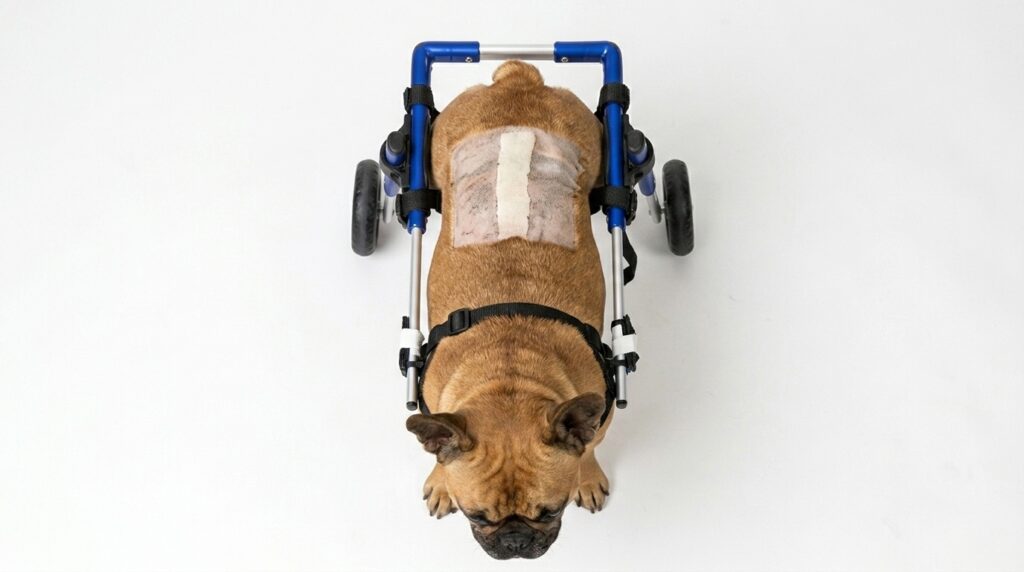
- Hemilaminectomy – the standard approach for thoracolumbar (mid to lower back) IVDD. The surgeon removes a window of bone from one side of the vertebra to access and remove the extruded disc material.
- Ventral slot – used for cervical (neck) IVDD, approaching from underneath the neck.
Surgeons may also perform fenestration – opening and clearing selected discs at the time of surgery to reduce the risk of those discs rupturing later.
Outcomes depend heavily on neurological grade:
- Dogs with intact deep pain before surgery often do very well and regain the ability to walk.
- Dogs with no deep pain have a much more guarded prognosis. French Bulldogs in this group appear to have higher complication and poor‑outcome rates than some other breeds, partly because of their spinal anatomy and higher risk of complications like extensive epidural bleeding and myelomalacia.
Surgery is expensive and emotionally heavy. Before deciding, it is reasonable to ask your vet or neurologist:
- What neurological grade is my Frenchie?
- What outcomes are realistic with conservative vs surgery in a dog like this?
- What is the time window for making a decision, based on my dog’s current state?
Recovery, Recurrence, and Life With IVDD
What recovery can look like
For a French Bulldog IVDD case where:
- Deep pain is intact.
- Treatment (surgery or conservative) is appropriate and timely.
Recovery often means:
- Pain controlled within days.
- Strength and coordination improving over weeks and months.
- Some permanent mild stiffness or wobbliness in a minority of dogs.
- A good quality of life with some lifestyle modifications.
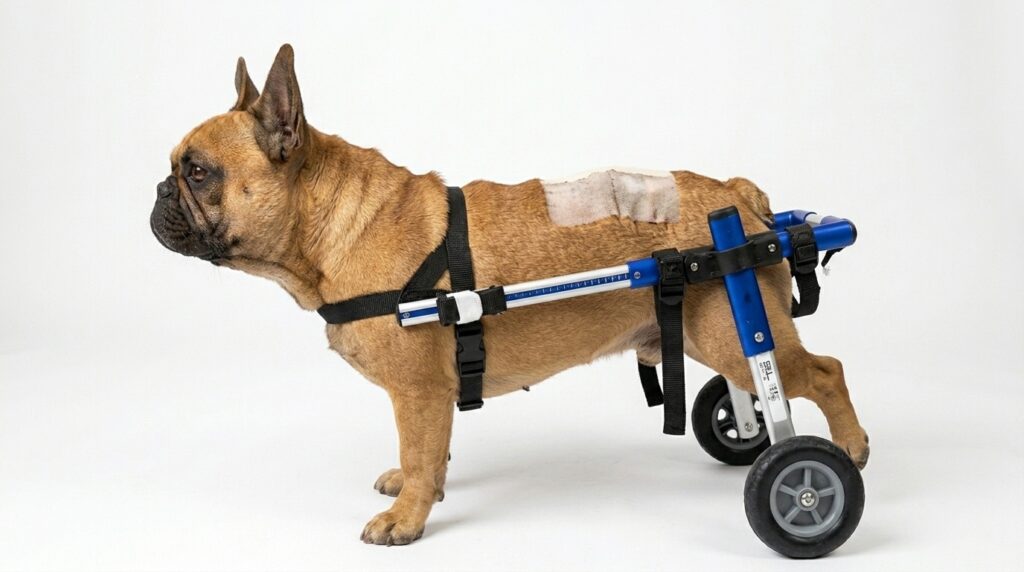
For more severe injuries, especially when deep pain was absent for a significant time, the best‑case scenario may be slower, partial recovery. Some dogs remain non‑ambulatory and need ongoing mobility support; some do not regain meaningful function despite maximal treatment.
Recurrence risk in French Bulldogs
One of the hardest truths is that many Frenchies with IVDD are not “one and done”. Once a French Bulldog has had a true IVDD episode:
- The risk of another disc problem is real, especially within the first year after surgery or a major episode.
- Dogs whose first IVDD episode occurs at a young age seem more prone to recurrences.
That does not mean you should live in constant fear. It does mean:
- You should treat lifestyle changes (weight, ramps, stairs, type of exercise) as permanent, not temporary.
- You should be quick to respond to small warning signs in future.
- It is reasonable to discuss recurrence risk honestly with your neurologist, including whether fenestration or other strategies were used to reduce risk.
Life expectancy and quality of life
Many French Bulldogs with IVDD continue to live happy, comfortable lives for years:
- They may not be allowed to sprint after balls or jump on furniture, but they can enjoy walks, sniffing, play, and affection.
- Pain can often be well controlled.
- Owners adapt the home and routine, and it becomes the new normal.
The most difficult quality‑of‑life decisions arise when:
- Pain cannot be adequately controlled.
- Progressive myelomalacia or repeated severe episodes make mobility and comfort impossible to maintain.
- Your Frenchie is frightened, distressed, or no longer able to enjoy basic activities despite treatment.
Those are not decisions you should make alone. Work closely with your vet and, where possible, a specialist. Second opinions are welcome in these situations.
Other French Bulldog Back and Joint Problems (Beyond IVDD)
Not every French Bulldog with a limp or reluctance to jump has IVDD. Other conditions can mimic or coexist with it.
Hip dysplasia and hip problems
Hip dysplasia is a poorly fitting hip joint that leads to arthritis over time. In Frenchies it may show as:
- Bunny‑hopping gait in the hind legs.
- Difficulty rising after rest.
- Gradual reluctance to exercise or jump.
- Thinning muscles over the hips.
Hip dysplasia tends to cause slowly progressive problems, not the explosive onset of pain and paralysis seen in many IVDD episodes.
Knee issues (patella luxation and others)
Luxating patella (a kneecap that pops in and out of place) is common in small breeds, including French Bulldogs. Owners typically see the following:
- An intermittent “skip” or hop on one hind leg.
- Brief periods of carrying the leg, then returning to normal.
- No clear back pain when you touch the spine.
This is very different from a French Bulldog IVDD emergency, although an older dog can certainly have both knee and disc disease.
Arthritis and general mobility issues
Older Frenchies often develop arthritis in hips, knees, and the spine itself. It can cause:
- Morning stiffness that improves as the dog moves.
- Reluctance to jump or use stairs.
- Shorter walks and slower pace.
The key difference is usually pace and severity. Arthritis creeps; IVDD often crashes. A vet exam and, if needed, imaging will help distinguish them.
Everyday Support and Prevention for a Frenchie at Risk of IVDD
You cannot prevent every disc from ever rupturing, but you can change the forces your French Bulldog’s spine deals with every day.
Keep your Frenchie lean
Excess weight is a direct, constant load on your dog’s spine and joints. It also makes anaesthesia and recovery harder.
- Aim for a clear waist from above, a slight tummy tuck from the side, and ribs easily felt without digging.
- Use measured meals instead of eyeballing.
- Audit treats honestly – they add up very fast in a small dog.
If your Frenchie is already a bit round, use the overweight French Bulldog weight loss guide as a step‑by‑step plan. It is built specifically for French Bulldogs rather than generic dogs.
Manage jumping, stairs, and slippery floors
Every jump and hard landing sends force up your Frenchie’s spine. You can reduce that load with simple changes:
- Block or restrict unsupervised access to stairs.
- Use ramps for beds, sofas, and cars instead of allowing jumping, especially downwards.
- Add rugs or runners on slick floors where your dog tends to slip or scramble.
- Help your dog on and off high surfaces rather than letting them launch themselves.
These habits are essential after a French Bulldog IVDD episode, but they make sense for any high‑risk Frenchie.
Choose spine‑friendly gear
Harnesses and bedding matter:
- Use a well‑fitted harness instead of a collar, especially for any Frenchie with IVDD history. A good harness avoids pressure on the neck and distributes forces across the chest and shoulders. The French Bulldog harness and health guide walks you through safe options.
- Invest in a supportive orthopaedic bed – a firm memory‑foam mattress with a non‑slip underside and a low step‑in edge is ideal. It supports your dog’s back and joints and makes it easier for them to get in and out without jumping, which is exactly the kind of product that fits naturally with careful affiliate use.
Exercise and enrichment that respect the spine
Once your vet clears your Frenchie for activity:
- Choose short, frequent, flat walks over long or steep routes.
- Skip explosive ball‑throwing and frisbee games that require sudden acceleration, stopping, and turning.
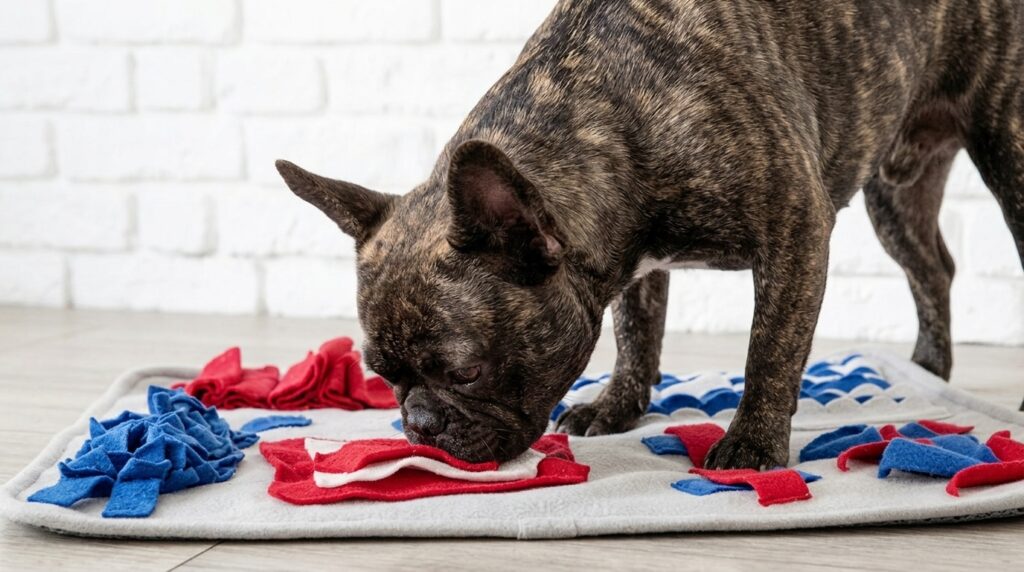
- Use scent games, puzzle feeders, and training sessions to tire them mentally without hammering the spine.
- Combine IVDD‑safe exercise with your existing strategies for breathing and heat safety from your overheating and exercise intolerance content.
You are not wrapping your dog in bubble wrap; you are choosing activities that they can enjoy without repeatedly stressing a vulnerable back.
How to Talk to Your Vet When You Suspect IVDD
When you arrive at the clinic feeling scared, it is easy to forget what you meant to ask. Going in with a few prepared questions can make a big difference.
Consider asking:
- “What neurological grade is my Frenchie right now, and does he still have deep pain sensation?”
- “Based on this exam, do you recommend emergency imaging, or is it safe to monitor at home for a short time?”
- “What are the realistic outcomes with conservative treatment vs surgery in a French bulldog like mine?”
- “What signs at home mean I should come back straight away or go directly to the emergency vet?”
- “How can we reduce the risk of this happening again once he’s recovered?”
You don’t need to sound like a vet. You just need to make sure you understand your dog’s current status, options, and red flags.
French Bulldog IVDD FAQs
Helping a French Bulldog through IVDD is emotionally tough. But with fast recognition, clear triage decisions, realistic expectations about treatment and recurrence, and a home set up to support recovery, you can give your dog a much better chance at breathing easier, moving better, and staying comfortable for years rather than weeks.

French Bulldog Cost in 2026: Price, Vet Bills, and the True Lifetime Cost
French Bulldog Temperament: Personality, and Are They Good Family Dogs?

Best Dog Toothpaste for French Bulldogs: A Vet-Guided Guide
Do French Bulldogs Shed? Coat, Grooming, and When to Worry

Why Your French Bulldog Chews Everything (and How to Stop It)