Written by Jinna CAMERON, veterinary medical student and dog health researcher. Reviewed for factual accuracy against trusted veterinary sources by DVM Carla DONTESK
If you’ve ever stood over your Frenchie at 6 a.m. watching them bring up a puddle of yellow foam, you already know the particular kind of worry this breed inspires. I run this site because I lost my own French Bulldog, Pearly, to airway-related complications I didn’t read the warning signs of soon enough, and one thing that surprised me later in my studies is how often a Frenchie’s stomach trouble is really a clue about something happening higher up, in the airway. French Bulldog vomiting is one of the most searched health worries owners have, and it deserves a clearer, more honest answer than “Frenchies just have sensitive tummies”.
This guide walks through what’s normal, what isn’t, what the color of the mess can and can’t tell you, and the red flags that mean it’s time to stop reading and call a vet. I’m a veterinary medical student and a dog-health researcher,so nothing here replaces an exam by your own vet. The goal is to help you understand what you’re actually seeing when your French Bulldog is throwing up, so you can react with judgment instead of panic.

Is It Normal for French Bulldogs to Vomit?
Here’s the uncomfortable truth that gets glossed over: French Bulldogs really do bring food and fluid back up more than most breeds, and it isn’t just bad luck. It’s tied to their anatomy. In one study of Frenchies with airway disease, an astonishing 98 percent showed some degree of regurgitation or vomiting before surgery, and 93 percent were in the moderate-to-severe range. For comparison, the same problem affected 58 percent of English Bulldogs and only 16 percent of Pugs. So a Frenchie throwing up is statistically common, but common is not the same as harmless.
This is exactly where owners get into trouble, including me. When something happens often enough, it starts to feel ordinary, and the brain quietly files it under “just how my dog is.” Research backs this up uncomfortably well: in one survey, around 60 percent of owners of Frenchies with clear airway disease couldn’t recognize the clinical signs at all. So the honest framing for French Bulldog vomiting is this: occasional, isolated episodes in an otherwise bright, healthy dog are usually low-drama, but a repeating pattern is a message, not background noise. Tracking how often it happens, what it looks like, and whether it lines up with meals or mornings is what turns a vague worry into a clinical picture your vet can actually use.
Vomiting vs Regurgitation: The Difference Most Owners Miss
Before anything else, you need to know which of two very different things your dog is actually doing, because they point to different problems and even respond to different medications. Most owners, and honestly plenty of clinics, lump them together, and that single mistake can delay the right diagnosis. So much reported French Bulldog vomiting turns out, on closer look, to be something else entirely.
Vomiting is active. There’s effort involved: heaving, abdominal contractions, often some drooling or lip-licking beforehand because the dog feels nauseated. What comes up is partially digested, may smell sour, and can contain bile or foam. It can happen well after a meal.
Regurgitation is passive. There’s no heaving and no warning. Food or fluid just slides back up, often within minutes of eating, and it usually looks undigested, sometimes in a tube-like shape because it never made it past the esophagus. This is the one most people misread.
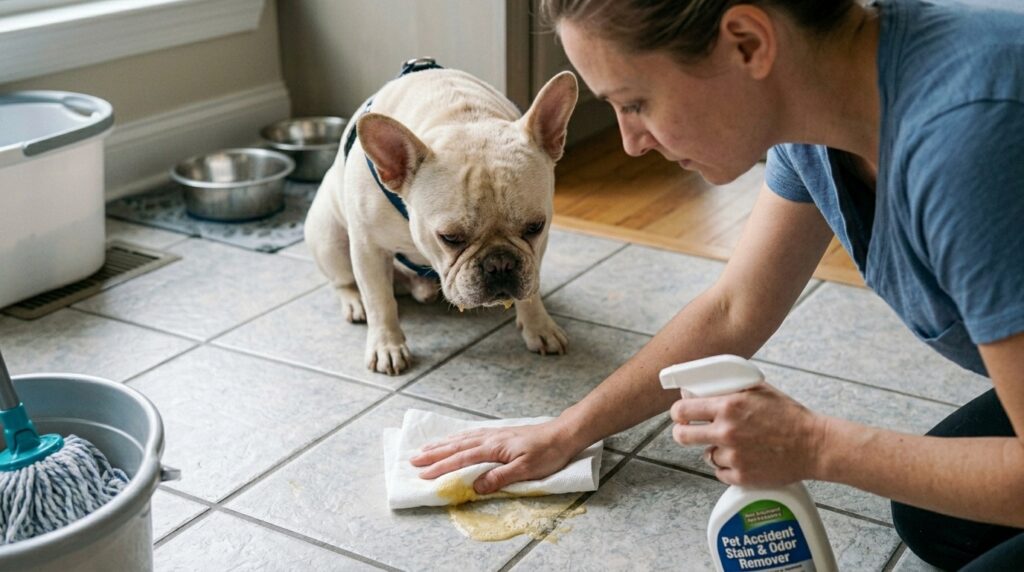
Why does this matter so much for this breed in particular? Because in French Bulldogs, a great deal of what owners call vomiting is actually regurgitation caused by an esophagus that isn’t moving food along properly. In brachycephalic dogs studied with swallowing X-rays, the majority with esophageal motility problems were young, with a median age of just one year. When you watch closely and note whether there was effort or not, you hand your vet the single most useful piece of information they can get. If you’re ever unsure, filming an episode on your phone genuinely helps more than any description.
What the Color and Contents Mean
This is the part everyone searches first, so let’s be useful about it, with one important caution at the end. Decoding French Bulldog vomiting by appearance can point you in a direction, as long as you don’t treat color as a diagnosis.
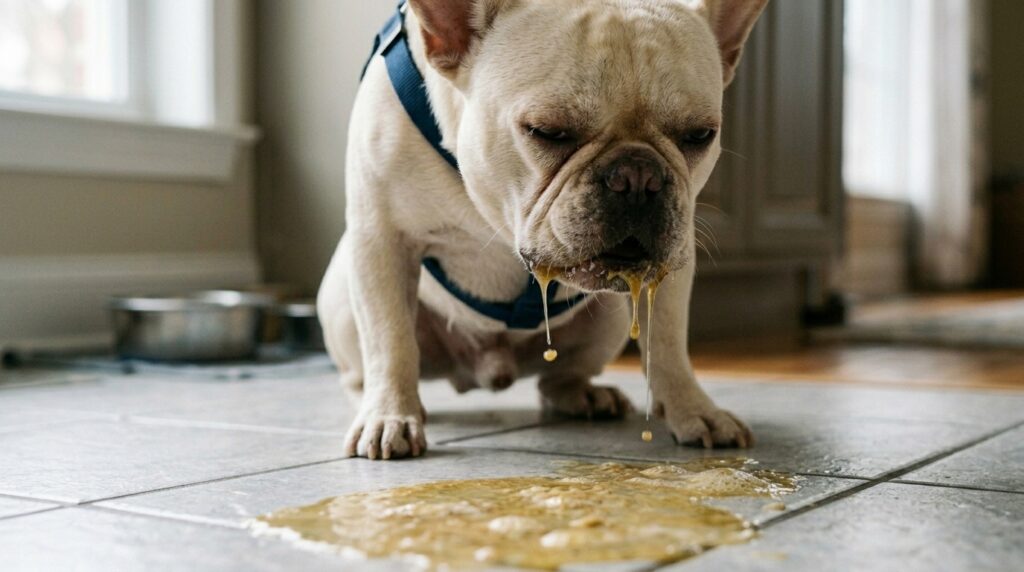
Yellow or foamy bile usually means the stomach is empty and bile has washed back up from the intestine. It classically shows up in the morning or after a long stretch without food, a pattern often called bilious vomiting. In a breed already prone to acid reflux, this kind of French Bulldog vomiting is a frequent visitor, and the fix is often as simple as a small bedtime snack, which we’ll get to.
White foam is typically saliva mixed with air and a little stomach fluid, and Frenchies, with their tendency to gulp air, produce it readily. Most of the time it’s minor. But this is the one pattern I won’t let you read as automatically harmless: white foam together with repeated unproductive retching and a swelling, hard belly can signal bloat, a twisting of the stomach that is a true, clock-is-ticking emergency. If you see that combination, skip the rest of this article and get to an emergency vet now.
Undigested food, especially right after eating, leans much more toward regurgitation than true vomiting, and given how common a sluggish esophagus is in this breed, it’s a pattern worth noting carefully rather than dismissing as a greedy eater.
Blood is never wait-and-see. Fresh red streaks or dark, coffee-ground-looking material both point to bleeding somewhere in the gut, and given how often these dogs carry low-grade gastritis and esophagitis, it earns an urgent call.
Now the caution, because honesty is the whole point of this site: with French Bulldog vomiting, color is a hint, not a verdict. There’s no reliable evidence that vomit color alone tells you the cause. The timing, the frequency, the relationship to meals, and above all whether it was vomiting or regurgitation will tell your vet far more than the shade ever will. Use color as a clue to report, not a conclusion to act on.
If your dog starts vomiting within a few hours of getting into human food, one possibility worth ruling out fast is grapes or raisins, which often cause vomiting before they damage the kidneys. Because there’s no safe amount, this is one case where you shouldn’t wait and watch, our guide to what happens if a French Bulldog eats grapes walks through the timeline and the emergency steps.
Common Causes of French Bulldog Vomiting
The list of possible triggers is long, but for this breed it’s lopsided, with a few causes doing most of the heavy lifting. Understanding the common causes of French Bulldog vomiting helps you tell the routine from the worrying.
By far the biggest breed-specific driver is airway-related digestive disease: reflux, esophagitis, hiatal hernia, and that esophageal dysmotility mentioned earlier. This single cluster explains why French Bulldog vomiting is so disproportionately common, and it’s important enough that it gets its own section below.
Chronic gastritis, meaning ongoing inflammation of the stomach lining, is also common in this breed and often turns up on biopsy in Frenchies with airway disease. Bacteria related to Helicobacter are frequently found in young dogs and are linked to both stomach changes and French Bulldog vomiting.

Food-related issues matter too. Dietary upset and food sensitivities are well recognized in the breed, and gut disorders rank among the most common health problems Frenchies are seen for. If episodes cluster around new foods, treats, or table scraps, that’s a meaningful pattern. This is also where French Bulldog vomiting overlaps with the looser, runnier end of things, so if your dog has both, our guide to French Bulldog diarrhea is a useful companion read, and a suspected food trigger is worth exploring alongside French Bulldog food allergies.
Then there are the causes that affect every breed but are no less serious here: a swallowed foreign object causing a blockage, pancreatitis, infections and parasites, toxins, medication side effects, motion sickness, and plain stress or anxiety. Stress-related French Bulldog vomiting is easy to overlook, but a sudden routine change, travel, or time alone can unsettle a sensitive gut, and motion sickness is common in younger dogs not yet used to car rides. A swallowed toy, sock, or chunk of chew belongs front of mind too, because this breed’s curiosity outpaces its judgment, and a real blockage is an emergency rather than a passing upset.
None of these are uniquely Frenchie problems, but a flat-faced dog has less margin for error, which brings us to one more breed-specific danger. Because these dogs are prone to bringing material up, they’re also prone to inhaling it, and aspiration pneumonia is a recognized and serious consequence of repeated regurgitation in brachycephalic dogs. That risk is precisely why French Bulldog vomiting deserves more respect than the same symptom in a long-nosed dog.
The Airway Connection: Reflux, Hiatal Hernia, and BOAS
This is the part almost no owner-facing article explains, and it’s the key to understanding why your Frenchie’s gut behaves the way it does. It also reframes French Bulldog vomiting from a stomach issue into something that often starts with breathing.
When a dog with a partly obstructed airway works hard to breathe in, it generates strong negative pressure inside the chest. Over time, that suction effectively tugs on the stomach and the junction where the esophagus meets it. The result is a cascade: acid refluxes upward, the esophagus gets irritated and stops moving food efficiently, and in many dogs a portion of the stomach slides up through the diaphragm into the chest, a condition called a sliding hiatal hernia. Studies using swallowing X-rays have found hiatal hernia in roughly 36 to 40 percent of French Bulldogs in referral populations, far higher than older scope-based estimates suggested. Objective acid monitoring in Frenchies has even captured reflux happening silently, without any visible regurgitation the owner would notice.
In other words, a great deal of French Bulldog vomiting and regurgitation isn’t really a stomach problem at all. It’s an airway problem expressing itself through the gut. The breed’s odds of carrying the underlying airway syndrome in the first place are staggering compared to non-brachycephalic dogs. What this means in practice is that treating French Bulldog vomiting purely as a diet question can miss the real driver entirely; diet still matters, but for many dogs the stomach sits downstream of the airway.
The hopeful flip side is that fixing the airway often calms the gut. When surgeons correct the obstruction, GI signs frequently improve, with one study reporting meaningful reductions in moderate-to-severe regurgitation and vomiting afterward, the effect most pronounced in French Bulldogs. Adding acid-reducing medication around the time of surgery improved digestive outcomes further still. If your dog’s French Bulldog vomiting travels alongside noisy breathing, exercise intolerance, or heat sensitivity, those dots connect, and our full guide to BOAS surgery for French Bulldogs explains how addressing the airway can be part of the answer to the stomach. This is a conversation to have with your vet, not a DIY project, but knowing the link exists changes the questions you’ll ask.
When to Worry: Red Flags and Emergencies
Most single episodes in a bright, playful dog resolve on their own. The judgment call is knowing which episodes don’t get the benefit of the doubt, because not all French Bulldog vomiting carries the same weight. Treat the following as reasons to call your vet, and the emergencies as reasons to go now.
Get to a vet promptly if you see vomiting or regurgitation that persists beyond about 24 hours, or that recurs daily or after most meals, since a repeating pattern in this breed reflects real underlying disease rather than a one-off. Blood in any form, fresh or coffee-ground, warrants an urgent call. So does ongoing weight loss, which can accompany the reflux and hernia problems Frenchies are prone to.
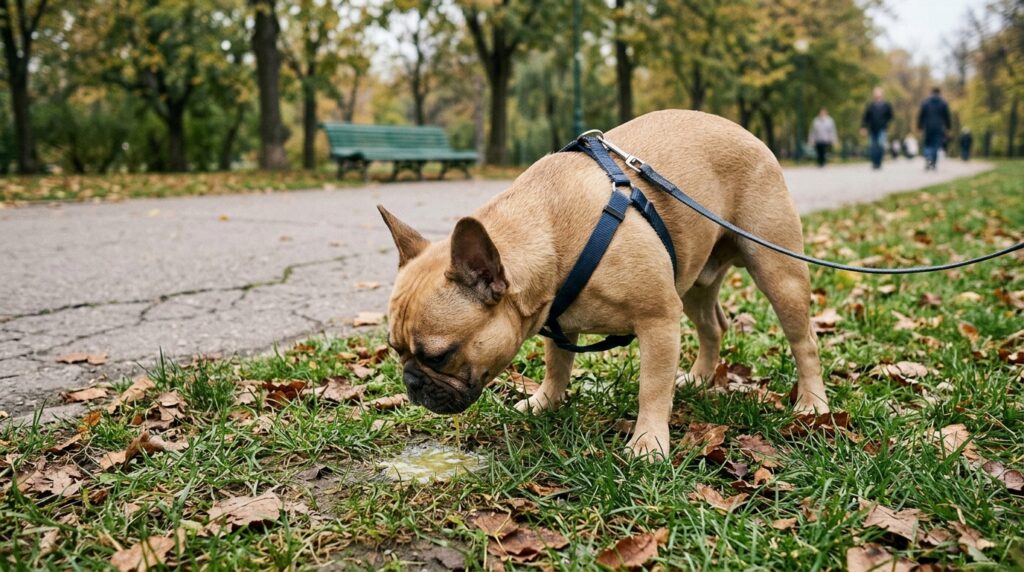
Go to an emergency clinic immediately for the danger signs: unproductive retching with a swollen, firm abdomen and restlessness, which can mean bloat; any French Bulldog vomiting paired with breathing difficulty, coughing, or fever, which can signal that material has been inhaled into the lungs; and collapse or obvious distress. Because the airway and the gut are so linked in this breed, vomiting that shows up at the same time as worsening breathing is a combination to take seriously rather than wait out.
Puppies get a lower threshold. French Bulldogs are a young population to begin with, and serious gut issues genuinely do appear early in life. A small puppy has far less reserve against dehydration and low blood sugar than an adult, so what might be a watch-and-wait situation in a grown dog is a same-day vet visit in a baby Frenchie. When in doubt with a puppy, err toward calling: the cost of an unnecessary check is low, and the cost of missed dehydration is not.
What You Can Safely Do at Home
For the mild, occasional episode where your dog is otherwise their normal self, there are sensible, supportive things you can do, all with the understanding that they manage symptoms rather than cure anything, and that anything in the red-flag list above overrides them. The aim of home care for French Bulldog vomiting is to reduce the everyday triggers while your vet sorts out any deeper cause.
Slowing down meals is the highest-value change for most Frenchies, because gulping food and air feeds straight into the reflux and pressure problems at the root of so much French Bulldog vomiting. Smaller, more frequent meals reduce the load on a temperamental stomach, and a slow-feeder bowl that forces your dog to work the food out gradually is one of the simplest, most genuinely useful tools you can own for this breed. It tackles the air-swallowing directly rather than just mopping up after it.
For the dog that throws up bile in the early morning, a small snack right before bed often breaks the empty-stomach cycle that drives it. During a mild acute episode, a temporary bland diet of something plain and easy, like boiled chicken with white rice, can give the stomach a rest before you ease back to normal food. For dogs whose trouble is mainly regurgitation rather than true vomiting, feeding from a slightly raised bowl and keeping your dog calm and upright for a little while after meals lets gravity do some of the work the esophagus is struggling with. None of this fixes an underlying hernia, but it can meaningfully cut down day-to-day episodes.
Now the caveat that separates careful advice from copy-paste advice. The classic recommendation to withhold food for 24 hours is not a great fit for this breed. An empty stomach can actually worsen acid reflux in a Frenchie prone to it, and for puppies, prolonged fasting risks dangerously low blood sugar. Managing acid and feeding thoughtfully is usually wiser than starving the problem. And the prescription medications that genuinely help reflux here, the acid reducers and motility drugs, are exactly that, prescriptions, so they belong in a conversation with your vet rather than a guess from the cupboard.
Frequently Asked Questions
A Final Word
If you take one idea from this, let it be that French Bulldog vomiting is rarely “just a sensitive stomach.” More often it’s the visible end of a quieter chain that starts with this breed’s airway and anatomy. Occasional episodes in a happy, healthy dog are usually nothing to panic over. A repeating pattern, blood, breathing changes, or a hard swollen belly are different, and they deserve a professional set of eyes.
I write all of this calmly now, but it comes from learning too late how connected a Frenchie’s breathing and overall health really are. If something about your dog’s French Bulldog vomiting has been nagging at you, that instinct is worth honoring. Note what you see, film it if you can, and let your vet help you tell the ordinary from the urgent. That small step is one I’d give anything to have taken sooner.
This article is educational and is not a substitute for veterinary care. Always consult your own veterinarian about your dog’s health.


French Bulldog Breathing Hard: Causes, When to Worry, and What to Do

French Bulldog Eye Discharge: What’s Normal, What’s Not, and When to Worry
French Bulldog Soft Stool: Causes, Food Triggers, and What to Feed
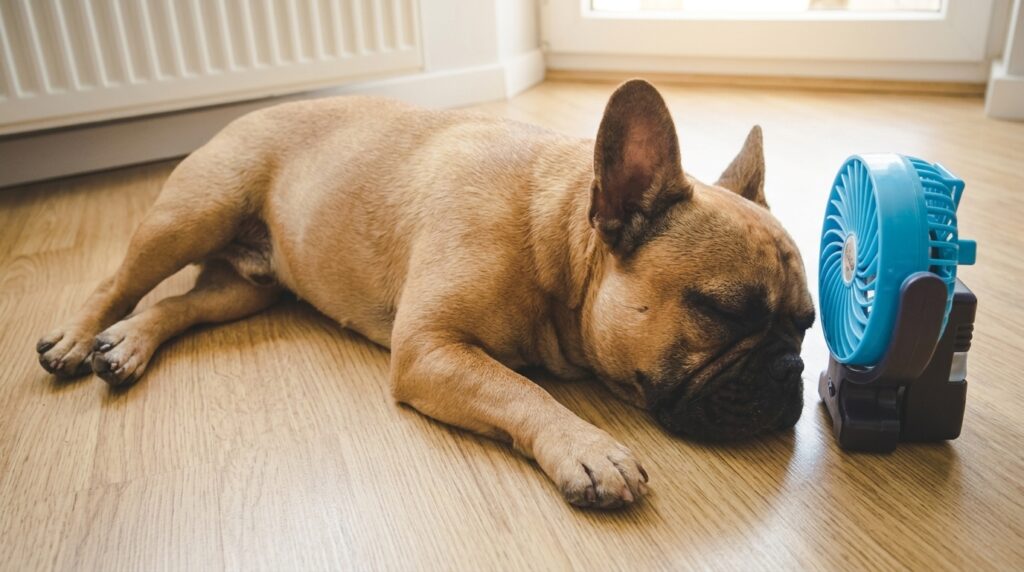
French Bulldog Heat Exhaustion: Early Signs, Causes, and What to Do
French Bulldog Dry Eye: Symptoms, Causes, and Treatment