Written by Jinna CAMERON, veterinary medical student and dog health researcher. Reviewed for factual accuracy against trusted veterinary sources by DVM ,Carla DONTESK
I started this site after losing my own French Bulldog, Pearly, to respiratory complications I didn’t catch in time. So when owners ask me about BOAS surgery, I don’t hear a clinical question. I hear a frightened person trying to decide whether to put their dog through an operation, and whether it will actually help. This guide is written for that person. It pulls together what the veterinary research currently shows about BOAS surgery in French Bulldogs, what the procedure involves, what it tends to cost, and what recovery honestly looks like, so you can walk into your vet’s office already understanding the decision in front of you.
One thing up front, and I’ll repeat it more than once: nothing here replaces an exam by your own veterinarian. I’m a veterinary medical student and a dog-health researcher, not your dog’s surgeon. The goal is to make you a better-informed owner, not to tell you what to do.
What BOAS Surgery Actually Is
Brachycephalic obstructive airway syndrome, or BOAS, isn’t a single problem with a single fix. It’s an airway-obstruction syndrome that comes from the flat-faced shape French Bulldogs are bred for. The short skull packs the same soft tissue as a longer muzzle into a much smaller space, and that crowding raises resistance to airflow. The result is the noisy, effortful breathing, the poor heat tolerance, and the exercise intolerance that so many Frenchie owners recognize.
Because the obstruction usually happens at several points at once, BOAS surgery is typically what surgeons call “multilevel” correction. Rather than one procedure, it’s a set of corrections chosen for your individual dog’s anatomy. The most common components are:
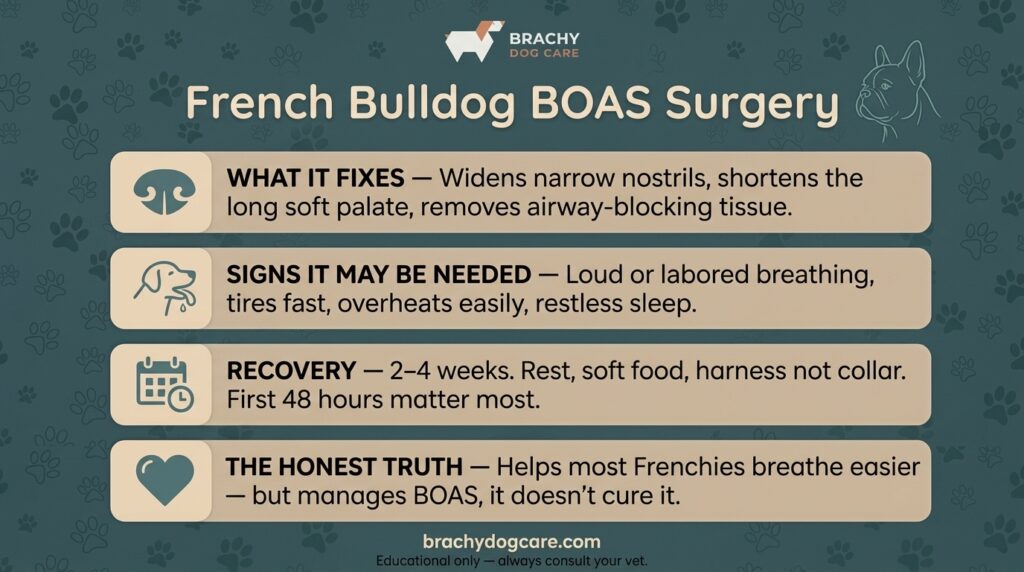
Widening the nostrils. Many French Bulldogs are born with stenotic nares, meaning the nostril openings are pinched too narrow. Opening them up (a procedure sometimes called alarplasty) reduces resistance right at the entrance to the airway, which is often the first place a Frenchie struggles to pull air through.
Shortening the soft palate. In most brachycephalic dogs the soft palate is too long and too thick, so it hangs into the opening of the windpipe and partially blocks it. Trimming and thinning that tissue, historically called soft palate resection or staphylectomy and increasingly performed as a more refined palatoplasty, is one of the central parts of BOAS surgery.
Removing everted laryngeal saccules. In some dogs, small soft-tissue pouches near the voice box get sucked inward over time from the constant strain of trying to breathe against an obstruction. When they contribute to the blockage, they may be removed as part of the same operation.
Addressing the nasal turbinates. In selected cases, surgeons use a laser technique to reduce obstructing tissue deeper inside the nose. This is more specialized and not part of every BOAS surgery, but it reflects how much the field has moved toward treating obstruction at every level it occurs.
The shared logic behind all of these is simple: reduce the obstruction in as many places as it exists, so the cumulative resistance drops and the dog can move air more easily. That’s the promise of BOAS surgery, and it’s a real one. The honest caveat, which the research is clear about, is that even careful multilevel correction reduces the disease burden rather than erasing it. Some anatomical limits sit deeper than surgery can reach, and we’ll come back to that.
How Vets Decide Your French Bulldog Needs Surgery
Not every flat-faced dog needs an operation, and a good surgeon won’t rush one. The decision usually weighs how much the airway is genuinely compromising your dog against the risks of anesthesia and surgery themselves.
The starting point is your dog’s history and signs: how loud the breathing is, whether your Frenchie tires quickly, gags during or after eating, struggles to settle at night, or wilts in even mild heat. Owners are often the worst judges of this, not because they aren’t paying attention, but because the sounds become so familiar they start to feel normal. Research in pugs and French Bulldogs has repeatedly found clinically significant airway disease in a large share of dogs whose owners didn’t think anything was seriously wrong. That’s exactly the trap Pearly and I fell into.
To make the assessment less subjective, vets increasingly lean on structured grading. The most widely used is the functional grading developed by the University of Cambridge BOAS Research Group alongside the Kennel Club, which assesses breathing before and after a short, controlled exercise test. It’s the same scheme now offered to French Bulldog, bulldog, and pug owners through screening programs, and it gives a far more reliable severity grade than a casual “he seems fine.” More specialized tools exist too, including whole-body barometric plethysmography that produces an objective airway-function index, though that equipment is mostly confined to referral and research settings.
There’s also a validated preoperative tool surgeons use to weigh risk specifically, sometimes called a BRisk score. It uses admission details such as breed, body condition, airway status, whether other procedures are being done at the same time, and even the dog’s temperature on arrival, to estimate the chance of a serious complication during the hospital stay. It’s genuinely useful, because it turns “this surgery has risks” into a more concrete conversation about how much risk this particular dog carries. Dogs scoring in the higher range have been shown to be many times more likely to have a difficult outcome, which directly shapes both whether and how BOAS surgery should proceed.
If your dog’s signs are mild and well managed with weight control, heat avoidance, and harness use, your vet may reasonably recommend watching rather than operating. If the obstruction is clearly limiting your Frenchie’s life, BOAS surgery moves up the list. That judgment belongs to a vet who can examine your dog, not to a checklist online.
Does Age Matter? The Timing Question
A question I get constantly is whether it’s better to do BOAS surgery early or wait. The research doesn’t give a single magic age, but it leans toward not waiting too long.
Two findings point that way. First, in studies of surgical outcomes, older age has been associated with a higher chance of needing a temporary tracheostomy after the operation, which is interpreted as a signal that earlier intervention may be smoother. Second, brachycephalic breeds, French Bulldogs very much included, tend to accumulate upper-airway disease earlier in life than other dogs, and French Bulldogs carrying upper respiratory diagnoses have shown notably shortened lifespans in large insured-population data. Taken together, that suggests the obstruction and its downstream damage can start young, and that giving it years to worsen is rarely doing the dog a favor.
What the evidence does not yet provide is a precise window in months, or proof that early BOAS surgery prevents every later complication. So the responsible framing is this: earlier is plausibly better, severe signs shouldn’t be left to drift, but the actual timing is a decision to make with your surgeon based on your dog’s grade, not a deadline to panic about.
What BOAS Surgery Costs for a French Bulldog
Cost is usually the second question, right after “is it safe,” and the honest answer is that it varies a lot. Peer-reviewed studies don’t publish price lists, so the figures below come from veterinary clinics and pet-insurance sources, and they shift by region, clinic, and the severity of your dog’s case.
As a rough orientation, the core combination of widening the nostrils and shortening the soft palate often falls somewhere between $2,500 and $3,500 in the United States. Some clinics price the pieces separately, with soft palate work running around $1,300 to $1,400 and nostril correction in the few-hundred-dollar range, sometimes discounted when bundled. When a dog needs the full set of corrections plus diagnostics, total costs reported in the $3,000 to $5,000 range are not unusual.
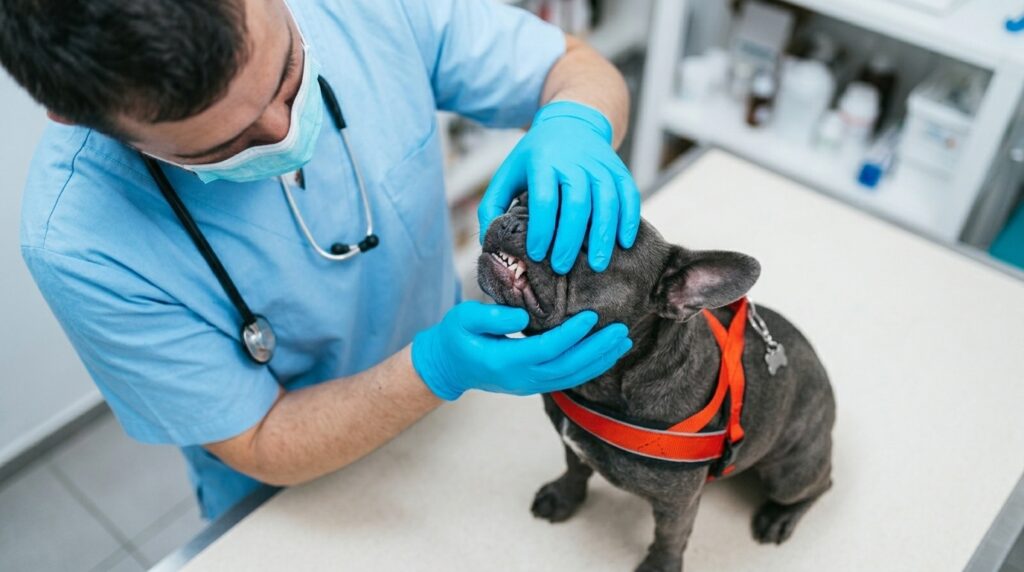
Those headline numbers are only part of the bill. Pre-operative bloodwork and a consultation are typically required to confirm your dog can handle anesthesia safely. Imaging such as a CT scan, increasingly used to map the airway before surgery, adds cost but can meaningfully improve planning. Anesthesia, hospitalization for monitoring, and the medications sent home afterward all add up. The drivers of variation are fairly predictable: how many levels need correcting, how severe and high-risk the dog is, whether advanced imaging is used, and how much postoperative support the case demands. A straightforward young dog and a severe, older one are simply not the same financial picture.
If a clinic quotes you a number far below the typical range, it’s worth asking what’s included, and whether the team is experienced with the particular anesthetic challenges of brachycephalic dogs. Cheaper is not the metric that matters here.
One of the less obvious reasons this surgery matters is its effect on the gut. The same airway pressure that makes breathing hard also drives acid reflux and hiatal hernia, which is why many Frenchies vomit or regurgitate so often. We explain that connection in detail in our guide to French Bulldog vomiting and its causes, including how correcting the airway can ease the stomach too.
The Risk Conversation You Should Actually Have
This is the part owners most want to skip and most need to read. BOAS surgery is generally safe in experienced hands, but it is not risk-free, and brachycephalic dogs are precisely the patients for whom anesthesia carries extra weight.
The reason is the same anatomy you’re trying to fix. A dog that already struggles to keep its airway open is more vulnerable around sedation, intubation, and the swelling that follows any throat surgery. That’s why specialist teams take brachycephalic anesthesia so seriously, with careful pre-operative assessment and close monitoring afterward.
On the numbers, the clearest summary in the literature reports complications in up to roughly a quarter of cases and mortality up to around 5 percent, figures cited in the context of how serious this disease and its treatment can be. That mortality figure frightens people, and it should be taken seriously, but it also deserves context: much of that risk concentrates in the sickest, highest-grade dogs, which is exactly why preoperative risk scoring exists. The same BRisk tool mentioned earlier flags the dogs most likely to need prolonged oxygen or a temporary tracheostomy, letting the surgical team prepare, adjust, and counsel owners honestly rather than be caught off guard.
The practical takeaway isn’t “avoid surgery because it’s dangerous.” It’s “choose an experienced surgical and anesthesia team, get the honest risk grade for your individual dog, and weigh it against what the obstruction is already doing to your Frenchie’s life.” For a severely affected dog, the risk of not operating is its own serious risk.
Recovery: What the First Weeks Really Look Like
Recovery from BOAS surgery is where calm, informed owners make a real difference, because the early healing window is genuinely delicate and most of it happens at home with you.
The first 24 to 48 hours are the most critical. Expect quieter breathing fairly quickly in many dogs, but also expect that swelling can make breathing sound rough or labored at first, and a little blood around the nostrils or mouth in the first day is common as tissues settle. Most surgeons keep dogs in hospital for several hours or overnight to watch for airway swelling, because that’s when a serious problem would show up. Sutures are usually dissolvable, so there’s often nothing to remove later.
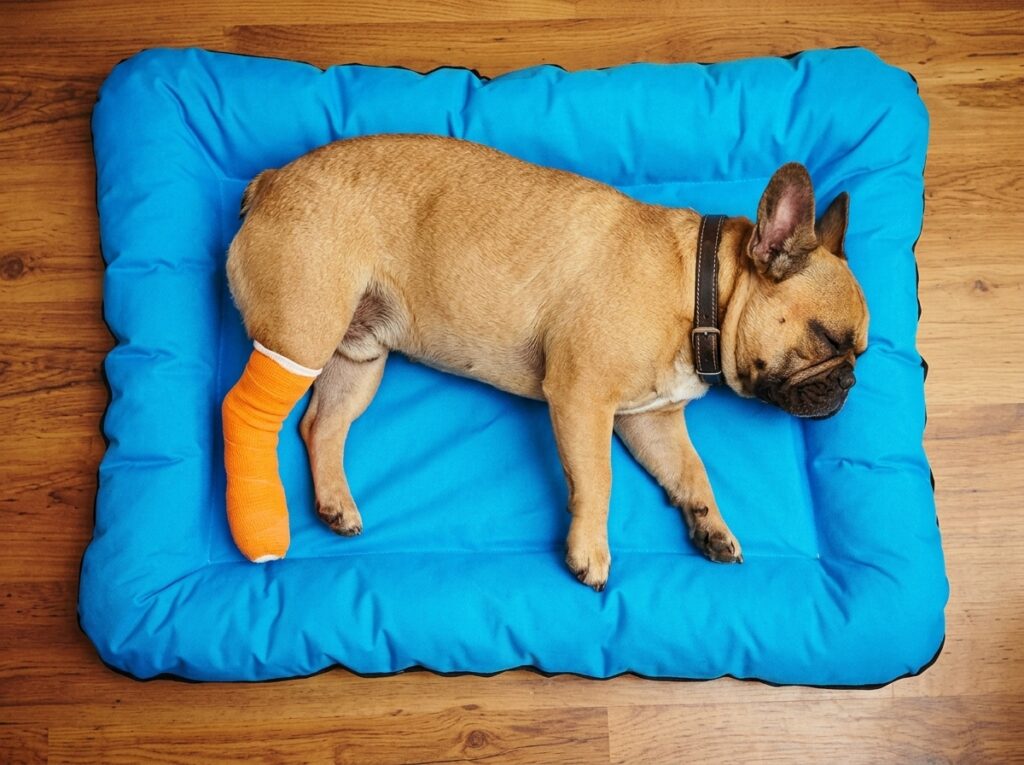
Once home, the plan is consistent across good clinics. Activity is restricted to short, calm leash walks for bathroom breaks for the first one to two weeks, with no running, jumping, or rough play. Meals shift to soft or soaked food in small amounts for the first days to weeks, since hard kibble, chews, and treats can irritate healing tissue in the mouth and throat. A cool, quiet environment matters, because heat puts strain on an airway that’s still recovering. Your vet will usually recheck the dog within a couple of weeks, and a prospective study measuring breathing sound found clear improvement by the ten-to-fourteen-day mark in dogs that had BOAS surgery, so noticeable progress within about two weeks is a realistic expectation for many.
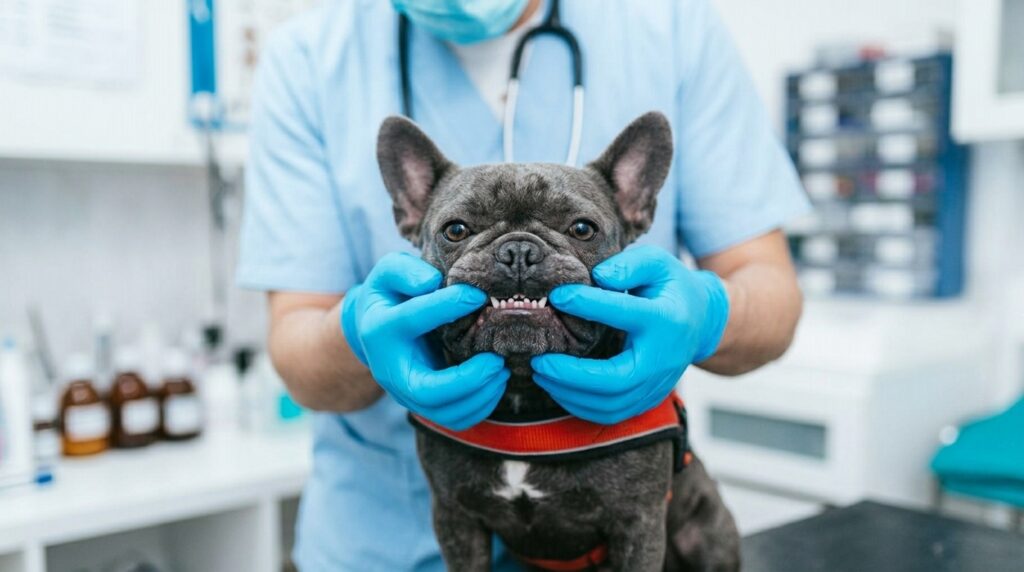
One simple piece of aftercare deserves a spotlight, because it protects the surgery and helps for the rest of your dog’s life: ditch the collar for walks. Anything that presses across the front of the throat works against a windpipe that’s often already narrow in this breed. A properly fitted Y-shaped front harness keeps pressure off the trachea and distributes the load across the chest instead, which is exactly what a recovering, and permanently brachycephalic, airway needs. It’s the kind of small switch I wish I’d made for Pearly far sooner.
Know your red flags. Genuine distress, an inability to settle, persistent or heavy bleeding, or breathing that worsens rather than eases are reasons to call your vet or an emergency clinic right away. Some noise and mild gagging in the first days can be normal; a dog that is frightened and can’t catch its breath is not.
What BOAS Surgery Can and Can’t Fix
Here’s the honesty that separates a trustworthy guide from a sales pitch. BOAS surgery helps most dogs, and helps some dramatically, but it does not turn a French Bulldog into a long-nosed dog with a normal airway.
The research is strikingly consistent on this. Roughly 90 percent of dogs show marked improvement in respiratory function after appropriate surgical treatment, which is a genuinely encouraging number. And yet, even after that appropriate treatment, around 60 percent retain some measurable respiratory compromise. Both things are true at once: most dogs breathe better, and most dogs are still brachycephalic dogs who need lifelong care. Going in expecting improvement rather than a cure is the mindset that prevents disappointment.
There’s a real bright spot for one of the scariest risks Frenchie owners face. In French Bulldogs specifically, BOAS surgery has been associated with a smaller rise in body temperature and a lower heart rate during a standardized treadmill test afterward, meaning better heat handling under exertion. That matters enormously, because brachycephalic dogs are massively overrepresented in heat-related illness, and the obstruction itself sabotages the panting that should cool them. BOAS surgery can improve that picture, but it does not remove the danger, and lifelong attention to overheating signs and heat avoidance stays non-negotiable even for a dog who has had the operation.
Why do some dogs improve less than others? Part of the answer is anatomy that sits beyond what standard surgery addresses. Cambridge research has identified an inward positioning of certain skull bones that narrows the nasopharynx, and in French Bulldogs this has been significantly linked to poor surgical outcomes, with no routine surgical fix currently available for it. Advanced changes like laryngeal collapse, which can develop when an airway is strained for years, also worsen the outlook. This is another argument for not letting severe disease run for ages before acting, and for a CT-based assessment in complex cases so the surgical team can set realistic expectations rather than overpromise.
Insurance and the Bigger Picture
Many owners ask whether pet insurance will cover BOAS surgery, and the truthful answer is that it depends on the insurer and, crucially, on timing. The recurring catch is that BOAS stems from a congenital, breed-related conformation, so a policy taken out after a dog already shows signs may treat it as pre-existing and decline it. Insurance data clearly show BOAS generating a large and rising share of surgical claims, so the procedure is common enough to be on every insurer’s radar, but that’s a population-level fact, not a guarantee about your specific policy. Read the wording, ask directly about congenital and pre-existing exclusions, and do it before signs appear if you possibly can.
It would be dishonest to write a whole guide about fixing this surgically without naming the obvious. BOAS is, at root, a consequence of breeding for an extreme flat face. Research has shown that the syndrome appears strongly when the muzzle is less than about half the length of the skull, which is why veterinary and welfare organizations increasingly advocate breeding toward less extreme conformations. None of that is a reason to love your own Frenchie any less, but it is a reason to support responsible breeders, to take screening schemes seriously, and to push the breed’s future in a healthier direction. BOAS surgery treats the individual dog in front of us. Prevention is what protects the next generation.
The airway is also the single biggest factor in how long these dogs live. Untreated breathing problems are among the leading causes of early death in the breed, which is exactly why recognizing and addressing them matters so much. If you want the bigger picture, our guide to the French Bulldog lifespan explains how airway health, heat, and weight together shape how many years a Frenchie gets, and what you can actually do about it.
For: Overweight French Bulldog
Keeping your Frenchie lean isn’t just about mobility or looks, it’s one of the most direct ways to extend their life. Excess weight worsens breathing, raises heat risk, and strains the heart and joints, all of which feed into the breed’s sobering longevity statistics. We cover exactly how much this matters in our honest guide to how long French Bulldogs live, including why weight is one of the few longevity levers fully within your control.
For: French Bulldog Heat Stroke (or Overheating Signs)
Heat-related illness isn’t just a summer scare, it’s one of the leading causes of early death in this breed, with a frighteningly high fatality rate when it strikes. Understanding that puts heat safety in its proper context. Our guide to the French Bulldog’s life expectancy explains where heat sits among the breed’s biggest longevity risks, alongside the airway and spinal issues, and how owners can meaningfully tip the odds.
Quick placement note: these three are your strongest linkers because the lifespan article is a hub, and each of these older posts represents one of its leading causes of death, so the links reinforce that authority relationship in both directions. Drop each paragraph near the article’s “why this matters” or prevention section rather than the intro, so the link sits where the reader is already thinking about the bigger picture.
The airway is also the single biggest factor in how long these dogs live. Untreated breathing problems are among the leading causes of early death in the breed, which is exactly why recognizing and addressing them matters so much. If you want the bigger picture, our guide to the French Bulldog lifespan explains how airway health, heat, and weight together shape how many years a Frenchie gets, and what you can actually do about it.
Frequently Asked Questions
A Final Word
If you take one thing from this, let it be that BOAS surgery is a serious, often worthwhile decision that deserves a clear-eyed conversation with a veterinarian who knows brachycephalic airways well. For many French Bulldogs it means easier breathing, better heat tolerance, and a fuller life. For all of them it remains part of a bigger commitment to lifelong care, not a one-time cure.
I’m able to write this calmly now, but it grew out of a loss I didn’t see coming in time. If your Frenchie’s breathing has been worrying you, please don’t sit with that worry quietly the way I did. Book the exam, ask about grading, and let a professional tell you where your dog actually stands. That single step is the one I’d give anything to have taken sooner.
This article is educational and is not a substitute for veterinary care. Always consult your own veterinarian about your dog’s health and any decision regarding surgery.
French Bulldog Luxating Patella: Signs, Grades, and Surgery Costs
French Bulldog Hip Dysplasia: Signs, Causes, and What It Really Means
Can French Bulldogs Eat Onions or Garlic? Why Both Are Dangerous
Can French Bulldogs Eat Bananas? How Much Is Safe and How Often
Can French Bulldogs Eat Peanut Butter? Safety, Amounts, and the Xylitol Warning