Written by Jinna CAMERON, veterinary medical student and dog health researcher. Reviewed for factual accuracy against trusted veterinary sources by DVM Carla DONTESK
No. French Bulldogs cannot eat grapes, and neither can any other dog. Grapes and raisins can cause sudden kidney failure, there is no known safe amount, and reactions are unpredictable, so any grape your Frenchie eats should be treated as a potential emergency. If your dog has just eaten one, don’t wait to see how they do. The rest of this page explains why, what the warning signs are, and exactly what to do, but the action steps come first because that’s what matters most.

I run this site after losing my own French Bulldog, Pearly, and I don’t soften safety messages. This is educational, not a substitute for your vet, but on grapes the veterinary position is clear and worth acting on immediately.
If Your Frenchie Just Ate a Grape, Do This Now
Stay calm and move quickly. First, take away any remaining grapes or raisins so no more can be eaten. Then call a professional straight away rather than searching for reassurance while time passes: the ASPCA Animal Poison Control Center at (888) 426-4435, or the Pet Poison Helpline at (855) 764-7661, and your own vet or the nearest emergency clinic.
Do not try to make your dog vomit at home unless a vet or poison line specifically tells you to. Home-induced vomiting carries a real risk of the material being inhaled into the lungs, and that aspiration risk is especially high in flat-faced breeds like French Bulldogs because of their airway anatomy. A vet can induce vomiting far more safely with proper injectable medication and monitoring. Have your dog’s weight, roughly how many grapes were eaten, and the time it happened ready to relay, since that shapes the advice you’ll get.
Why Grapes Are So Dangerous for French Bulldogs
The reason grapes frighten veterinarians is that they attack the kidneys, and they do it unpredictably. Researchers now suspect tartaric acid, a compound dogs can’t process well, as the likely culprit, a hypothesis proposed in veterinary literature in 2022. It fits what vets see clinically, because tartaric acid varies a lot between grape varieties, growing regions, and ripeness, which would explain why the same amount harms one dog and not another. The important thing for owners is that this is still a working theory, and it doesn’t change the advice at all: grapes can cause acute kidney injury, and once that damage takes hold it can be irreversible. So when people ask whether French Bulldogs can eat grapes even occasionally, the honest answer stays a flat no.
This isn’t a breed-specific poison. A French Bulldog’s kidneys aren’t more vulnerable to grapes than any other dog’s. But two things do make grapes a particular worry for this breed. Their small size, typically around 8 to 13 kilograms, means the same handful of grapes delivers a proportionally bigger dose than it would to a large dog. And their brachycephalic airway raises the danger of aspiration during vomiting, which is exactly why home remedies are the wrong move for a Frenchie. Grapes belong firmly among the toxic foods French Bulldogs can’t eat, and they’re one of the most dangerous on that list.
“My Frenchie Ate One Grape, Will They Be OK?”
This is the question owners ask most, and it deserves an honest answer rather than false comfort. The truth is that no one can tell you a single grape is safe, because no safe minimum has ever been established. Toxicity has been reported from very small quantities, while other dogs have eaten more with no apparent effect, and there’s currently no way to predict which dog you have.
So the responsible course, the one every major poison authority takes, is to treat any grape ingestion as a potential emergency and call. That isn’t being dramatic or overcautious; it reflects a genuine gap in what’s known. Because individual sensitivity varies and even the amount of the suspected toxin differs from grape to grape, a single grape genuinely could be a problem for your particular dog. When the downside is kidney failure and the cost of caution is a phone call, the phone call wins every time.
Not all fruit is dangerous, thankfully. Where grapes are a hard no, bananas are a safe yes in moderation, which makes them a much better way to give your Frenchie a sweet, fruity treat. Our companion guide on bananas for French Bulldogs explains the right portion and the simple rules that keep them healthy.
What About Green Grapes, Red Grapes, and Raisins?
There’s no safe version. Red, green, seeded, seedless, organic, and conventionally grown grapes have all been linked to poisoning, so color and type make no difference to the risk. If anything, the tartaric acid theory suggests toxicity can vary even between batches of the same kind of grape, which is another reason not to gamble on one type being safer.
Raisins and currants deserve extra caution, because they’re simply dried, concentrated grapes, which makes them more dangerous per bite. That matters more than people realize, since raisins hide in so many everyday foods, trail mix, cereal, baked goods like cookies and scones, and snack bars. Grape juice and wine count too. If your Frenchie raids something containing raisins, treat it exactly as seriously as fresh grapes.

Signs of Grape Poisoning and How Fast They Appear
Knowing the timeline helps you act, and it also explains why waiting is so risky. Vomiting is usually the earliest sign, often within a couple of hours to six hours of eating grapes, sometimes followed by diarrhea, low energy, loss of appetite, and belly discomfort.
The more serious phase involves the kidneys, and it develops over the following days. Within roughly 12 to 24 hours, a poisoned dog may start producing less urine, and over about 24 to 72 hours acute kidney injury can set in, which can be life-threatening. Later signs include heavy lethargy, ongoing vomiting, dehydration, mouth ulcers, and a distinctive bad breath. As for how long grapes stay in the system, the fruit itself passes through the gut within a day or so, but the kidney damage can outlast it, which is why the first three days are the critical window regardless of how your dog looks early on. An absence of immediate symptoms is not the all-clear.
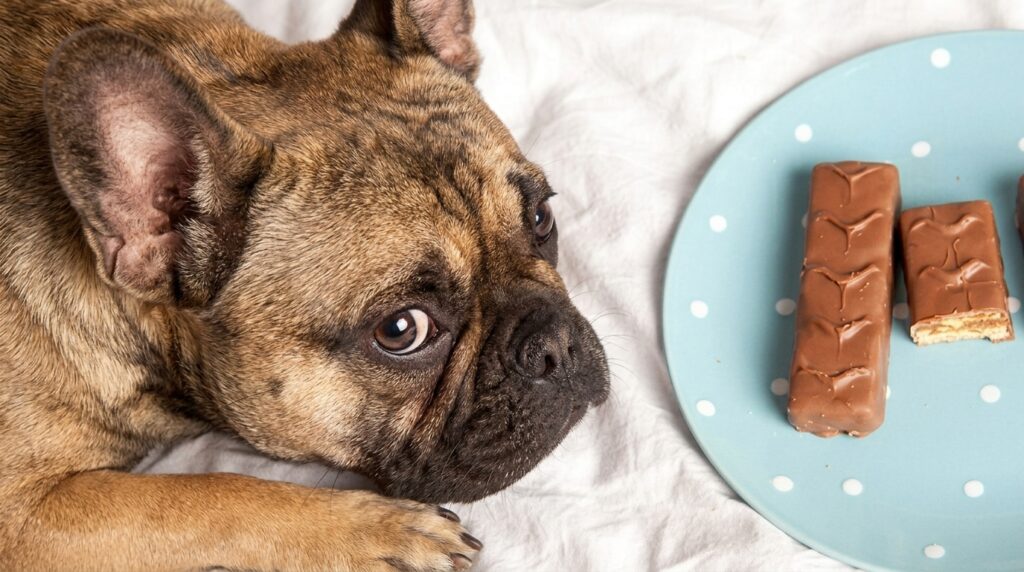
Grapes aren’t the only common treat that’s dangerous for this breed. Chocolate is another of the classic emergencies, and because a Frenchie is small, even modest amounts of the darker kinds can cause real harm. Our companion guide on chocolate and French Bulldogs covers the warning signs, the type-by-type danger, and the emergency steps to take.

What the Vet Will Do
Understanding the treatment can steady your nerves and explains why getting in early matters so much. If your dog is seen soon after eating grapes and is still well, the vet may safely induce vomiting and give activated charcoal to reduce how much is absorbed. The mainstay of care is then aggressive intravenous fluids, usually for two to three days, to protect the kidneys and keep urine flowing.
Alongside that, the team will run blood tests to watch kidney values and monitor urine output closely, adding anti-nausea medication and other supportive care as needed. The prognosis depends heavily on how fast treatment starts and whether kidney injury develops. Dogs whose kidney values stay normal through about 72 hours generally do well, while those who progress to kidney failure face a much harder outlook, which is the whole reason early action saves lives. If vomiting is part of the picture, our guide to French Bulldog vomiting explains how this breed’s anatomy makes bringing food up riskier than in other dogs.
Frequently Asked Questions
The Bottom Line
Grapes and raisins are a clear, avoidable danger, and the safest approach is simple: keep them completely out of your Frenchie’s reach and never offer them as a treat, no matter how much your dog begs. Because there’s no safe amount and reactions are unpredictable, the honest rule is that any grape is worth a phone call.
Having lost a Frenchie myself, I’d rather you make one unnecessary call to poison control than sit and hope after a real ingestion. So the next time you wonder whether French Bulldogs can eat grapes, remember that the safest answer never changes: keep the ASPCA number somewhere you can find it fast, act early rather than waiting to watch, and when your dog gets into grapes, treat it as the emergency it may well be.
This article is educational and is not a substitute for veterinary care. If you suspect your dog has eaten grapes or raisins, contact your veterinarian or an animal poison control center immediately.
While grapes are a clear no, plenty of everyday foods are perfectly safe with the right precautions. Peanut butter is a good example, a genuinely useful treat, as long as it’s free of xylitol and you skip the grape-jelly pairing. Our companion guide on peanut butter for French Bulldogs covers the label check, the right amount, and the best kind to buy.

French Bulldog Luxating Patella: Signs, Grades, and Surgery Costs
French Bulldog Hip Dysplasia: Signs, Causes, and What It Really Means
Can French Bulldogs Eat Onions or Garlic? Why Both Are Dangerous
Can French Bulldogs Eat Bananas? How Much Is Safe and How Often
Can French Bulldogs Eat Peanut Butter? Safety, Amounts, and the Xylitol Warning