Written by Jinna CAMERON, veterinary medical student and dog health researcher. Reviewed for factual accuracy against trusted veterinary sources by DVM ,Carla DONTESK
French Bulldog probiotics are everywhere right now treats, powders, chews, “gut health” blends—but it’s hard to know if they truly help or just add one more variable to your Frenchie’s bowl. Used well, they can support gas, soft stool, and sensitive stomachs. Used badly, they can delay real treatment or just empty your wallet.
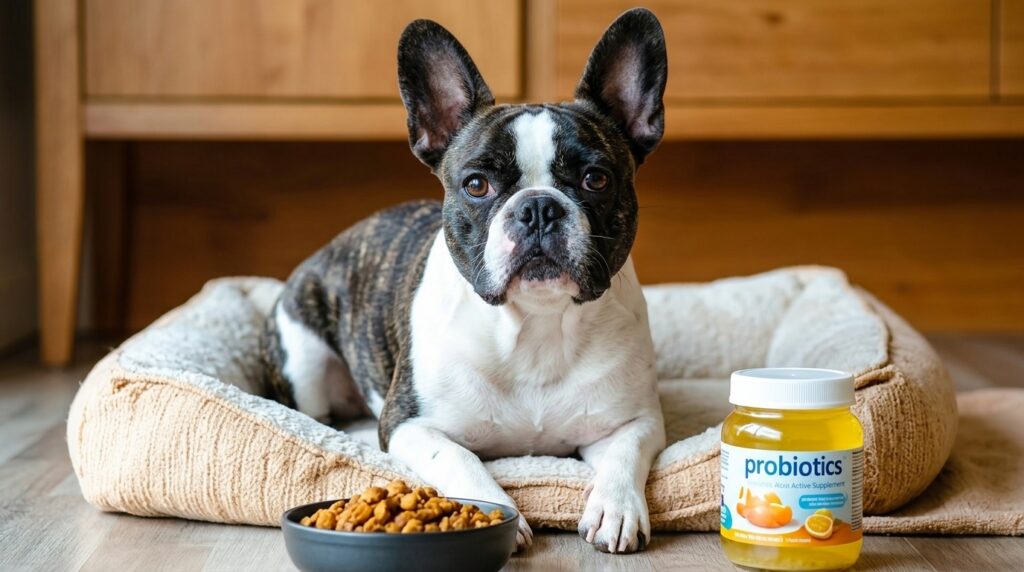
I’m writing this as a veterinary medical student and dog‑health researcher. This guide is educational only. It’s here to help you understand French Bulldog probiotics and make better decisions with your vet, not to diagnose, prescribe, or replace a proper veterinary exam.
Why French Bulldog probiotics are such a big topic
French Bulldogs and sensitive guts almost go together by default. They’re over‑represented in GI disease statistics and show up often in chronic enteropathy and colitis case series. In daily life, that looks like:
- Gas that seems to come out of nowhere
- “Pudding” stool that never quite firms up
- Upset tummies with every food or treat change
At the same time, marketing for French Bulldog probiotics promises everything: fixing gas, curing allergies, boosting immunity, detoxing, even calming anxiety. If you own a Frenchie with gut issues, it’s natural to wonder whether you’re doing something wrong by not adding a probiotic.
The reality is more balanced:
- There is real, strain‑specific evidence that probiotics can help some GI problems in dogs.
- The evidence is strongest for certain types of diarrhea and post‑antibiotic support, and weaker for “fix all gas and allergies” claims.
- For French Bulldogs, probiotics are best viewed as one supportive tool in a bigger plan that includes diet, monitoring, and timely veterinary care.
To use French Bulldog probiotics safely and realistically, it helps to understand what they actually are.
What probiotics and prebiotics are (for dogs)
Probiotics in dog terms
Probiotics are live microorganisms (usually specific bacteria or yeast) that, when given in adequate amounts, can benefit the host. In this case, the host is your Frenchie.
In dogs, probiotics are mainly used to:
- Support a healthier balance of gut bacteria (the microbiome)
- Help the intestines digest and absorb nutrients more effectively
- Modulate immune function at the gut level
Rather than “dumping in some good germs,” think of French Bulldog probiotics as carefully selected strains that can:
- Compete with less helpful or potentially harmful bacteria
- Produce substances that make the gut environment less hospitable for the “wrong” microbes
- Interact with immune cells in the intestinal lining in a way that can calm some types of inflammation
Prebiotics and synbiotics
- Prebiotics are fermentable fibers that feed beneficial gut bacteria, encouraging them to grow and produce useful compounds like short‑chain fatty acids.
- Synbiotics combine probiotics with prebiotics in one product, aiming to both introduce helpful microbes and create a better environment for them to thrive.
For a Frenchie, a synbiotic can, in theory, improve the odds that the probiotic strains survive the stomach, reach the colon, and stay active. But the benefit still depends heavily on the exact strains and fibers used, not just on the word “synbiotic” on a label.
When French Bulldog probiotics can genuinely help
The evidence for probiotics is not all or nothing. It’s stronger in some situations and mostly theoretical in others. Here’s where French Bulldog probiotics are most likely to justify their place in the bowl.
1. Mild acute diarrhea (with vet awareness)
Several controlled studies in dogs with acute diarrhea have tested probiotic products. In some of these trials, dogs given specific canine‑formulated probiotics:
- Had firmer stool sooner
- Vomited less
- Cleared certain “bad” bacteria more quickly than placebo groups
At the same time, modern European guidelines on acute diarrhea in dogs point out that the evidence is moderate and product‑specific. They do not say every dog with diarrhea needs probiotics, or that probiotics can replace standard care. Instead, they frame them as optional, sometimes useful extras.
For French Bulldogs, probiotics in acute diarrhea make the most sense when:
- Diarrhea is mild and short‑term, with an obvious trigger (diet mistake, stress, a one‑off event)
- Your dog is bright, drinking, and not showing red‑flag signs
- A probiotic is used as a short course alongside a simple, appropriate diet
- You have a low threshold for calling your vet if things don’t improve
If the diarrhea is watery, bloody, persistent, or paired with vomiting or lethargy, that’s not the time to “see if French Bulldog probiotics will fix it.” That’s when your French Bulldog Diarrhea: Causes, Treatment, What to Give, and When to Worry article and a real vet exam need to take priority.
2. Chronic soft stool and mild chronic gut issues
In chronic inflammatory enteropathy and similar conditions, some synbiotic and probiotic formulas have shown:
- Improvements in clinical scores in certain dogs
- Shifts in gut bacteria toward a more “balanced” profile
- Changes in inflammatory markers that suggest calmer gut immune activity
However, these studies are relatively few, small, and use specific products under controlled conditions. Results are not consistent across the board, so you can’t assume that any random French Bulldog probiotics chew will have the same effect.
In practice, probiotics may be reasonable in a Frenchie when:
- Soft but formed stool has been present for a while, but your dog is otherwise well
- A vet has examined your dog and ruled out or treated major underlying disease
- Diet has been cleaned up: no constant food/treat switches, high‑quality main food, no ongoing table scrap chaos
- Probiotics are added as one piece of a plan, not as the only intervention
This is exactly the pattern you’re already addressing in French Bulldog Soft Stool: Causes, Food Triggers, and What to Feed. Your French Bulldog Poop Chart: What Healthy, Soft, and Runny Stools Really Mean can help owners see whether stool is moving toward the “ideal” zone when a probiotic is introduced.
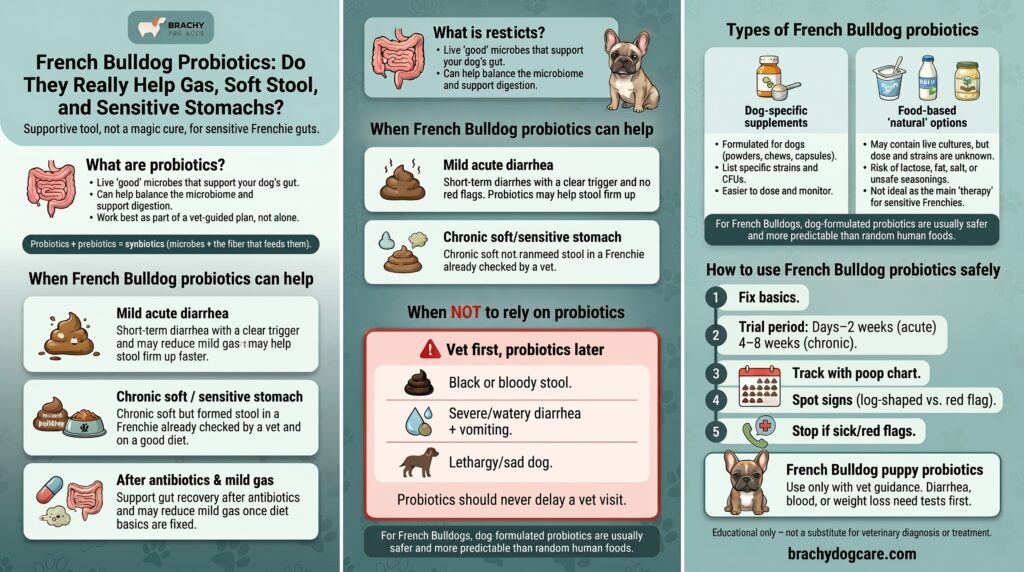
3. After antibiotics
Antibiotics can disrupt normal gut flora by killing helpful species alongside the target pathogens. That’s well recognized in humans and is also a concern in dogs.
While dog‑specific data on antibiotic‑associated diarrhea are less extensive, many vets:
- Use probiotics during or after antibiotic courses
- Aim to support faster microbiome recovery
- Hope to reduce the risk or severity of loose stool related to antibiotics
For a French Bulldog that truly needs antibiotics, veterinarians may suggest French Bulldog probiotics (or other dog‑formulated probiotics) as a reasonable adjunct, especially when the dog has a history of sensitive guts. The key message remains: probiotics support recovery; they don’t justify skipping or stopping necessary antibiotics.
4. Gas and bloating
French Bulldog probiotics are marketed aggressively for gas and “stinky farts.” Direct, controlled studies measuring flatulence are scarce, but we know:
- Probiotics and synbiotics can change which bacterial groups dominate the gut.
- Some bacterial profiles are associated with less gas production than others.
- Owners and brand case reports often report “less gas” on certain products, though those observations are rarely quantified in trials.
In real life, probiotics sometimes seem to help a gassy Frenchie when:
- Diet quality, feeding schedule, and treat habits have already been addressed
- Obvious gas triggers (leftovers, dairy, very fatty snacks) are removed
- There is mild, chronic gas plus soft stool rather than sudden, painful bloating
The non‑supplement side of gas is covered in depth in French Bulldog Gas: Normal Farts, Food Triggers, and When to Worry. If those steps are in place and your vet feels it’s safe, French Bulldog probiotics can be a reasonable “next experiment” for ongoing mild gas.
5. Allergies and itchy Frenchies
The gut and skin are connected through the immune system. Probiotics can:
- Influence immune responses in the intestines
- Affect barrier function
- Modestly change certain inflammatory markers
Some early studies and expert reviews suggest probiotics might have small adjunctive benefits in allergic or itchy dogs. They’re especially considered in plans for chronic allergic disease where the gut is clearly involved.
But for a French Bulldog with allergies, probiotics are:
- A supportive layer, not the main treatment
- Something to consider alongside elimination diets, environmental control, and vet‑guided medications
- Not a replacement for the detailed approach you use in Best Dog Food for French Bulldogs with Allergies: Vet‑Informed Guide and your allergy education resources
When French Bulldog probiotics are not enough (or not appropriate)
A big part of using French Bulldog probiotics safely is knowing where they don’t belong.

Red‑flag signs that need a vet, not more supplements
You should not rely on any probiotic if your Frenchie has:
- Black, tar‑like stool (possible digested blood from higher up in the GI tract)
- Large amounts of bright red blood in stool, or stool that looks mostly like blood
- Very frequent, watery diarrhea lasting more than about 24 hours in adults or 12 hours in puppies
- Repeated vomiting, especially if water or food won’t stay down
- A painful, tight, or swollen abdomen
- Marked lethargy, collapse, or refusal to move
- Rapid weight loss, persistent poor appetite, or obvious muscle loss
In those situations, the most probiotic‑friendly vet in the world will still tell you: this dog needs an exam and diagnostics, not just another powder added to the food.
Dogs and situations where extra caution is wise
Even though probiotics are generally considered safe, certain dogs require more caution:
- Severely immunosuppressed dogs (for example, on high‑dose immunosuppressants or with some cancers)
- Dogs with advanced liver or kidney disease, where any GI upset can destabilize them
- Dogs with severe food allergies, who may react to flavorings or protein carriers in probiotic products
- French Bulldog puppies with significant diarrhea, blood in stool, or systemic signs, where probiotics might distract from urgently needed tests and treatment
In these cases, probiotics might still be used, but only as a vet‑designed adjunct—never as the main plan.
Types of French Bulldog probiotics: supplement vs “natural”
Not all probiotics are the same. For a French Bulldog, the source and formulation matter a lot.
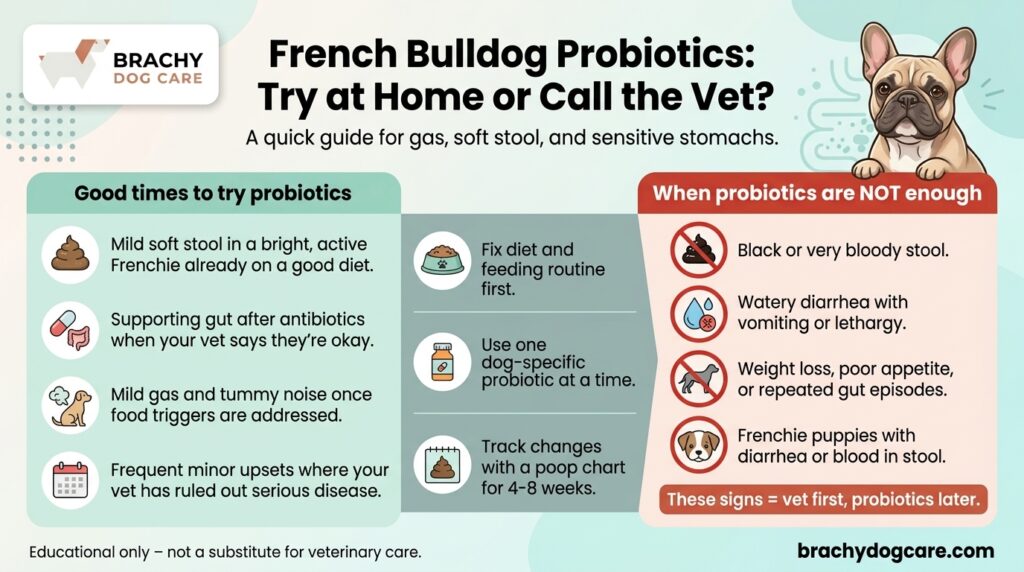
Dog‑specific probiotic supplements
These products are designed for dogs and usually list:
- One or more Lactobacillus species (e.g., L. acidophilus, L. rhamnosus, L. plantarum)
- One or more Bifidobacterium species (e.g., B. animalis)
- Sometimes Enterococcus faecium
- Sometimes a probiotic yeast like Saccharomyces boulardii
They typically deliver billions of CFUs per dose and come as powders, capsules, chews, or flavored pastes. When choosing, vets often look for:
- Clearly identified strains (not just “Lactobacillus species”)
- Plausible CFU numbers for dogs
- Evidence of quality control and stability (viable counts near expiry, temperature storage guidance)
- A track record in dogs or at least in veterinary use, not just human supplements repackaged with a dog on the label
For most French Bulldogs, these dog‑specific probiotics are a safer, more controlled option than improvising with human products or random foods.
Food‑based or “natural” probiotic sources
Common examples owners ask about:
- Plain yogurt
- Kefir
- Fermented goat’s milk
- Sauerkraut or other fermented vegetables
Potential upsides:
- May contain live lactic acid bacteria and beneficial fermentation products
- In tiny amounts, some healthy dogs tolerate plain yogurt or kefir without issues
But there are several important downsides, especially for a Frenchie:
- Many adult dogs don’t digest lactose well; dairy can worsen gas and soft stool.
- Some fermented dairy products are quite high in fat, which can be dangerous for pancreatitis‑prone dogs.
- Human sauerkraut and fermented vegetables often contain onion, garlic, spices, or a lot of salt—none of which are appropriate for dogs.
- You have no idea which strains or how many microbes are actually present, so you can’t connect effects to any research.
Because of these issues, most veterinary sources prefer dog‑formulated probiotics over relying on human fermented foods for therapeutic use in dogs, especially in breeds like French Bulldogs that already have fragile guts. A good, vet‑reviewed overview of canine probiotics compatible with this approach is Cornell’s article on the power of probiotics, which frames probiotics as useful but not miracle cures.
How to tell if your Frenchie might benefit from probiotics
There’s no single sign that says “your dog needs probiotics now.” But vets often consider probiotics for dogs showing patterns like:
- Mild, chronic soft stool without other warning signs
- Frequent minor GI upsets after stress, boarding, or small diet slips
- A history of looser stool during or after antibiotic courses
- Mild gas and digestive discomfort after food changes, once diet quality is solid
In a Frenchie, French Bulldog probiotics might be reasonable when:
- Your vet has examined the dog and doesn’t see red flags needing immediate deeper tests
- Food, feeding schedule, and treat habits are under control
- You’re ready to treat probiotics as a trial, not as a guarantee
If you’re unsure whether your situation is mild or more serious, your own French Bulldog Poop Chart is a helpful visual filter before you touch any supplement: it helps you quickly see whether stool changes sit in a “green,” “yellow,” or “red” zone.
French Bulldog probiotics for puppies
Puppies are not miniature adults. They’re more vulnerable to infections, parasites, and dehydration—and French Bulldog puppies are all of that plus breed‑specific risks.
When probiotics might be reasonable for a Frenchie puppy
- Slightly soft stool during diet transition, when the puppy is otherwise bright and gaining weight
- Mild GI upset after a known event (for example, deworming or a small diet mistake) where your vet is aware and monitoring
- As part of recovery after a diagnosed, treated gut infection, if your vet recommends probiotics as an adjunct
When diagnostics beat probiotics every time
Any French Bulldog puppy with:
- Repeated or watery diarrhea
- Blood in the stool (red or black)
- Poor appetite or weight loss
- Vomiting, lethargy, or fever
needs proper testing—fecal exams, parvo testing, diet review, and more—not just probiotics added to the bowl. French Bulldog probiotics, even good ones, must not “stand in” for a diagnostic work‑up in a sick puppy.
Some Frenchie‑focused products suggest not using probiotics in very young puppies unless a vet approves. That caution makes sense: in puppies, cause comes first, supplements come later.
How to introduce French Bulldog probiotics safely
If you and your vet decide French Bulldog probiotics are worth trying, treating them like a structured experiment is far better than tossing them in and hoping.
Step 1: Stabilize the foundations
Probiotics work best when the basics are in place:
- A consistent, high‑quality base diet that suits your dog’s needs
- No constant rotating of foods and treats
- Strict limits on table scraps and rich leftovers
- Gas, diarrhea, or chronic soft stool already being addressed using the principles in your gas, diarrhea, soft‑stool, and sensitive‑stomach articles
Step 2: Choose one dog‑specific product
- Pick a dog‑formulated probiotic with clearly named strains and realistic CFU counts.
- Avoid combining multiple probiotic products at once; start with one so you can interpret any changes.
- Follow the dosing instructions (often once or twice daily) and give with food unless your vet advises otherwise.

Step 3: Decide on a trial length and what you’ll watch
- For mild acute issues or post‑antibiotic use, a shorter trial—several days to a couple of weeks—is typical.
- For chronic, mild soft stool or sensitive stomach, an initial 4–8 week trial is more realistic to see whether French Bulldog probiotics are helping.
Track:
- Stool consistency and shape using your French Bulldog Poop Chart.
- Frequency (more or fewer stools per day, any new accidents, more urgency).
- Comfort (less straining, less obvious discomfort after meals).
- Any non‑GI changes, like itch or general energy, while remembering probiotics are only one variable.
If stool worsens, new diarrhea appears, or your Frenchie seems unwell, stop the probiotic and call your vet.
Step 4: Avoid constant switching and stacking
Changing French Bulldog probiotics every few days, or stacking multiple products at once, makes it impossible to know what is doing what. It may also cause as much disturbance as it solves.
A better approach:
- Use one probiotic for a defined period, unless your dog clearly cannot tolerate it.
- Evaluate based on consistent tracking, then decide with your vet whether to continue, stop, or try a different approach (diet change, diagnostics, different supplement).
Prebiotics, synbiotics, and “gut support” blends
Many products marketed to French Bulldog owners are more than just probiotics. They may contain:
- Prebiotic fibers (like inulin or certain oligosaccharides)
- Digestive enzymes
- Herbs or other compounds aimed at calming the gut
Synbitotics (probiotic + prebiotic) have shown in studies that they can:
- Shift the microbiome toward more beneficial bacterial groups
- Increase helpful metabolites
- Influence local immune markers in the gut
For a Frenchie, that means:
- Synbiotics can be a sensible choice for mild chronic gut issues, especially when your vet is involved.
- They should still be seen as part of a combined plan (diet, monitoring, possibly medications), not as a standalone cure.
“Gut support” blends that add many extra ingredients (enzymes, herbs, multiple fibers) may help some dogs but also complicate things if your Frenchie reacts poorly. Starting simple and escalating only with a vet’s input is usually safer.
Common myths about French Bulldog probiotics
It’s easy to over‑sell probiotics, especially for a breed as tricky as the French Bulldog. Some myths to watch out for:
- “If I find the right probiotic, it will fix all my Frenchie’s stomach problems.”
No single product replaces a sound diet, realistic expectations, and vet diagnostics when poop or behavior says something is wrong.- “Probiotics can cure allergies and all itchy skin problems.”
They may have small supportive effects in some allergy patterns, but they won’t replace allergy testing, elimination diets, or medications where those are needed.- “If I keep changing probiotics, I don’t need to do tests.”
In a high‑risk breed like the French Bulldog, chronic diarrhea, unexplained weight loss, or persistent soft stool plus other signs should push you toward diagnostic work‑ups, not endless supplement experiments.- “Natural fermented foods are automatically better and safer.”
Uncontrolled fermented foods can introduce extra fat, lactose, salt, or unsafe ingredients. For Frenchies, the risk of making things worse often outweighs any theoretical probiotic benefit from those foods.
A calm, realistic way to think about French Bulldog probiotics
When you strip away the hype, French Bulldog probiotics are:
- Useful in certain situations: mild acute diarrhea, post‑antibiotic support, mild chronic soft stool, and as a small part of an allergy or sensitive‑stomach plan.
- Evidence‑supported but not miracle‑level: stronger for some types of diarrhea and microbiome support, weaker for gas and allergies, and very weak for “cure everything” claims.
- Best used as a structured trial, on top of solid food choices, careful stool tracking, and timely veterinary input.
Used that way, probiotics are not a waste—and they’re not magic. They are one more tool you can deploy thoughtfully, guided by what your Frenchie’s poop, comfort, and overall health are telling you, rather than by marketing promises alone.
French Bulldog Cost in 2026: Price, Vet Bills, and the True Lifetime Cost
French Bulldog Temperament: Personality, and Are They Good Family Dogs?

Best Dog Toothpaste for French Bulldogs: A Vet-Guided Guide
Do French Bulldogs Shed? Coat, Grooming, and When to Worry

Why Your French Bulldog Chews Everything (and How to Stop It)