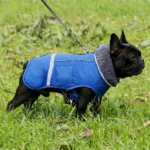
Written by Jinna CAMERON, veterinary medical student and dog health researcher. Reviewed for factual accuracy against trusted veterinary sources by DVM Carla DONTESK
If you’ve searched this because your Frenchie is limping, struggling to get up, or sitting with a leg splayed out, I want to give you something more useful than a generic list of symptoms. French Bulldog hip dysplasia is real, it’s more common in this breed than most people realize, and yet it’s frequently not the thing actually causing your dog’s discomfort. Both of those statements are true at once, and understanding why will make you a far better advocate at the vet’s office.
I run this site after losing my own French Bulldog, Pearly, and one lesson that stuck with me is how easily the obvious explanation becomes the assumed one. With back-leg problems in this breed, the obvious answer is often the wrong answer. I’m a veterinary medical student and dog-health researcher, not a licensed veterinarian, so nothing here replaces a proper examination. But this is a topic where a little knowledge genuinely changes the questions you ask.
Do French Bulldogs Get Hip Dysplasia?
Yes, and the numbers surprise almost everyone. Hip dysplasia is usually filed under “large breed problem,” something you worry about with German Shepherds and Labradors rather than a compact dog that fits on your lap. The screening data tells a different story.
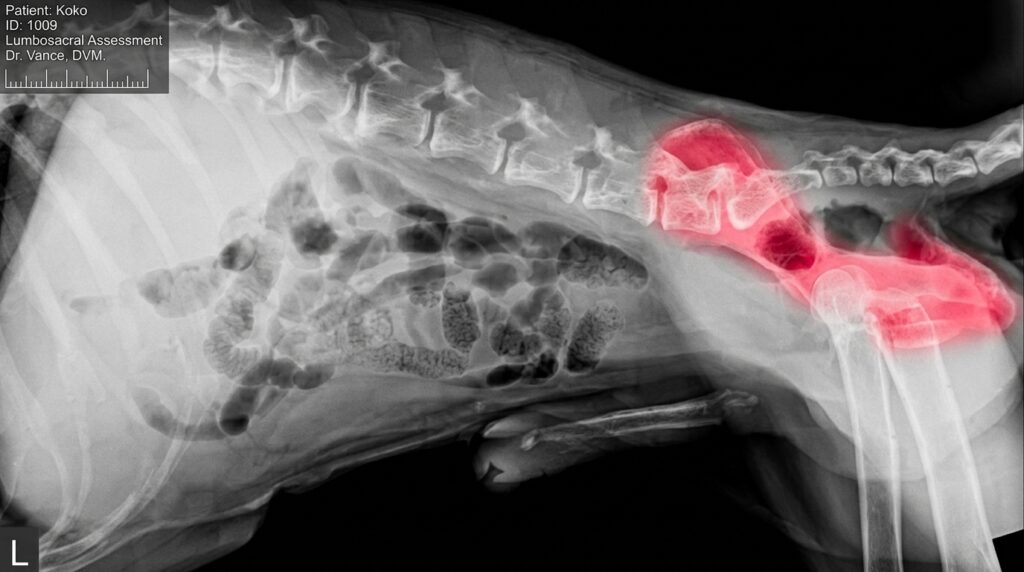
Records from the Orthopedic Foundation for Animals, which maintains the largest canine health database in the world, consistently place flat-faced small breeds at the very top of the hip dysplasia rankings, and French Bulldog hip dysplasia belongs in that conversation. Bulldogs come in around 73.9 percent and Pugs around 63 percent, higher than St. Bernards, higher than mastiffs, higher than the giant breeds everyone associates with the condition. The reason isn’t size at all, it’s conformation. The same selective breeding that produced the compact, wide-set, short-legged brachycephalic build also produced hips that frequently don’t form the way they should. French Bulldogs share that body plan, and French Bulldog hip dysplasia rates reflect it.
One honest caveat before you panic at those percentages. Screening figures come from X-rays that owners and breeders voluntarily submit, which means dogs are more likely to be imaged when someone already suspects a problem. The true rate across the whole population is probably lower than the headline number suggests. What the data does establish beyond doubt is that French Bulldog hip dysplasia is a genuine breed concern rather than a fringe worry.
What Hip Dysplasia Actually Is
To understand French Bulldog hip dysplasia, it helps to picture the joint itself. The hip is a ball-and-socket joint. The ball at the top of the thigh bone should sit snugly in a well-formed socket in the pelvis, held stable while the dog walks, runs, and jumps. In a dysplastic hip, that fit is wrong. The socket may be too shallow, the ball may not seat properly, and the joint is loose, what vets call laxity.
That looseness is the root of everything that follows. A joint that shifts and grinds rather than gliding smoothly wears abnormally, and over time that wear can produce arthritis and pain. French Bulldog hip dysplasia is largely hereditary, which is why responsible breeders screen for it, though weight and growth play a role in how badly it develops. In dogs generally, it’s the single most common cause of hind-limb lameness and rear-end pain, which is exactly why it gets blamed so readily.
The Twist: Common on X-Ray, Often Not the Problem
Here’s the part almost no owner-facing article explains, and it’s the most useful thing on this page.
In bulldog-type breeds, French Bulldog hip dysplasia frequently turns up on X-rays taken for an entirely unrelated reason. The dog came in for something else, the vet imaged the pelvis, and there it is, a dysplastic hip in a dog that has never limped a day in its life. Veterinary specialists who work extensively with bulldogs caution that the assumption that French Bulldog hip dysplasia always produces the severe pain and crippling arthritis seen in large breeds may simply not be accurate. Bulldogs also don’t reliably show pain the way owners, or even some veterinarians, expect them to.
That has a real consequence. If your Frenchie is limping and an X-ray shows dysplastic hips, it’s tempting for everyone to stop there. But those specialists make a pointed observation: the clinical signs that look like hip problems in most breeds are often caused by knee problems in bulldogs. A dysplastic hip on film doesn’t prove the hip is what hurts. Diagnosing French Bulldog hip dysplasia and diagnosing the source of your dog’s pain are two different jobs, and conflating them can send you down the wrong treatment path entirely.
None of this means you should dismiss a French Bulldog hip dysplasia finding. It means you should treat it as one piece of evidence rather than a verdict, and expect your vet to rule out the alternatives before committing to a plan.
Signs of Hip Dysplasia in French Bulldogs
If the hips genuinely are the problem, the signs of French Bulldog hip dysplasia follow patterns worth knowing, and a couple are wonderfully specific to how these dogs compensate.
The everyday signs are the ones you’d expect: difficulty standing up or jumping, particularly after a nap or a long rest; limping or favoring one back leg, even on short walks; a reluctance to climb stairs or hop onto the sofa; and a general drop in activity, where play just isn’t as appealing as it used to be. Some dogs develop an odd, hopping gait using both back legs together, often called bunny hopping.
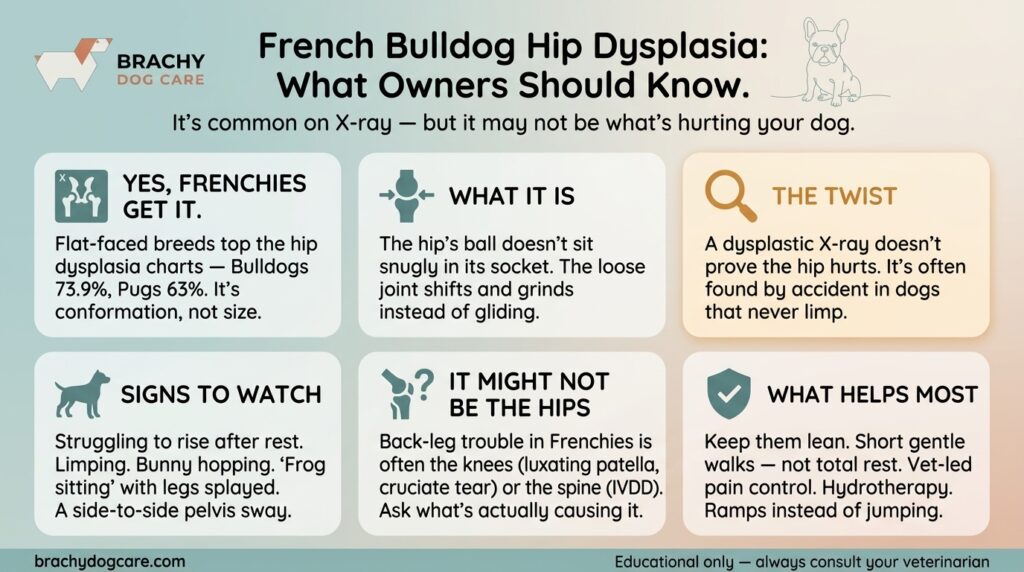
Then there are the two tells that make experienced eyes sit up. The first is frog sitting, where your dog sits with one or both hind legs splayed out to the side rather than tucked underneath. The second is a distinctive side-to-side pelvis motion when walking, sometimes described as an exotic belly-dancer movement. Both are your dog unconsciously working around a loose hip joint, and both are worth mentioning to your vet if you notice them.
A word of caution on interpreting these. Frog sitting in particular is common in Frenchies, including plenty of perfectly healthy ones, so seeing it once doesn’t mean your dog has a problem. It’s the pattern, the persistence, and the company it keeps that matter, especially when paired with stiffness after rest or a genuine drop in what your dog is willing to do.
It Might Not Be the Hips: Knees and the Spine
This is where the article earns its keep, because in this breed there are two very common alternative explanations for exactly the symptoms that get blamed on French Bulldog hip dysplasia.
The first is the knee. Medial patellar luxation, where the kneecap slips out of its groove, and cranial cruciate ligament tears, the dog equivalent of a torn ACL, are both prevalent in bulldog-type breeds and both produce hind-limb lameness. When a bulldog suddenly won’t put weight on a back leg, specialists specifically flag these as prime suspects. They need different treatment from hip disease, so getting this wrong costs your dog time and comfort.

The second is the spine, and this one is enormous in French Bulldogs. The peer-reviewed evidence here is far stronger than anything on hips. French Bulldogs carry roughly three times the odds of spinal cord disorders compared with other dogs. In a large referral study of Frenchies presenting with neurological signs, intervertebral disc herniation accounted for 45.5 percent of all definitive diagnoses, more than double its share in the general dog population. The breed is also built with congenital vertebral quirks: one study found that 93.5 percent of neurologically normal Frenchies had at least one thoracic hemivertebra. Spinal disease is, quite simply, the dominant mobility problem in this breed, and our guide to French Bulldog IVDD covers the warning signs every owner should know.
The practical takeaway is a question rather than an answer. If your Frenchie has back-leg trouble, the right thing to ask your vet is not “is it hip dysplasia?” but “what exactly is causing this?” Sudden hind-leg weakness or dragging, in particular, is a spinal red flag and an emergency, not something to manage at home with rest and supplements.
How Hip Dysplasia Is Diagnosed
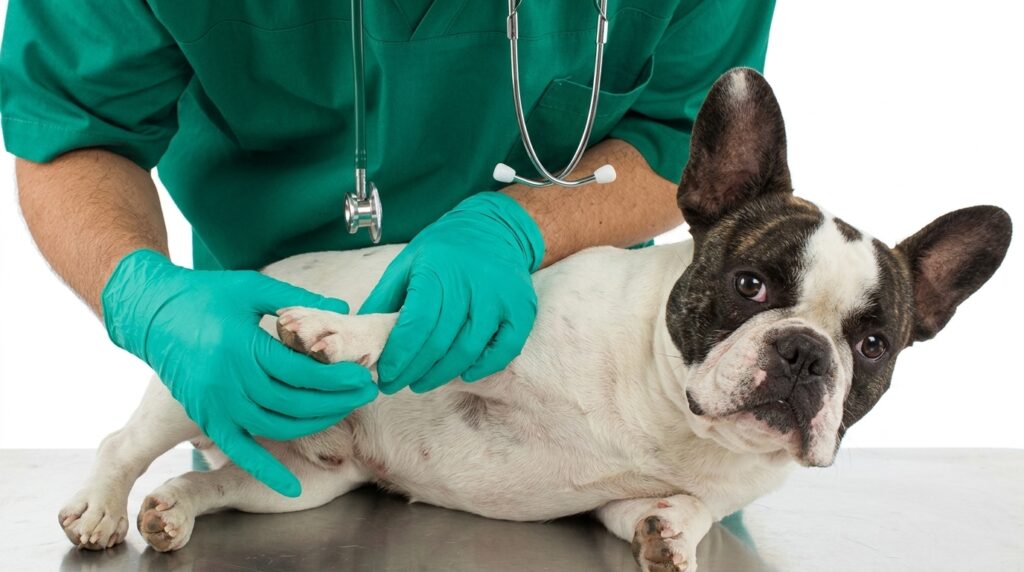
Diagnosing French Bulldog hip dysplasia starts with your hands and your vet’s. A physical exam checks for pain, restricted range of motion, and joint laxity, and a good history from you, when it happens, what it looks like, whether rest helps, is genuinely valuable evidence.
Imaging confirms it. There are two established radiographic standards. The OFA method uses a single extended-hip view and grades the joint on a seven-point scale from excellent down to severely dysplastic, assessing the state of the hip as it is now. PennHIP takes a different approach, measuring joint laxity as a distraction index; a lower number means a tighter joint, and an index near 0.30 is associated with low risk of developing arthritis. PennHIP can flag laxity early, before arthritis has appeared, which makes it useful for breeding decisions and for spotting French Bulldog hip dysplasia in young dogs.
Given everything above, the most important part of the workup is often what else gets examined. A thorough vet won’t just image the hips and call it done; they’ll assess the knees and, if the signs suggest it, look at the spine. That’s the difference between finding French Bulldog hip dysplasia and finding out what’s actually wrong with your dog.
Managing Hip Dysplasia Without Surgery
For mild to moderate French Bulldog hip dysplasia, and for many Frenchies whose dysplastic hips cause only modest trouble, conservative management does most of the work. This is where owners have real influence.
Weight is the single biggest lever you control. Every extra pound of body weight is extra load through an already unstable joint, and for a breed that gains weight easily, this matters enormously. Keeping your Frenchie lean is the highest-value thing you can do about French Bulldog hip dysplasia, and our guide to the overweight French Bulldog walks through how to do it safely for a dog that can’t exercise hard.
Exercise is where most owners managing French Bulldog hip dysplasia get it backwards. The instinct when a dog is sore is to rest it completely, but that’s counterproductive. The muscle around the hip is what stabilizes the joint, and muscle wastes without use. The better approach is short, gentle, regular activity, a couple of easy walks a day rather than either a weekend sprint or total confinement. Consistency beats intensity, and for a brachycephalic dog you’re keeping sessions short and cool anyway, which fits this pattern nicely. If your Frenchie tires unusually fast on those walks, it’s worth reading about exercise intolerance, since breathing and mobility problems often travel together in this breed.
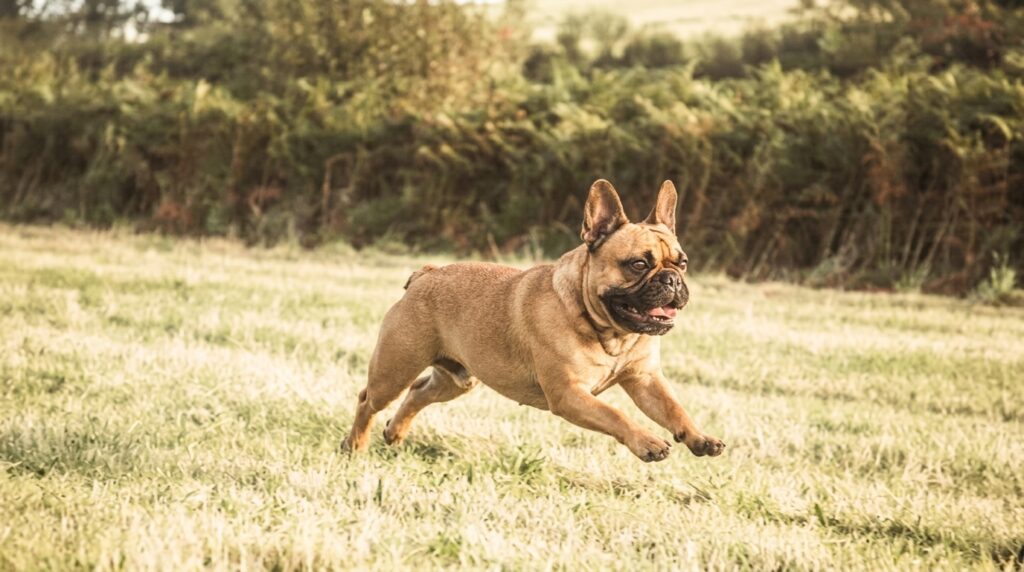
Pain management should be multimodal and vet-directed. Anti-inflammatories, gabapentin, omega-3 fatty acids, acupuncture, and hydrotherapy all have evidence behind them, and hydrotherapy is particularly elegant for this problem because it builds muscle without loading the joint. Physical therapy tailored to your dog can help too. All of these are prescriptions or professional services, so they belong in a conversation with your vet rather than a guess from the internet.
Joint supplements sit alongside all of this as a supporting player rather than a cure for French Bulldog hip dysplasia. Glucosamine, chondroitin, and omega-3s are commonly recommended as part of long-term joint care, and a daily joint supplement formulated for small breeds is an easy thing to add to a Frenchie’s routine. Be realistic about what they do: they support joint health over time and may modestly improve comfort, but they won’t reverse a malformed joint, and they’re no substitute for weight control or veterinary pain management.
This is worth expanding on, because the knees are the alternative that gets missed most often. A luxating patella, where the kneecap slips out of its groove, produces a distinctive skip that owners frequently mistake for a hip problem, and it’s common in small breeds like this one. If your Frenchie’s back leg trouble comes and goes rather than lingering, our guide to the French Bulldog luxating patella explains the four grades, the signs, and what treatment costs.
Surgical Options
When conservative care isn’t enough to manage French Bulldog hip dysplasia, surgery becomes a conversation. It’s a decision for your vet and, usually, an orthopedic specialist, based on your individual dog rather than a scan alone.
In very young dogs diagnosed before symptoms appear, juvenile pubic symphysiodesis is a preventive procedure that alters how the pelvis grows to improve hip coverage as the dog matures. Its window is narrow, only useful in puppies, which is one reason early screening has value. For older dogs with established disease, femoral head ostectomy removes the head of the thigh bone so the body forms a false joint of scar tissue, an option that often works well in smaller, lighter dogs precisely because they don’t have great weight to carry. Total hip replacement, replacing the joint with an implant, is the most involved option and is generally reserved for severe cases.
Two honest notes. Surgery for French Bulldog hip dysplasia is far less automatic than in large dogs with painful dysplastic hips, both because the clinical picture is often milder and because you want to be very sure the hip is genuinely the pain source first. And anesthesia carries extra weight for a brachycephalic dog, so any elective orthopedic procedure deserves a frank conversation about airway risk alongside the orthopedic benefit.
Can You Prevent It?
Partly, and honestly the biggest levers sit upstream of you.
French Bulldog hip dysplasia is largely inherited, which makes breeding the most powerful intervention. Reputable breeders screen breeding pairs with OFA or PennHIP evaluations and select away from affected dogs. If you’re buying a puppy, asking to see hip screening results for both parents is a reasonable, ordinary request, and a breeder who bristles at it is telling you something.
Once your dog is home, what you control is the environment the joints grow and live in, and that shapes how much French Bulldog hip dysplasia ever troubles them. Keep your Frenchie at a healthy weight from puppyhood, since excess weight during growth is genuinely harmful to developing joints. Feed a good, balanced diet appropriate to their life stage. Avoid encouraging repetitive high-impact jumping, particularly off furniture, which is worth doing for the spine anyway in a breed this prone to disc disease. Ramps and steps for the sofa are a small change that pays off over years.
A few other adjustments at home are worth the minor effort. Slippery floors are harder on an unstable joint than most people realize, because a dog scrabbling for grip on laminate or tile is bracing and twisting in exactly the way a loose hip doesn’t like; a few runners or rugs along your dog’s usual routes make a genuine difference. A supportive, properly cushioned bed helps a sore dog rest without pressure points, and keeping nails trimmed matters more than it sounds, since overgrown nails change how a dog loads its feet and legs. None of these are dramatic interventions. They’re the sort of small, boring adjustments that quietly protect a joint over a decade rather than a week, and together they let your dog stay comfortable and mobile with far less intervention later on.
Supplements come up constantly in conversations about managing dysplastic hips, but they’re one of the most oversold corners of dog health, and the ingredient most owners reach for isn’t the one with the best evidence. If you’re considering adding one to your dog’s routine, our evidence-first guide to joint supplements for French Bulldogs breaks down what actually works, what’s mostly marketing, and when to start.
Frequently Asked Questions
The Bottom Line
French Bulldog hip dysplasia is a real breed concern that deserves your attention and not your panic. These dogs are dysplastic on X-ray at surprisingly high rates, but a dysplastic hip is not automatically a painful hip, and back-leg trouble in a Frenchie has other, often more likely explanations, particularly the knees and the spine.
So the useful posture is neither dismissal nor alarm. If your dog is struggling, get a proper diagnosis rather than an assumed one, and expect the workup to look beyond the pelvis. If dysplasia is confirmed and it is genuinely the culprit, take heart: weight management, sensible daily movement, and good pain control do a great deal of work, and most dogs live comfortable, happy lives.
Having lost a Frenchie myself, I’ve learned that the questions you ask matter as much as the answers you get. Ask what’s actually causing the limp. Keep your dog lean. Keep them moving gently. That’s most of the battle with this breed’s joints, and it’s almost entirely in your hands.
This article is educational and is not a substitute for veterinary care. If your dog is limping, in pain, or suddenly weak in the back legs, contact your veterinarian promptly, as sudden hind-limb weakness can be a spinal emergency.

Joint Supplements for French Bulldogs: What Actually Works
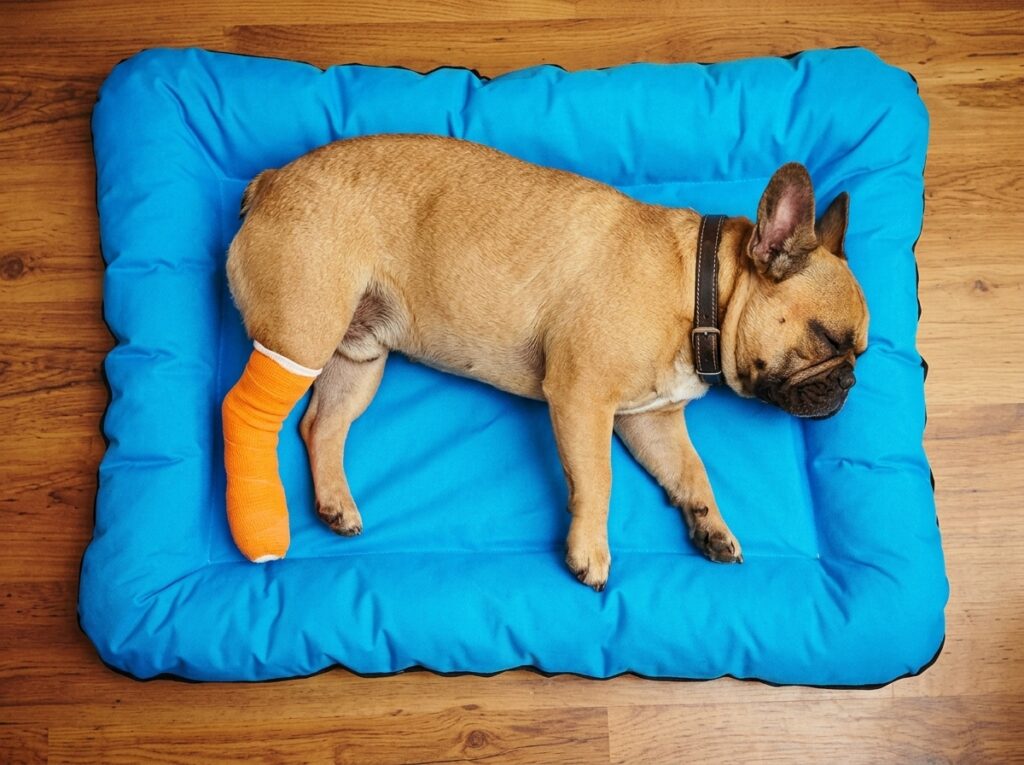
French Bulldog Luxating Patella: Signs, Grades, and Surgery Costs
French Bulldog Hip Dysplasia: Signs, Causes, and What It Really Means

Can French Bulldogs Eat Onions or Garlic? Why Both Are Dangerous

Can French Bulldogs Eat Bananas? How Much Is Safe and How Often