Written by Jinna CAMERON, veterinary medical student and dog health researcher. Reviewed for factual accuracy against trusted veterinary sources by DVM Carla DONTESK
Of all the health topics that get overlooked in this breed, dental care might be the most quietly important. It isn’t dramatic like a breathing crisis or frightening like a poisoning, so dental care slides down the priority list, and yet dental disease is one of the most common health problems dogs face, and French Bulldogs are built to get it worse than most. Good French Bulldog dental care isn’t about a pretty smile. It’s about preventing a painful, progressive disease that can quietly affect your dog’s whole body.
I run this site after losing my own French Bulldog, Pearly, and one thing I wish I’d taken more seriously earlier is how much a Frenchie’s mouth needs active management. I’m a veterinary medical student and dog-health researcher, not a licensed veterinarian, so use this as a practical guide and let your vet examine your dog’s actual mouth. But the routine here is genuinely within reach for any owner, and it pays off.
Do French Bulldogs Have Bad Teeth?
When it comes to dental care, French Bulldogs don’t have bad teeth exactly, but they do have a bad situation for the teeth they have. A French Bulldog carries the same 42 teeth as any other dog, but they’re packed into a dramatically shorter jaw. That mismatch is the whole problem. When a normal set of teeth is crammed into a compact, pushed-in muzzle, the teeth overlap, twist, and sit too close together, creating countless little traps where food and plaque collect and are hard to clean out.
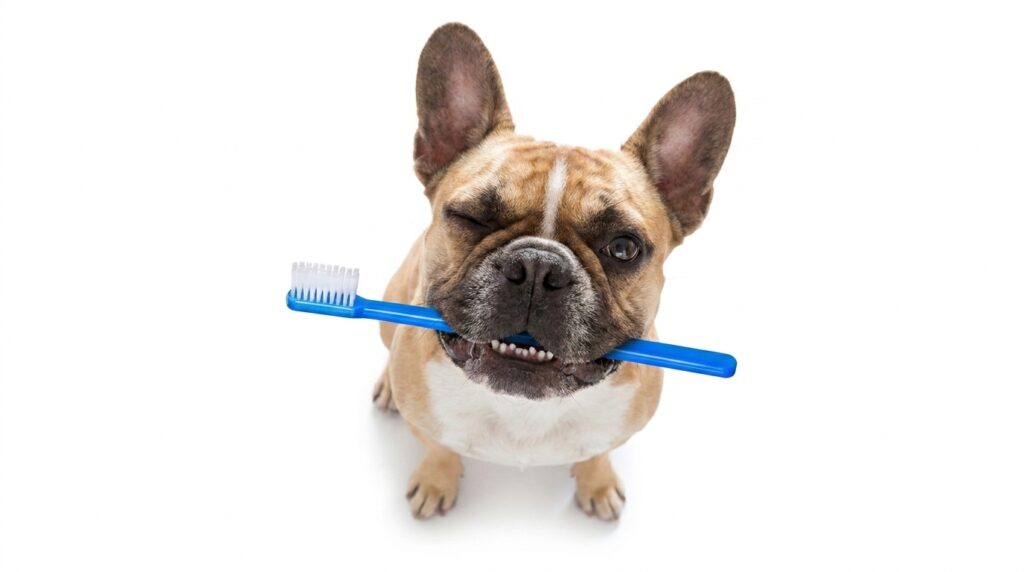
There’s a second, subtler factor that makes it worse. Frenchies breathe through their mouths far more than long-nosed dogs, a direct consequence of their airway, and mouth-breathing dries out the saliva that would normally help rinse bacteria away. So you have crowded teeth that trap debris and a drier mouth that clears it less effectively, which is why this breed accumulates plaque and tartar faster and is particularly vulnerable to gum disease. That combination is exactly why French Bulldog dental care can’t be an afterthought the way it sometimes is for a long-muzzled dog with well-spaced teeth.
What Dental Disease Actually Is
Understanding the process makes the whole approach to dental care make sense. It starts with plaque, a soft, sticky film of bacteria that forms on teeth constantly, every day, in every dog. If it isn’t removed, plaque hardens into tartar, also called calculus, a rough mineralized deposit that brushing can no longer shift. Tartar irritates the gums, producing gingivitis, the red, inflamed early stage. Left unchecked, that inflammation progresses below the gumline into periodontal disease, where the structures holding the teeth in place break down, leading eventually to bone loss, infection, and lost teeth.
The cruel feature of this progression is that it’s largely painless until it’s advanced. A dog can have significant disease brewing beneath the gumline while still eating happily and showing no obvious distress, because dogs are stoic and the early stages simply don’t hurt much. By the time the signs are unmistakable, real damage has often been done. That silent progression is the single best argument for proactive French Bulldog dental care rather than waiting for a problem to announce itself.
Signs of Dental Disease to Watch For
Even though early disease hides well, there are tells worth knowing, and catching them early is what makes home dental care so valuable, since the sooner you notice them the easier they are to manage.
The most common is bad breath. A little doggy breath is normal, but genuinely foul, offensive breath is not, and it’s often the first sign owners notice that dental care has slipped. Beyond that, look for yellow or brown tartar buildup along the teeth, especially the big teeth toward the back; red, swollen, or bleeding gums; and drooling more than usual. Behavioral changes matter too: a dog that’s suddenly reluctant to eat hard food, chews only on one side, drops food, or paws at its mouth may be in discomfort. At the advanced end, you might see visibly loose teeth, or teeth that have fallen out altogether.
If you spot any of these, a vet check is the right next step rather than a wait-and-see. Because dental disease progresses and because the mouth pain can quietly suppress appetite, changes in eating are worth taking seriously, and if your Frenchie is off its food our guide to French Bulldog vomiting covers the other digestive causes worth ruling out alongside a sore mouth.
Why It Matters Beyond the Mouth
Here’s the part that reframes dental care from a cosmetic chore into a genuine health priority. Untreated dental disease doesn’t stay in the mouth.
When periodontal disease takes hold, the mouth becomes a reservoir of bacteria and chronic inflammation, and that has consequences elsewhere in the body. Veterinary sources consistently link advanced, untreated dental disease to effects on the heart, kidneys, and liver, as bacteria and inflammatory products enter the bloodstream through diseased gums. On top of that systemic risk, there’s the simpler matter of chronic pain: a mouth full of infected, loose teeth genuinely hurts, day in and day out, in a way a stoic dog won’t always show you.
This whole-body dimension is why French Bulldog dental care belongs in the same conversation as the other things that shape a dog’s long-term health and comfort, the topics we cover in our French Bulldog lifespan guide. Looking after the mouth is, in a real sense, looking after the whole dog.
How to Brush Your French Bulldog’s Teeth
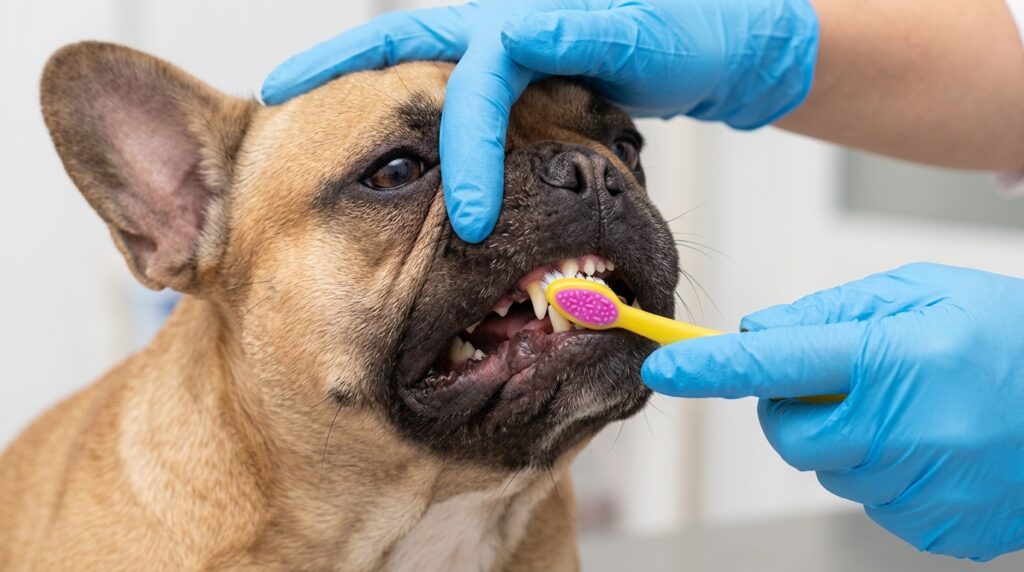
Daily brushing is the gold standard of home dental care, and it’s the single most effective thing you can do for your dog’s mouth at home. It sounds harder than it is, and the mechanical action of the brush, physically disrupting plaque before it hardens, is what does the work, more so even than the toothpaste.
Start slow, especially with an adult dog who isn’t used to it. Spend the first few days simply letting your Frenchie lick a little dog toothpaste off your finger so they associate it with something pleasant. Then progress to gently rubbing a finger or a soft dog toothbrush along the outer surfaces of the teeth, where most tartar forms, focusing on the gumline. You don’t need to scrub the inner surfaces much, the tongue handles those reasonably well. Keep sessions short, calm, and full of praise, and build up over a couple of weeks rather than forcing a full brushing on day one. Positive, patient training early on makes this a routine your dog tolerates rather than fights.

One rule is non-negotiable: only ever use toothpaste made for dogs. Human toothpaste can contain fluoride and, critically, xylitol, a sweetener that is toxic to dogs even in small amounts and one of the toxic foods French Bulldogs can’t eat. Dog toothpaste is designed to be swallowed and comes in flavors dogs actually like. As for frequency, daily is ideal, since plaque begins hardening into tartar within a couple of days, so anything less than every day or two lets the process you’re trying to prevent get a foothold.
Dental Chews, Water Additives, and Other Home Care
Brushing is the foundation of dental care, but for a breed this prone to dental trouble, a few extras genuinely help, particularly for dogs that resist the brush. The trick is knowing what actually works versus what just sells.
The tool that cuts through the marketing is the Veterinary Oral Health Council, or VOHC, which awards a seal of acceptance to products proven to reduce plaque or tartar. When you’re choosing anything for your dog’s teeth, looking for that seal is the simplest way to separate evidence from packaging. A VOHC-accepted dental chew mechanically scrapes plaque as your dog chews, and it’s a useful daily supplement, especially handy on days when brushing doesn’t happen. Do watch the calories, though, since chews add up for a small, weight-prone breed, and factor them into your dog’s daily allowance.

Water additives, which add antimicrobial agents to the drinking bowl, offer a modest but convenient effect and are worth considering for the brush-averse, again favoring VOHC-accepted ones. Plaque-control powders that work through the saliva are another option for dogs who won’t tolerate a brush at all. What I’d steer you away from is very hard chews, antlers, bones, and similar, because dogs commonly fracture teeth on them, which is a painful and expensive irony in a product bought for dental health. And never give cooked bones, which splinter. Whatever extras you choose, treat them as support for brushing rather than a replacement, because none of them clean beneath the gumline the way brushing and professional cleaning do.
Choosing between them is harder than it should be, because most dental products can claim to clean teeth without ever proving it. The filter worth knowing is the VOHC seal, and beyond that, getting the size right matters more than the brand — a chew that’s too small gets swallowed whole with no cleaning benefit at all. Our guide to the best dental chews for French Bulldogs covers which ones are genuinely proven, how to size them for a 16 to 28 pound dog, and what to avoid entirely.
Professional Cleaning and What It Costs
No matter how diligent your home dental care, most dogs eventually need a professional cleaning, because only a vet can clean below the gumline where periodontal disease actually starts. A proper veterinary dental cleaning involves scaling away tartar above and below the gums, polishing the enamel smooth, a full oral exam, and usually dental X-rays to assess the roots and bone that you simply can’t see.
That work requires general anesthesia, and this is where honesty matters for a brachycephalic dog. There’s no safe way to thoroughly clean beneath the gumline on an awake dog, which is why veterinary bodies strongly discourage anesthesia-free cleaning, it removes visible tartar for a cosmetic effect while leaving the real disease untouched below the gums, creating a false sense of security. At the same time, anesthesia carries extra weight for a French Bulldog because of the airway, so the right approach is a vet experienced with the breed, proper pre-anesthetic bloodwork, and careful monitoring, rather than avoiding cleaning altogether. Diligent home care genuinely helps here too, by reducing how often and how extensively your dog needs to go under.
On cost, expect a routine cleaning at a general practice to run somewhere around $300 to $700, though 2026 figures often land in the $400 to $1,200 range depending on where you live and the clinic. Pre-anesthetic bloodwork and dental X-rays may be billed separately and can add $150 to $300, and if extractions are needed the total commonly climbs to $1,000 to $1,500 or more. Because Frenchies accumulate disease faster, many need a cleaning every six to twelve months rather than the yearly-or-longer interval a healthy large breed might manage. It’s worth asking for an itemized estimate up front, and worth remembering that consistent home care is what keeps these bills, and your dog’s suffering, to a minimum.
Brushing is only as good as what’s on the brush, and the choice of toothpaste matters more than most owners realise, starting with the fact that human toothpaste is genuinely dangerous for dogs. If you want to get this part right, our guide to the best dog toothpaste for French Bulldogs explains why enzymatic formulas are the gold standard, what the VOHC seal means, and which picks are actually worth buying.
Building a Prevention Routine
The good news in all of this is that preventive dental care is genuinely effective and genuinely doable. A dog whose teeth are cared for from the start is far less likely to face painful extractions later in life.
A sustainable routine for a Frenchie looks roughly like this. Brush daily, or as close to it as you can manage, using dog toothpaste and building the habit patiently. Add a VOHC-accepted chew or water additive to your dental care routine as backup, counting any chew calories into the daily total. Take a look in your dog’s mouth regularly so you notice tartar, red gums, or bad breath early. Fold a professional dental care assessment into your dog’s routine checkups, and follow your vet’s advice on cleaning frequency, which for this breed often means more often than average. Start all of this young if you can, since a puppy who learns to accept a toothbrush becomes an adult who tolerates it easily. None of these steps is difficult on its own; the whole of French Bulldog dental care is really just doing the small things consistently.
If your Frenchie is already an adult who has never had its teeth touched, don’t be discouraged. It’s genuinely never too late to start, and while an older dog may need patience and possibly a professional cleaning to reset a mouth that’s fallen behind, a consistent home routine still slows disease and protects the teeth that remain. The best dental care is the routine you’ll actually keep up, so build one that fits your life rather than an ideal you’ll abandon in a fortnight.
Frequently Asked Questions
The Bottom Line
French Bulldog dental care is one of those unglamorous routines that quietly protects your dog for a lifetime. This breed’s crowded jaw and drier mouth make dental disease more likely and faster-moving than in most dogs, and because it’s largely painless until it’s advanced, dental care is easy to neglect until real damage is done. The antidote is simple and entirely in your hands: brush most days, use vet-backed extras, watch for the early signs, and keep up with professional cleanings on the schedule your vet recommends.
Having lost a Frenchie myself, I’ve learned that the small, boring, daily acts of care are often the ones that matter most over a whole life. A toothbrush and two minutes isn’t dramatic, but for this breed it prevents pain, protects the whole body, and saves a great deal of money and heartache down the line. Your Frenchie’s mouth is worth those two minutes.
This article is educational and is not a substitute for veterinary care. If your dog has bad breath, sore or bleeding gums, or difficulty eating, have your veterinarian examine their mouth.
French Bulldog Cost in 2026: Price, Vet Bills, and the True Lifetime Cost
French Bulldog Temperament: Personality, and Are They Good Family Dogs?

Best Dog Toothpaste for French Bulldogs: A Vet-Guided Guide
Do French Bulldogs Shed? Coat, Grooming, and When to Worry

Why Your French Bulldog Chews Everything (and How to Stop It)