Written by Jinna CAMERON, veterinary medical student and dog health researcher. Reviewed for factual accuracy against trusted veterinary sources by DVM Carla DONTESK
Walk down the dental aisle and every packet promises the same thing: fresher breath, cleaner teeth, healthier gums. Most of those claims aren’t tested by anyone. There is, however, one independent standard that separates the products with real clinical evidence from the ones with good packaging, and once you know what it is, choosing becomes straightforward. There’s also a sizing mistake that quietly makes many chews useless, and almost no buying guide mentions it.
I run this site after losing my own French Bulldog, Pearly, and I’d rather point you to the handful of things that genuinely work than pad out a list. Dental chews are a legitimately useful tool for this breed, whose crowded jaws accumulate plaque faster than most dogs. But they’re a supplement to brushing, not a substitute, and the right one matters. I’m a veterinary medical student and dog-health researcher, so check anything new with your own vet.
Do Dental Chews Actually Work?
Yes, with honest limits, and it’s worth knowing the actual numbers rather than the marketing ones.
The independent benchmark comes from the Veterinary Oral Health Council, which only awards its seal to products shown to reduce plaque or tartar by at least 15 to 20 percent with regular use. That’s the floor, not the ceiling. Individual products report considerably more in their trials: the widely recommended Greenies cite up to 60 percent plaque reduction and 33 percent tartar reduction with daily use, Virbac’s veterinary chews report up to 70 percent tartar reduction, and Purina’s DentaLife reports around 57 percent.
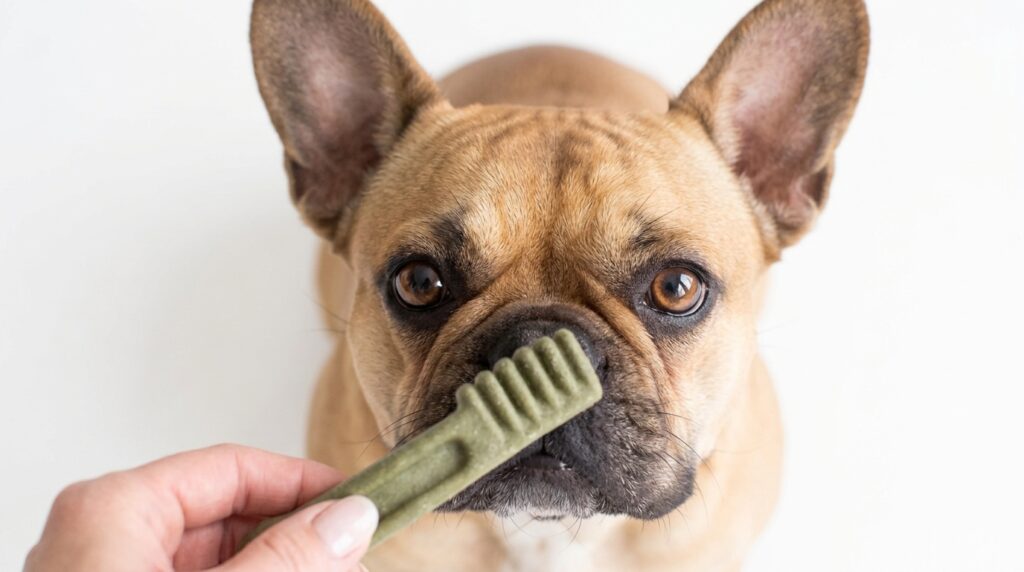
Those are meaningful reductions. In practical terms it’s the difference between a mouth that builds dangerous levels of plaque within weeks and one that stays in safer territory for months between professional cleanings.
Now the honest caveat, because it matters. Trial data shows dental chews reliably reduce plaque, tartar, and bad breath, but they don’t meaningfully improve gingivitis, the inflammation of the gums themselves. And nothing you give your dog to chew cleans below the gumline, which is exactly where periodontal disease does its damage. So dental chews work at what they’re designed for, reducing the buildup on the visible tooth surfaces, and they don’t replace brushing or veterinary cleaning. Used that way, they’re one of the most cost-effective preventive tools available, particularly when you consider that a professional cleaning typically runs $300 to $700 and that over 80 percent of dogs show signs of gum disease by age three.
The VOHC Seal: Your First Filter
If you take one practical thing from this article, make it this. The Veterinary Oral Health Council seal is the only independent, clinical-trial-backed standard in the entire pet dental category, and both the American Veterinary Medical Association and the American Animal Hospital Association specifically recommend choosing VOHC-accepted products.
Here’s why that matters so much in this aisle. Pet dental products are barely regulated, and manufacturers can make broad claims about cleaning teeth or freshening breath without submitting a shred of evidence. The VOHC exists precisely to fill that gap: manufacturers voluntarily submit trial data, and only products that hit the standard earn the seal. So when you’re standing in front of thirty packets, the seal instantly narrows the field to the ones that have actually proven something.
Two practical notes. The seal is awarded separately for plaque control and for tartar control, and some products carry both, which is ideal. And the accepted list changes as new products earn the seal and others lapse, so it’s worth checking the current VOHC accepted products list directly rather than trusting a packet that might be out of date. It takes thirty seconds and it’s the single best filter you have.
Getting the Size Right (Where Most Owners Go Wrong)
This is the part that almost no buying guide covers properly, and it’s both an effectiveness issue and a safety one.
The VOHC recommends weight-matched sizing as the primary safety measure for dental chews, and it’s not a suggestion to eyeball. Never size by breed or by how big the chew looks next to your dog. Use your dog’s actual current body weight against the range printed on the packaging. Get it wrong in either direction and the chew fails you: too small, and your dog gulps it down whole with essentially zero cleaning benefit, because the abrasive contact between chew and tooth never happens; too large, and it becomes a genuine choking hazard.
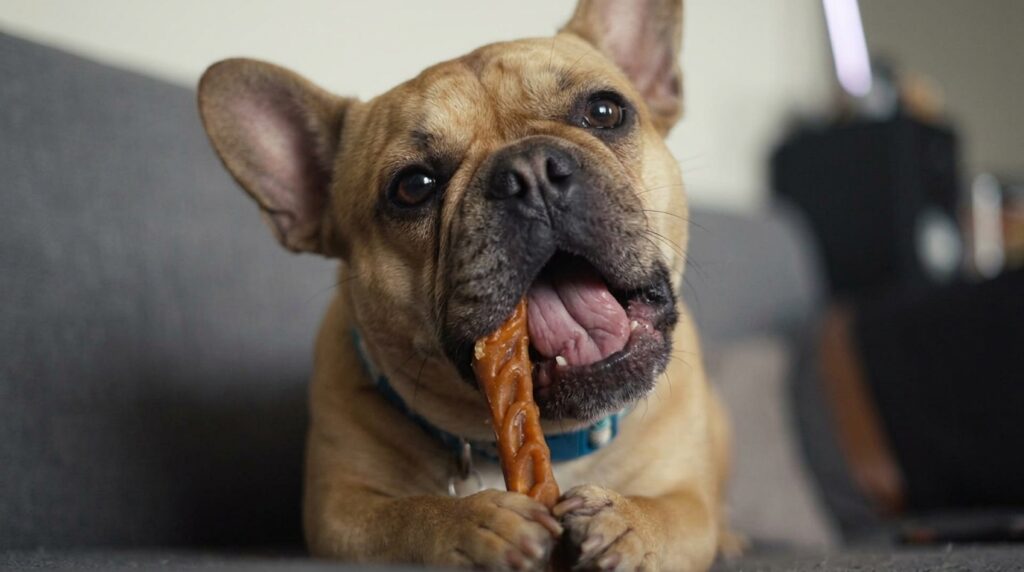
For a French Bulldog, most adults sit somewhere around 16 to 28 pounds, which straddles two size tiers on most brands. Taking Greenies as the example, their Teenie size covers 5 to 15 pounds and their Petite covers 15 to 25 pounds, so the majority of adult Frenchies land in Petite, with smaller individuals in Teenie and larger ones potentially needing the next size up. Weigh your dog rather than guessing, and re-check if their weight changes.
The other half of getting value from a chew is how it’s given. The most common reasons dental chews underperform are incorrect sizing, dogs swallowing rather than chewing, and irregular use. Give one daily rather than occasionally, ideally after a meal when your dog’s chewing rhythm is naturally settled, and always supervise. A dog that reliably gulps its chew whole isn’t getting the benefit no matter which brand you buy, and that’s worth noticing.
What Else to Look For
Beyond the seal and the size, a few things separate good dental chews from mediocre ones.
Calories deserve real attention with this breed. A dental chew is a daily treat, and they add up: roughly 26 calories for a Teenie-sized chew and 56 for a Petite. On a compact dog that gains weight easily, that’s a meaningful slice of the daily allowance, and it needs to be counted rather than added on top of normal food. Since keeping a Frenchie lean matters for their joints, their breathing, and their lifespan, it’s worth reading our guide to the overweight French Bulldog alongside this one and adjusting meals accordingly.
Texture and shape matter too. The better dental chews are designed to flex and contour around the tooth rather than shatter, which lets them reach down toward the gumline where a toothbrush often misses. Ridged, grooved, or Z-shaped designs increase the surface contact that does the cleaning.
Ingredients are worth a glance if your dog has a sensitive stomach or known food sensitivities, which isn’t unusual in this breed. Plenty of VOHC-accepted options exist in plant-based, grain-free, and limited-ingredient forms, so you’re not forced to compromise. And one age rule: dental chews aren’t for puppies under about six months, since their adult teeth haven’t come through yet.
The Best Dental Chews for French Bulldogs
Here are the dental chews I’d actually consider, all VOHC-accepted, with an honest drawback for each. I haven’t lab-tested these myself, so I’m describing them from their evidence and design rather than pretending to a bench test.
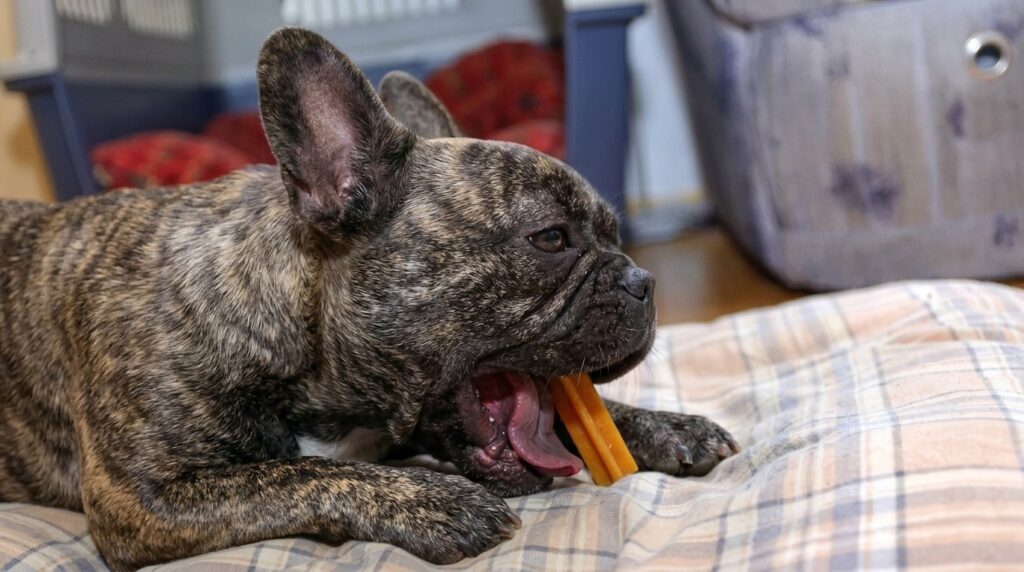
Best overall: Greenies
Greenies are the consensus pick among veterinary panels, and the reasoning holds up. They carry the VOHC seal for both plaque and tartar control, which not every product does, they’re the most vet-recommended dental chew brand in the US, and their chewy, flexible toothbrush shape bends around the teeth to reach the gumline rather than snapping apart. They come in six size tiers, so getting a proper weight match for a Frenchie is easy, and most dogs find them genuinely appealing, which solves the compliance problem. A correctly sized pack of Greenies is the default recommendation for most owners. The honest drawbacks: they’re not the cheapest option, and the calories are worth watching on a small dog.
Best from a veterinary dental brand: Virbac C.E.T. VeggieDent Fr3sh
If you want a product designed by a company that specializes in veterinary dentistry, this is it. VeggieDent Fr3sh had its VOHC acceptance renewed in 2026, it’s plant-based, and its Z-shape is built to maximize contact with the tooth surface, with reported tartar reduction up to 70 percent. Virbac also makes a C.E.T. Enzymatic chew that’s a sensible pick for dogs with food sensitivities, since it avoids wheat and corn while adding a gentle dual-enzyme action. The drawback is availability and price: these are more of a vet-clinic or specialist-retailer product than a supermarket grab.
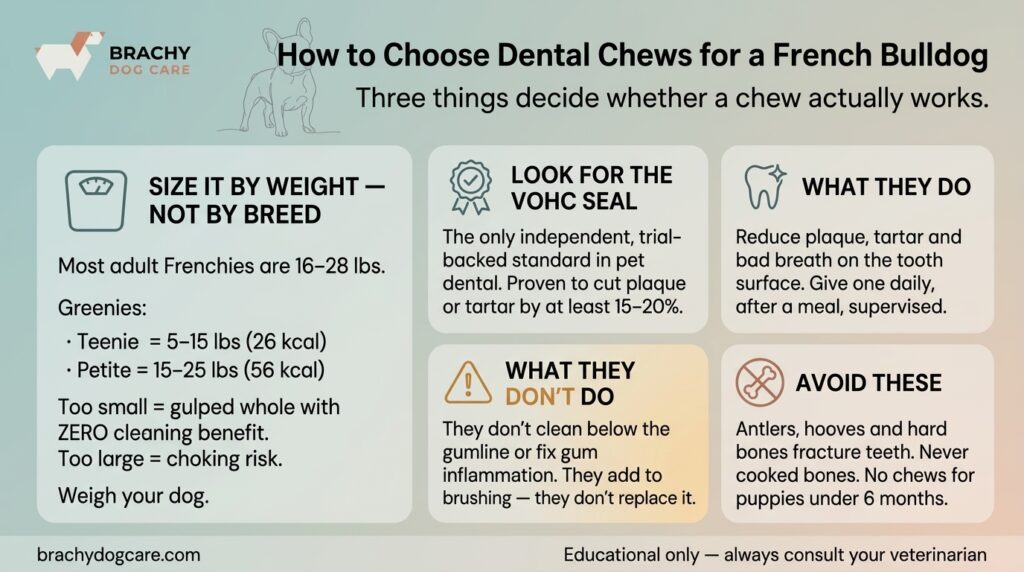
Best natural option: Whimzees Brushzees
For owners who prefer a short, clean ingredient list, Whimzees are plant-based with around six ingredients, no artificial additives, and VOHC acceptance for tartar control. Their ridged shapes are engineered to scrub from multiple angles, and they tend to last noticeably longer than softer chews, which is a real advantage if your Frenchie inhales treats. The trade-off is that they’re firmer than a Greenie, so some dogs take longer to warm to them, and they carry a tartar seal rather than the dual plaque-and-tartar acceptance.
Best budget: Purina DentaLife or Pedigree Dentastix
If cost is the deciding factor, both of these are VOHC-accepted and widely available in ordinary supermarkets. DentaLife uses an eight-ridge porous design and reports around 57 percent tartar reduction, while Dentastix uses an X-shape aimed at the gumline and tends to be the cheapest VOHC option at mass retail. The honest note is that budget chews generally come with more filler ingredients and a less premium ingredient list, so they’re a compromise, but a genuinely evidence-backed one. A cheap chew with the seal beats an expensive one without it.
What to Avoid
A few products are marketed for dental health and are, at best, a poor idea for a French Bulldog.
The big one is very hard chews: antlers, hooves, and hard bones. Dogs fracture teeth on these regularly, and a broken carnassial tooth is painful and expensive to treat, which is a bleak irony for something bought to protect the teeth. Cooked bones are worse again, because they splinter. If a chew doesn’t visibly give when you press it hard with your thumbnail, it’s likely too hard for your dog’s teeth.
Beyond that, treat any product without the VOHC seal as unproven rather than proven. It might still be fine, but you have no independent evidence it does anything for plaque or tartar, and the claims on the front of the packet aren’t required to be substantiated. And skip anything sized wrongly for your dog, however appealing the marketing, since the wrong size undoes the entire point.
What Dental Chews Can’t Do
I want to be clear about the limits, because overselling these products would do your dog a disservice.
Dental chews reduce plaque, tartar, and bad breath. They do not clean below the gumline, they don’t meaningfully improve gum inflammation once it’s established, and they cannot reverse periodontal disease. Daily brushing remains the gold standard of home care, and professional veterinary cleaning under anesthesia is the only way to address disease beneath the gums, which is where it actually causes damage.
The realistic way to think about it is as a layered routine: brushing does the heavy lifting, dental chews cover the gaps and add a daily mechanical clean your dog actually enjoys, and professional cleanings handle what home care can’t reach. Our guide to French Bulldog dental care covers how to build that whole routine, including why this breed’s crowded jaw and mouth-breathing make them more vulnerable than most dogs in the first place.
Frequently Asked Questions
The Bottom Line
Choosing dental chews for a French Bulldog comes down to three things: look for the VOHC seal, match the size to your dog’s actual weight, and give one daily rather than occasionally. Get those right and you have a genuinely evidence-backed tool that reduces plaque and tartar in a breed that accumulates both faster than most.
Having lost a Frenchie myself, I’ve become wary of any product that promises to replace real care. Dental chews don’t replace the toothbrush or the vet, but they are one of the easier wins in dog health, cheap, effective within their limits, and something your dog actively looks forward to. Choose a proven one, size it properly, and let it do the job it’s genuinely good at.
This article is educational and is not a substitute for veterinary care. Speak to your veterinarian about the right dental routine for your dog, especially if they already have signs of gum disease.
Best Dental Chews for French Bulldogs: What Actually Works
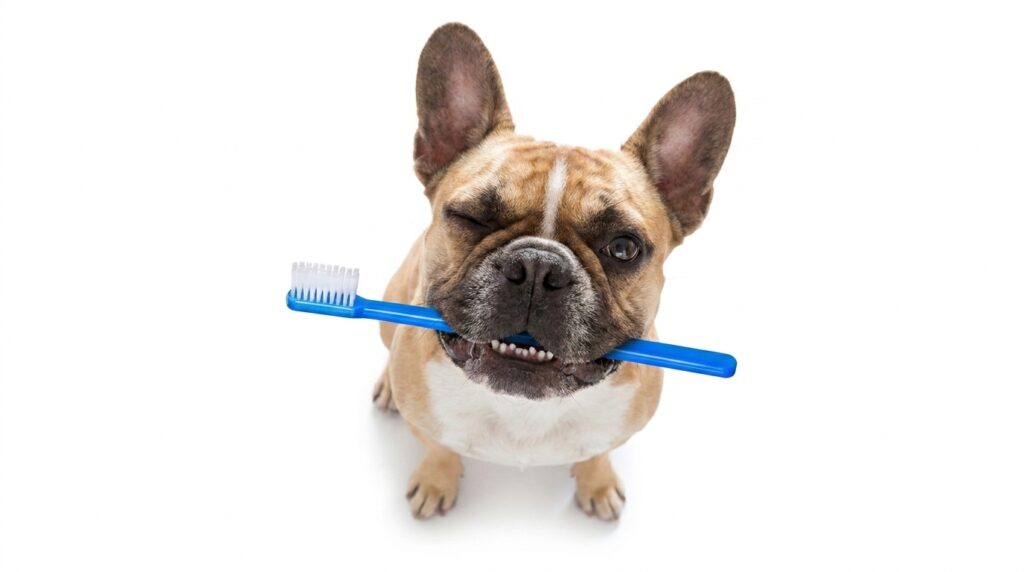
French Bulldog Dental Care: Teeth, Cleaning, and Prevention
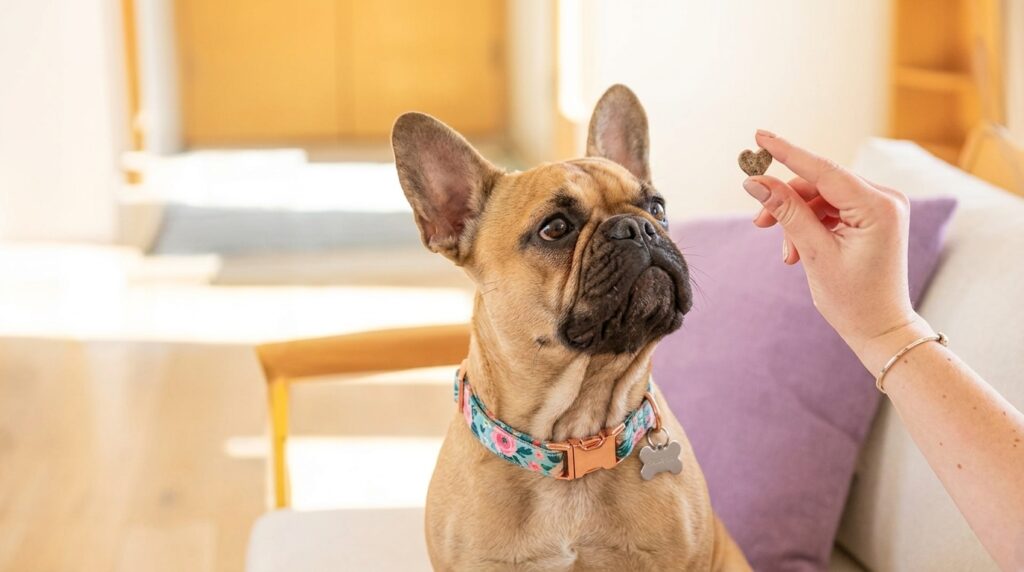
Joint Supplements for French Bulldogs: What Actually Works
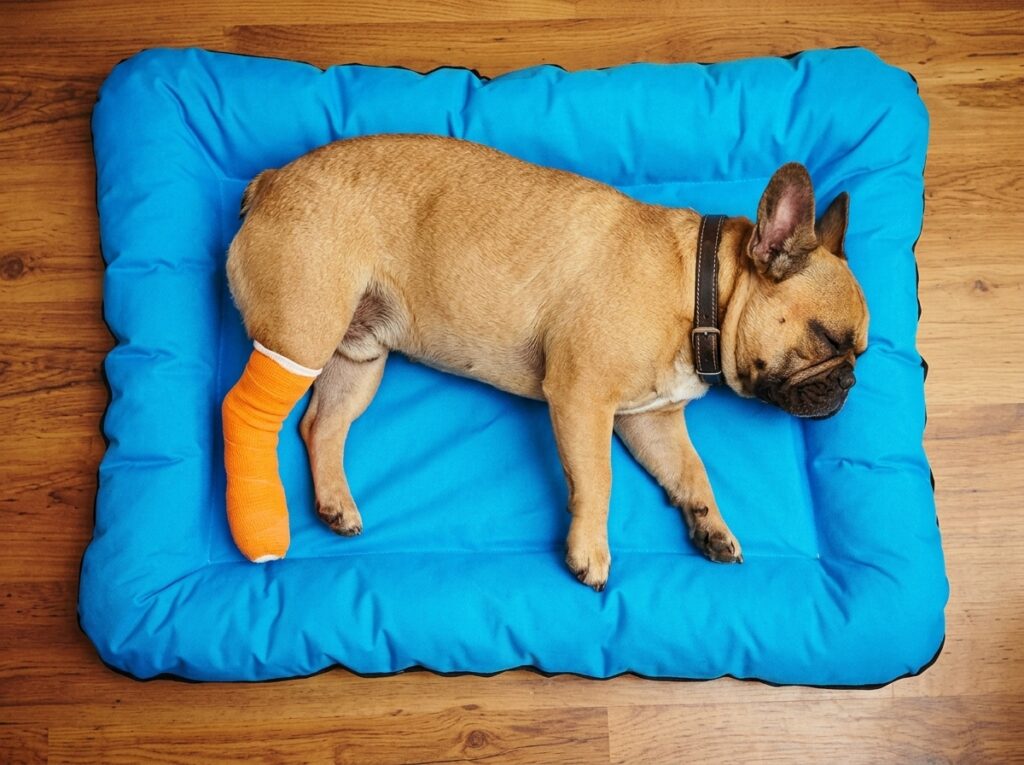
French Bulldog Luxating Patella: Signs, Grades, and Surgery Costs
French Bulldog Hip Dysplasia: Signs, Causes, and What It Really Means