Written by Jinna CAMERON, veterinary medical student and dog health researcher. Reviewed for factual accuracy against trusted veterinary sources by DVM Carla DONTESK
If your Frenchie falls apart the moment you leave, barking, chewing the doorframe, or having accidents despite being perfectly house-trained, I want to tell you something important before anything else: that isn’t your dog being naughty. It’s panic. Understanding that distinction changes everything about how you respond to it, and it’s the difference between making the problem worse and actually helping.
French Bulldogs are more prone to this than most breeds, and it’s not a character flaw, it’s baked into what they are. I run this site after losing my own French Bulldog, Pearly, and I’ve come to believe that behaviour problems deserve the same patient, honest treatment as physical ones. I’m a veterinary medical student and dog-health researcher, not a certified behaviourist, so for a severe case please lean on a professional. But for understanding what’s happening and what genuinely helps, this guide will get you a long way.
Why French Bulldogs Are Prone to Separation Anxiety
To understand the problem, you have to understand what this breed was made for. French Bulldogs were bred, first and foremost, to be companions. Not to work, not to guard, not to hunt, but simply to be with their people. That history has produced a dog that bonds intensely with its family and genuinely thrives on closeness, which is exactly why so many of us fall for them.

The flip side of that devotion is a vulnerability. A dog bred to be constantly by your side is, almost by definition, a dog that struggles when you’re not there. This is why French Bulldogs show separation-related distress more readily than many breeds. Not every Frenchie develops a clinical problem, but a great many show some degree of difficulty being alone, particularly if they were never deliberately taught that solitude is safe and temporary. There’s a physical dimension too: as a brachycephalic breed, Frenchies are more sensitive to the physiological effects of stress, and a panicking flat-faced dog can work itself into genuine breathing difficulty, which ties this behavioural issue directly to the airway concerns we cover in our guide to French Bulldog breathing problems. So separation anxiety in this breed isn’t just an emotional matter, it can become a physical one, and chronic stress does a dog’s overall wellbeing no favours over the years, which is part of the bigger health picture we cover in our French Bulldog lifespan guide.
Can French Bulldogs Be Left Alone? And for How Long?
This is one of the first questions prospective and new owners ask, and it deserves a direct answer. Yes, French Bulldogs can be left alone, but not for long stretches, and not without preparation.
As a general guide, a healthy adult Frenchie shouldn’t be left alone for more than about four to six hours, and many do better with less, especially a dog already showing signs of separation anxiety. Puppies need far shorter absences, since they can’t hold their bladders long and haven’t yet learned to cope with solitude at all. But here’s the crucial point that raw numbers miss: the goal isn’t simply to avoid leaving your dog, it’s to teach your dog that being left is fine. A Frenchie who has genuinely learned that alone time is safe copes far better than one who is simply never left, because the latter never builds the skill and panics the moment circumstances force it.
Minimizing alone time genuinely helps, and options like a dog sitter, daycare, a trusted neighbour, or bringing your dog along where you can all reduce the burden. But treat those as support for the real work of teaching independence, not as a way to sidestep it forever. A dog that can only cope when someone is always home is a fragile arrangement, and life has a way of disrupting it.
Signs of Separation Anxiety in French Bulldogs
Separation anxiety announces itself through a fairly consistent set of behaviours, and the single most important diagnostic clue is that they happen only when your dog is alone, or when your dog senses you’re about to leave.
The common signs include excessive vocalization, barking, whining, or howling that starts shortly after you go; destructive behaviour concentrated around exit points like doors, windows, and blinds, where a distressed dog chews, scratches, or digs as if trying to escape; and house soiling, accidents indoors even in a fully house-trained dog. You may also see pacing, restlessness, drooling, or trembling, either in the anxious build-up before you leave or in a frantic state when you return. In severe cases, dogs attempt to break out of crates or rooms, sometimes injuring themselves, and some experience what amount to full panic attacks.

What ties all of these signs of separation anxiety together is context. A dog that chews a shoe while you’re home is doing something different from a dog that systematically destroys the front door the moment you leave. If the behaviour is bound tightly to your absence, separation anxiety is the likely explanation, and it’s worth taking seriously rather than scolding.
And scolding really is the wrong response, worth saying plainly because the instinct is so common. Coming home to a wrecked doorframe and telling your dog off does nothing except add fear of your return to the fear of your leaving, because your dog can’t connect a punishment now to something it did in a panic an hour ago. Separation anxiety is not disobedience, and it doesn’t respond to discipline. It responds to patient teaching that being alone is safe, which is the entire thrust of the approach below.
Destructive chewing is one of the most common ways this distress shows itself, but it’s worth knowing that not all chewing is anxiety-driven, plenty of it is simple boredom, teething, or a lack of appropriate outlets, and each needs a different response. If your Frenchie is shredding things whether you’re home or not, our guide to why French Bulldogs chew everything and how to stop it helps you tell the causes apart and match the fix to the real problem.
Is It Separation Anxiety or Just Boredom?
This is a genuinely useful distinction, because the two look similar at first glance but need completely different responses, and getting it wrong wastes everyone’s time.
The clearest tell is timing. Separation anxiety behaviour usually erupts within minutes of your departure, driven by the acute distress of being left. Boredom-related mess, by contrast, tends to happen later in the absence, once your dog has run out of things to do and goes looking for entertainment. A dog that shreds the sofa two hours in is probably bored; a dog that panics at the door within five minutes is probably anxious.

The second tell is how hard your dog finds it to settle. A bored dog is restless and under-stimulated, and more exercise and enrichment often solve the problem. A truly anxious dog stays stressed for long stretches and struggles to calm down at all, even when left with toys and treats they’d normally love. If enrichment alone fixes it, it was likely boredom. If your dog is too distressed to engage with anything, you’re dealing with anxiety, and that needs the behavioural approach below rather than just a busier schedule.
What Causes Separation Anxiety
Several threads usually feed into separation anxiety, and identifying which apply to your dog helps you target the fix. Before anything else, though, a first step worth taking is a visit to your vet, because a number of medical issues can cause distress that mimics separation anxiety, and it’s important to rule those out rather than assume.
Beyond the breed’s built-in bonding tendency, the common contributors are a lack of early alone-time training, where a puppy or newly adopted dog was never gradually taught to cope with solitude; sudden changes in routine, such as a new work schedule, a house move, or a household member leaving; and past trauma, abandonment, or rehoming, which is why rescue dogs and those with unstable early histories are at higher risk. None of these are the owner’s fault, and none of them mean the dog is broken. They’re simply starting points that tell you what your dog needs to learn.
How to Help: What Actually Works
The good news is that separation anxiety is manageable, often very successfully, with the right approach, and thousands of Frenchie owners have worked through it. The bad news is that there’s no instant fix, and the methods that work require patience and consistency. Here’s what genuinely helps, roughly in order of importance.
Desensitization is the core of it, and everything else supports it. The idea is to gradually teach your dog that being alone is safe by exposing them to very short absences and slowly extending them. Start almost absurdly small, leaving for just seconds to a couple of minutes while your dog is happily occupied with a food puzzle or a chew, then returning calmly before panic sets in. Over many repetitions across days and weeks, you stretch the duration, always staying below the threshold that triggers distress. It’s slow, but it’s the method with the best track record, and rushing it undoes the progress.
Keep departures and arrivals low-key. Emotional, drawn-out goodbyes and ecstatic reunions actually heighten the contrast between your presence and absence, teaching your dog that your comings and goings are a very big deal. Calm, matter-of-fact exits and entrances send the opposite message: this is normal, nothing to panic about.
Teach a settle. Training your Frenchie to relax on cue in their own spot, calmly and without needing your attention, builds the underlying skill that tolerating alone time depends on. A dog that can switch itself off in another room while you’re home is far better equipped to do it while you’re out.
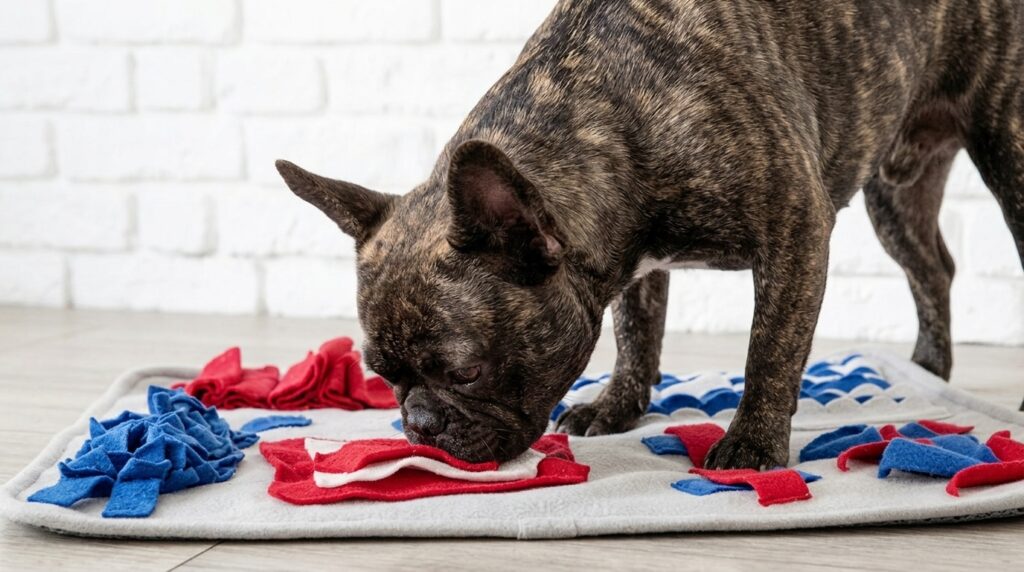
Build a predictable routine and tire your dog out beforehand. Dogs settle more easily when feeding, walks, and play happen at reliable times, and a Frenchie that’s had a gentle walk and some mental stimulation before you leave carries less nervous energy into the absence. Keep exercise sensible for a brachycephalic dog, but a tired, calm dog settles better than a wound-up one. Enrichment during the absence helps too, and a long-lasting puzzle feeder or lick mat gives your dog something absorbing to do in those first critical minutes after you leave, which is exactly when anxiety tends to peak.
One important nuance about crates, because well-meaning advice often gets this wrong. A crate makes some dogs feel secure and can genuinely help, but for a dog with real separation anxiety that hasn’t been carefully conditioned to love its crate, confinement can massively increase panic, sometimes to the point of self-injury. Never use a crate as a way to contain an anxious dog you haven’t properly prepared, and if crating clearly distresses your dog, don’t force it.
Behaviour struggles rarely travel alone, and house-training setbacks often overlap with anxiety, since a stressed or overstimulated dog has more accidents, not fewer. If your Frenchie is still learning the basics alongside their alone-time worries, our guide to potty training a French Bulldog explains the calm, reward-based approach that works for this stubborn but clever breed.
Calming Aids and When to Get Professional Help
You’ll see a lot of products marketed for dog anxiety, calming treats, pheromone diffusers, anxiety wraps, supplements, and some do offer mild, genuine support for milder cases. The honest framing is that these are adjuncts, not cures. They may take a little edge off, but none of them will resolve genuine separation anxiety on their own, and using them as a substitute for the behavioural work above tends to disappoint. If a calming aid helps your dog engage with desensitization more easily, it’s earning its place; if you’re relying on it to fix the problem outright, it won’t.
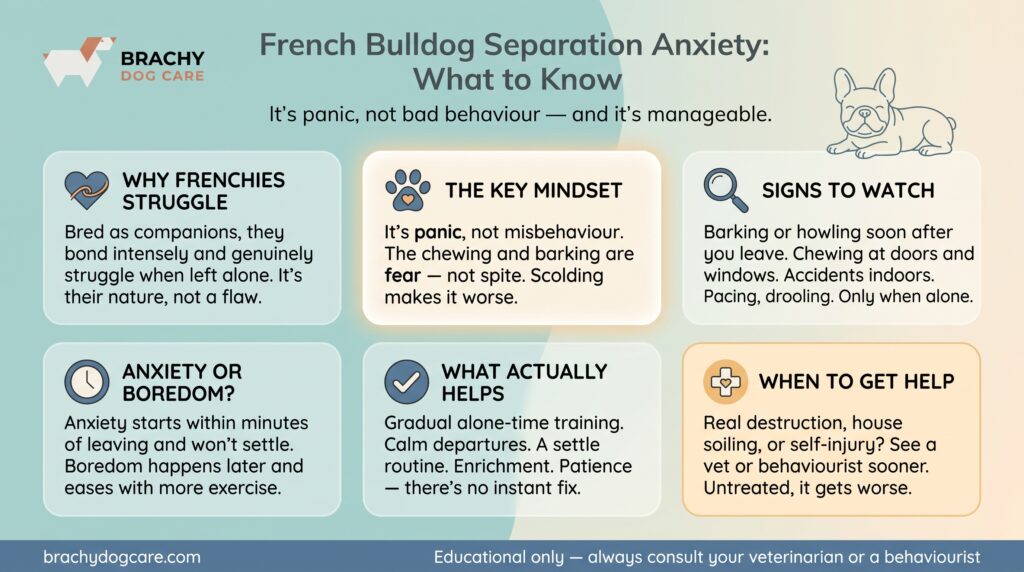
Know when to bring in a professional, and err on the side of sooner. If your Frenchie shows significant distress, real destruction, house soiling, or self-injury when alone, a certified behaviourist or your veterinarian is worth consulting sooner rather than later, because separation anxiety left unaddressed tends to become more entrenched over time, not less. For moderate to severe cases, a vet may prescribe anti-anxiety medication to be used alongside behaviour modification, not instead of it, taking enough of the edge off the panic that your dog can actually learn. There is no shame in this. A dog in genuine distress deserves proper help, exactly as it would for a physical illness.
Many owners look for something to take the edge off while they do the slower behavioural work, and that’s reasonable, as long as you choose honestly. Some calming products genuinely help mild or situational anxiety, but plenty are marketing over substance, and none replace training. Our evidence-first guide to calming aids for French Bulldogs breaks down what actually has science behind it, what’s a waste of money, and how to use it as a support rather than a fix.
Preventing Separation Anxiety
If you’re reading this with a new puppy or a recently adopted dog who hasn’t yet developed a problem, you’re in the best possible position, because prevention is far easier than cure.
Start teaching independence early and gently. Practise short absences from day one, leaving the room for a few minutes and returning calmly, so that being alone becomes an ordinary, unremarkable part of life rather than a shock. Encourage your dog to relax alone in another room for short stretches while you’re home. Keep your goodbyes and hellos calm from the very beginning. And build the predictable routine that helps this breed feel secure. A Frenchie who learns as a youngster that alone time is safe and temporary rarely develops the full-blown version of the problem, which is a far kinder outcome than trying to unpick a deeply distressed adult dog later.
A crate can be part of the solution or part of the problem, depending entirely on how it’s introduced. Done gradually and positively, a crate gives an anxious dog a secure den to settle in; forced on a dog that already panics when confined, it can make the distress far worse. If you want to use one the right way, our guide to crate training a French Bulldog walks through the calm, step-by-step method and the signs that tell you to slow down.
Frequently Asked Questions
The Bottom Line
French Bulldog separation anxiety is common, it’s manageable, and above all it’s a genuine emotional problem rather than bad behaviour. Your dog isn’t punishing you for leaving, it’s frightened, and the destruction and noise are symptoms of panic, not defiance. Once you see it that way, the path forward becomes clear: teach your dog patiently that being alone is safe, keep your comings and goings calm, build a steady routine, and bring in professional help when the distress is real.
Having lost a Frenchie myself, I know how deeply these dogs attach to us, and that attachment is one of the best things about them. The work here isn’t about loving your dog less or creating distance, it’s about giving your Frenchie the security to feel safe even in the moments you’re not there. That’s one of the kindest gifts you can give a dog built to love you this much.
It helps to understand that this struggle isn’t a flaw in your individual dog, it’s woven into the breed itself. French Bulldogs were bred purely as companions, so the same devotion that makes them so lovable is exactly what leaves them prone to distress when alone. If you’d like the fuller picture of what makes this breed tick, our guide to French Bulldog temperament explains the personality traits behind the clinginess and what else to expect from these deeply people-oriented dogs.
This article is educational and is not a substitute for professional veterinary or behavioural care. If your dog is experiencing significant distress, consult your veterinarian or a certified animal behaviourist.

French Bulldog Cost in 2026: Price, Vet Bills, and the True Lifetime Cost
French Bulldog Temperament: Personality, and Are They Good Family Dogs?

Best Dog Toothpaste for French Bulldogs: A Vet-Guided Guide
Do French Bulldogs Shed? Coat, Grooming, and When to Worry

Why Your French Bulldog Chews Everything (and How to Stop It)