Written by Jinna CAMERON, veterinary medical student and dog health researcher. Reviewed for factual accuracy against trusted veterinary sources by DVM Carla DONTESK
Every summer, the same heartbreaking story circulates in Frenchie owner groups: a dog slipped into a pool during a barbecue, and by the time anyone noticed, it was too late. I run this site because I lost my own French Bulldog, Pearly, to airway-related complications, so I don’t take this lightly. French Bulldog swimming is one of those topics where a cheerful “sure, dogs love water” can get a dog killed, and owners deserve the honest version instead of the breezy one.
So let’s answer the question plainly, then unpack the why and the how. I’m a veterinary medical student and dog-health researcher, and nothing here replaces your own vet’s advice. But this is one area where the evidence points clearly in one direction, and a little caution around French Bulldog swimming is the kind thing to do.
Can French Bulldogs Swim? The Honest Answer
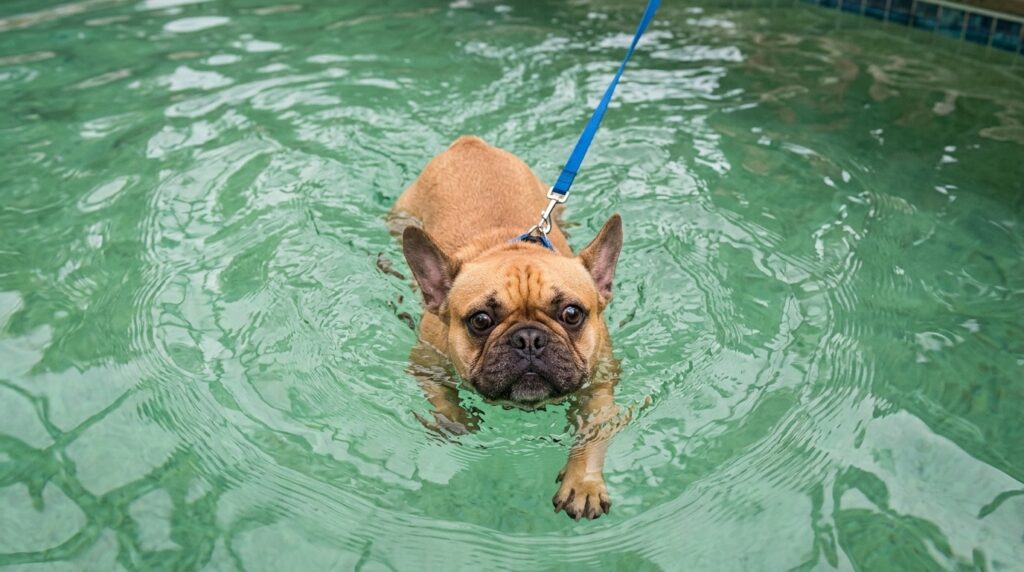
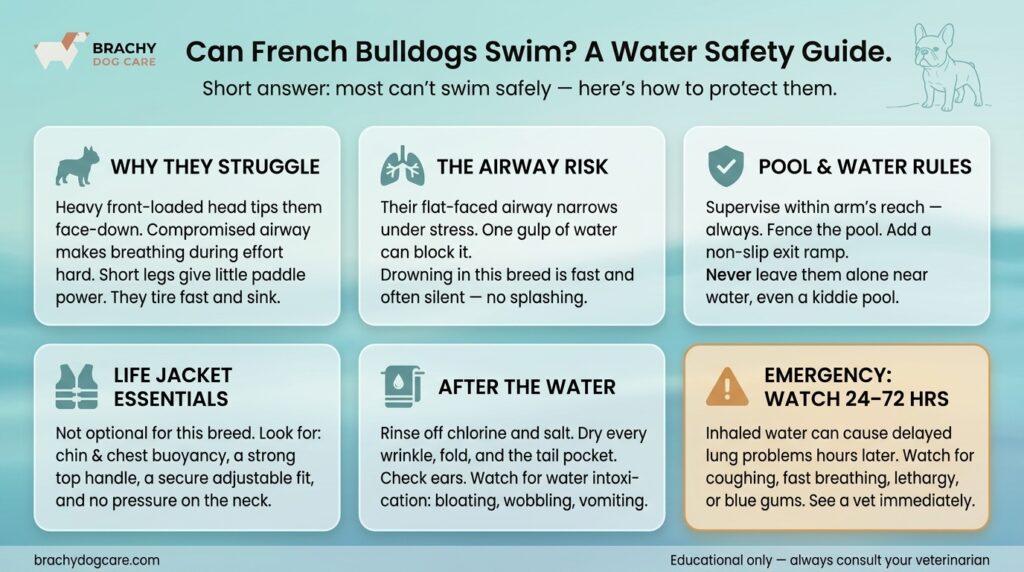
Most French Bulldogs cannot swim safely, and many cannot swim at all. Unlike retrievers built for water, this breed carries a heavy front-loaded body, a compromised airway, and short limbs, a combination that makes staying afloat genuinely difficult and tiring. Some individual Frenchies can paddle for a short time in shallow, calm water, but “can paddle briefly” is not the same as “can swim,” and it is nowhere near “is safe unsupervised near water.” On the whole question of French Bulldog swimming, treat your dog as one who needs active protection around water, not one who can be trusted in it.
That isn’t fear-mongering; it’s the cautious reading of how these dogs are built. The rest of this guide explains exactly why, and what safe water access can look like when it’s done right.
Why French Bulldogs Struggle in Water
The trouble with French Bulldog swimming starts with the body itself. Several features stack up, and together they create a real risk rather than a minor disadvantage.
The first is weight distribution. The brachycephalic head looks small, but it carries dense, heavy soft tissue. Research measuring tongue tissue in flat-faced dogs found it was far denser and proportionally larger than in longer-nosed breeds, part of a broader pattern of heavy soft tissue packed into the front of the skull. Add the breed’s broad, deep chest and muscular forequarters, and the center of gravity sits forward. In water, that means the head tends to pitch downward, exactly the wrong direction when the whole job is keeping the nose and mouth above the surface.
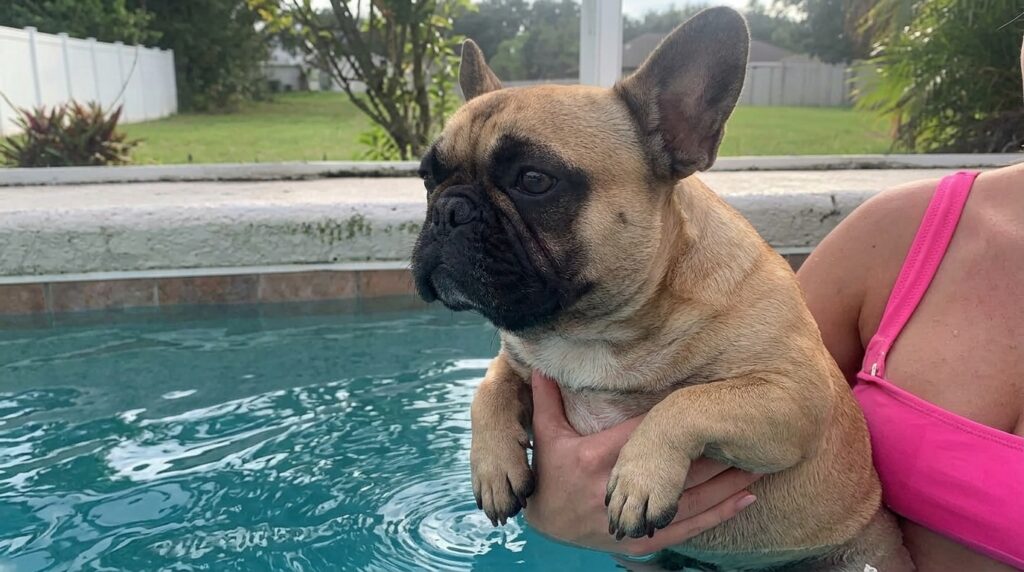
The second is breathing, and it’s the heart of why French Bulldog swimming is so demanding. A Frenchie works far harder to move air than a typical dog even while resting. Studies using airflow modeling have found that resistance through the nose and throat can be roughly ten times higher in brachycephalic dogs than in long-nosed ones. On land that produces the familiar snorting and quick tiring. In water, where oxygen demand spikes and the airway has to stay clear of the surface at the same time, that baseline deficit becomes dangerous fast. Measurements of breathing in calm, outwardly healthy flat-faced dogs show reduced air movement and even higher carbon dioxide levels before any symptoms appear, meaning the reserve simply isn’t there when exertion arrives.
The third is propulsion. Short, stocky legs give less paddle surface and a shorter stroke than the long limbs of breeds built to swim. So a Frenchie has to work harder to stay up while generating less forward movement, a poor trade in open water.
Put these together and you get a dog who is front-heavy, easily winded, and underpowered in exactly the environment that punishes all three. None of this is the dog’s fault, and none of it means your Frenchie is fragile in daily life. It simply means water is a setting where their anatomy works against them, which is why French Bulldog swimming deserves real caution rather than a casual attitude.
The Airway Connection: Why Water Is Especially Risky
This is the part that turns a swimming difficulty into a genuine emergency risk, and it’s the same airway story that runs through so much of this breed’s health. What makes French Bulldog swimming uniquely dangerous, compared with a clumsy swimmer of another breed, is the airway.
Many French Bulldogs have some degree of brachycephalic obstructive airway syndrome, or BOAS, the airway obstruction that comes from their conformation. Worryingly, surveys have found that around 60 percent of French Bulldog owners didn’t recognize BOAS in dogs that objectively had it. That means a large share of owners may be putting a dog with a compromised airway into water without knowing the airway is compromised at all.
What makes water uniquely dangerous is how this airway behaves under stress. The flat-faced airway narrows further with effort; imaging during breathing has shown the back of the throat collapsing dramatically in brachycephalic dogs compared with almost not at all in normal dogs, and that collapse gets worse the harder the dog works. Exhaustion makes it worse still, because tired airway muscles relax and can obstruct further. In water, a single moment of that obstruction can mean a breath of water instead of air, and once water gets in, the situation spirals.
There’s a knock-on danger too. These dogs are already prone to reflux and a stomach that sits poorly, so material reaching the lower airways is a known problem for them, and their bodies sit in a low-grade inflamed state with little spare capacity to recover from an insult like inhaled water. If you want to understand the airway side of this breed more deeply, our guide to French Bulldog breathing problems covers how BOAS works and what the warning signs look like. The short version for French Bulldog swimming: the same airway that makes breathing hard on the sofa makes drowning frighteningly quick in a pool.
The drowning cascade is predictable. Hard work of breathing leads to rapid oxygen depletion, which leads to muscle fatigue, which leads to the head dropping, which leads to water inhalation, which collapses the airway further. For a breed that struggles to sustain even moderate land exercise, with one study finding flat-faced dogs five times more likely to fail a basic fitness test, the leap to the demands of French Bulldog swimming is exactly the kind of escalation their bodies can’t absorb.
What the Research Actually Shows (and Doesn’t)
In the spirit of honesty this site runs on, here’s the line between solid evidence and reasonable inference. The anatomy and airway findings above are well documented in the veterinary literature. What does not exist is a formal study counting how many dogs of each breed drown, so anyone claiming hard drowning statistics for French Bulldogs is overstating the data, and any honest discussion of French Bulldog swimming has to admit that gap.
What we can say is that the mechanism is strong and the convergence of risks is real: front-heavy build, poor ventilation, rapid fatigue, and a collapsing airway all point the same way. Major welfare and breed organizations warn that flat-faced and short-legged dogs are at elevated drowning risk, and that guidance rests on this clinical reasoning rather than a body count. I’d rather tell you that plainly than dress up a guess as a statistic. The practical conclusion is unchanged: with French Bulldog swimming, you manage the risk as real, because the biology says it is.
French Bulldog Swimming Safety: Pools, Beaches, and Home
If your dog will be anywhere near water, a few rules do most of the protective work. None are complicated, and together they prevent the overwhelming majority of tragedies, so think of French Bulldog swimming safety as a short checklist rather than a vibe.
Supervision is the single most important measure, and it means within arm’s reach, not “watching from a lounger.” No French Bulldog should be left unattended near any water, including a shallow kiddie pool. Given how many owners underestimate their dog’s airway limits, assume yours has less margin than you think.
Pools deserve special attention because of the exit problem. A short-legged, heavy-fronted dog often physically cannot haul itself out over a vertical pool wall, so a dog that falls in can swim briefly and still drown simply because there’s no way out. Fencing that blocks unsupervised access is essential, and a gentle, textured exit ramp gives a dog a fighting chance to self-rescue. Even with a ramp, a Frenchie needs to be taught where it is and may not find it in a panic, so the ramp supplements supervision rather than replacing it.
Open water adds hazards a backyard pool doesn’t: currents, waves, cold that accelerates fatigue and can trigger a spasm of the airway, and tides that turn a shallow spot deep. A reasonable rule is that French Bulldog swimming shouldn’t go past wading depth in open water at all, even wearing flotation.
Two quieter dangers are worth knowing. Water intoxication, from gulping too much water during play with hoses or floating toys, can be fatal, and this breed’s tendency to swallow air and water may raise the risk; watch for bloating, wobbliness, vomiting, or confusion and treat it as an emergency. And after any water, dry your dog thoroughly. The deep facial folds and the tail pocket trap moisture and breed infection, so rinse off chlorine or salt, then dry every fold, including the tail pocket, and check the ears. Skipping this is how a fun afternoon becomes a skin or ear infection a week later.
Do French Bulldogs Need a Life Jacket? How to Choose One
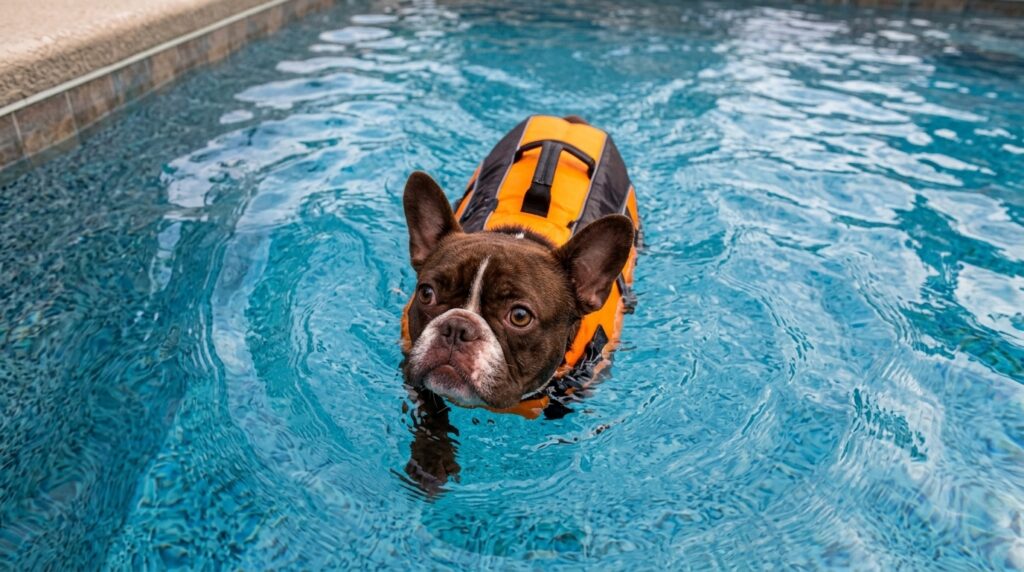
For this breed, the answer is yes: a life jacket is essential gear for any French Bulldog swimming beyond ankle-deep wading, not a cute accessory. Given everything above, flotation isn’t overkill; it’s the thing keeping a front-heavy, easily-tired dog’s nose above the surface.
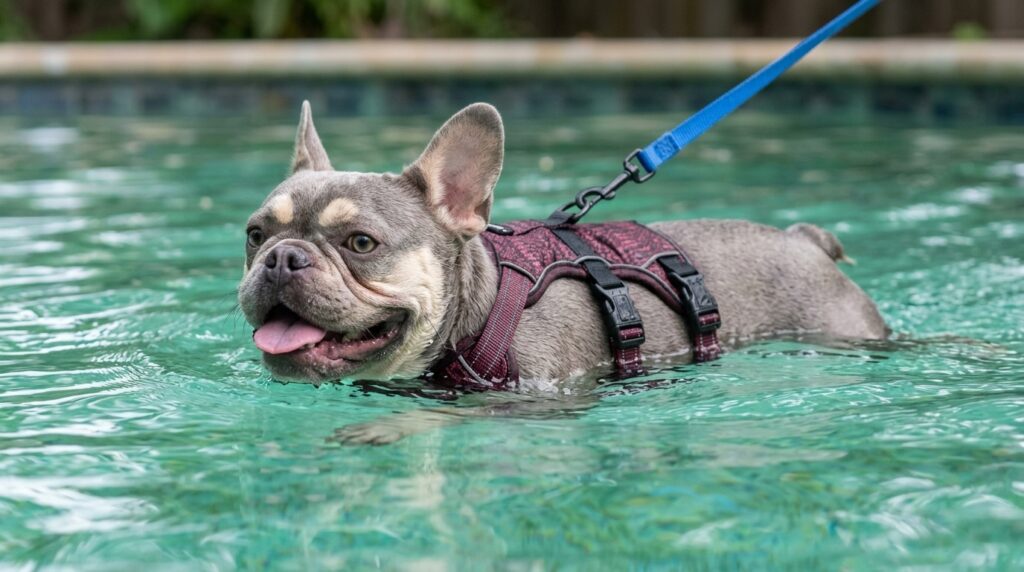
But not just any dog life jacket will do, because most are designed for longer, lighter-headed breeds. For a barrel-chested Frenchie, a few features genuinely matter. You want strong buoyancy under the chest and especially under the chin and neck, so the heavy head is held up without forcing the dog to crane its neck, which would only worsen the airway. You want a sturdy top handle, properly reinforced, so you can lift the full weight of your dog straight out of the water in a hurry. You want a secure, adjustable fit at neck, chest, and belly, because a jacket that rides up or spins on that barrel body can shift over the airway. And the straps must not compress the neck or chest, since even mild pressure there can make a tight airway worse. A well-designed Y-front French Bulldog life jacket that ticks those boxes is one of the few pieces of summer gear I’d call non-negotiable for safe French Bulldog swimming.
Sizing is worth doing carefully. Measure the chest girth at its widest point, the neck, and the body length from neck base to tail base, fit it so you can slip two fingers under any strap, and test it on land first while watching that your dog’s breathing doesn’t change. Then try it in shallow, controlled water before trusting it anywhere deeper. One honest caveat: dog life jackets are unregulated, with no safety-testing standard like human life vests have, so marketing claims aren’t independently verified. Choose on fit and construction, not on buoyancy numbers printed on a tag.
Can French Bulldog Puppies Swim?
When it comes to puppies, French Bulldog swimming is a wait-and-go-slow situation, because puppies are more vulnerable than adults, not less. A French Bulldog puppy shouldn’t meet water beyond a shallow splash until it has finished its primary vaccinations, usually around fourteen to sixteen weeks, to avoid waterborne infections. Beyond that, puppies have immature temperature control and less stamina than grown dogs, so a conservative approach delays any real water introduction until at least six months, ideally after a vet has assessed the puppy’s airway. There is no rush. A Frenchie that never learns to love deep water has lost nothing.
Since most Frenchies can’t swim safely on their own, the right flotation isn’t optional, it’s the single most important piece of water gear you’ll buy. If you’ve decided your dog will be near water this summer, our guide to choosing the best French Bulldog life jacket walks through the chin-float and fit features that actually matter for a barrel-chested, heavy-headed breed, plus real options across price ranges.
Teaching a French Bulldog to Swim Safely
If you do decide to introduce your dog to water, safe French Bulldog swimming means controlled confidence, never a sink-or-swim test. Several conditions need to be true first: your dog shows no breathing trouble at rest or with light activity, wears a well-fitted life jacket, and is in shallow, calm, warm water with you within arm’s reach, an easy exit nearby, and sessions kept to a few minutes.
Start where the dog can stand comfortably and let it choose to enter; never throw a French Bulldog into water or carry it into the deep end. Support the body, especially the hindquarters, which tend to sink, during those first attempts. Watch like a hawk for panic, fatigue, or any change in breathing, and end the session the instant you see it. Reward calm, and never punish a dog for being reluctant; reluctance around water is often good instinct in this breed. The aim of any French Bulldog swimming session is a dog that’s relaxed and safe in a few inches of supervised water, not one doing laps.
Drowning and Water Emergencies: What Every Owner Should Know
The emergency side of French Bulldog swimming starts with knowing that drowning in dogs is usually silent. There’s rarely the dramatic splashing people expect, so learn the quieter signs: the head tipping back with the mouth near the waterline, a vertical body with frantic but useless paddling, glassy eyes, no forward progress, or a sudden stop. In a Frenchie, fatigue can arrive faster than you’d believe given how quickly these dogs run out of air.
If the worst happens, act fast. Get the dog out immediately, using the life jacket handle if it’s wearing one. Briefly hold it with the head lower than the body to let water drain, but don’t swing the dog. Check for breathing and a pulse; if it isn’t breathing, give rescue breaths mouth-to-nose with the mouth held closed, keeping the airway as open as you can. If there’s no pulse, begin chest compressions with the dog on its side at roughly one hundred to one hundred twenty per minute. Then get to an emergency vet no matter how recovered the dog seems.
That last point matters enormously and is widely misunderstood. Even after a dog seems fine, inhaled water can trigger delayed lung inflammation and pneumonia in the hours that follow. “Dry drowning” isn’t a real separate diagnosis, but the underlying danger, delayed respiratory trouble after water gets into the lungs, is very real, and it’s the reason French Bulldog swimming demands an extra-cautious aftercare habit. For at least twenty-four to seventy-two hours, watch for coughing, faster or harder breathing, lethargy, blue-tinged gums, nasal discharge, or refusing food, and treat any of them as an emergency. Because these dogs have so little respiratory reserve, the threshold for calling the vet should be lower than for any other breed.
Frequently Asked Questions
A Final Word
If there’s one message I’d press into every Frenchie owner before summer, it’s that French Bulldog swimming is a situation to manage carefully, not a fun default to assume. Most of these dogs are built in a way that makes water genuinely risky, and the airway that defines the breed is exactly what makes drowning fast. That doesn’t mean your dog can never enjoy a shallow, supervised paddle on a hot day. It means flotation, supervision, and good judgment aren’t optional.
I write all of this from the perspective of someone who learned too late how serious this breed’s airway limitations can be. You don’t have to learn it that way. Respect the water, gear up properly, stay within arm’s reach, and let your vet weigh in on whether your individual dog should be in water at all. Handled with care, French Bulldog swimming can be a brief, joyful, completely supervised part of summer rather than a tragedy waiting to happen.
This article is educational and is not a substitute for veterinary care. Always consult your own veterinarian about your dog’s health and any water activity.


French Bulldog Diarrhea: Causes, Treatment, What to Give, and When to Worry
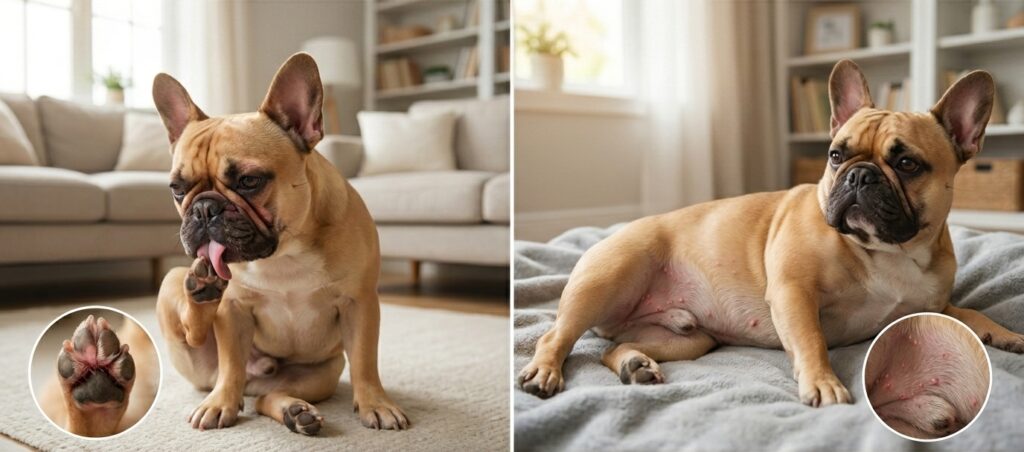
French Bulldog Allergies vs Skin Infection: How to Tell the Difference
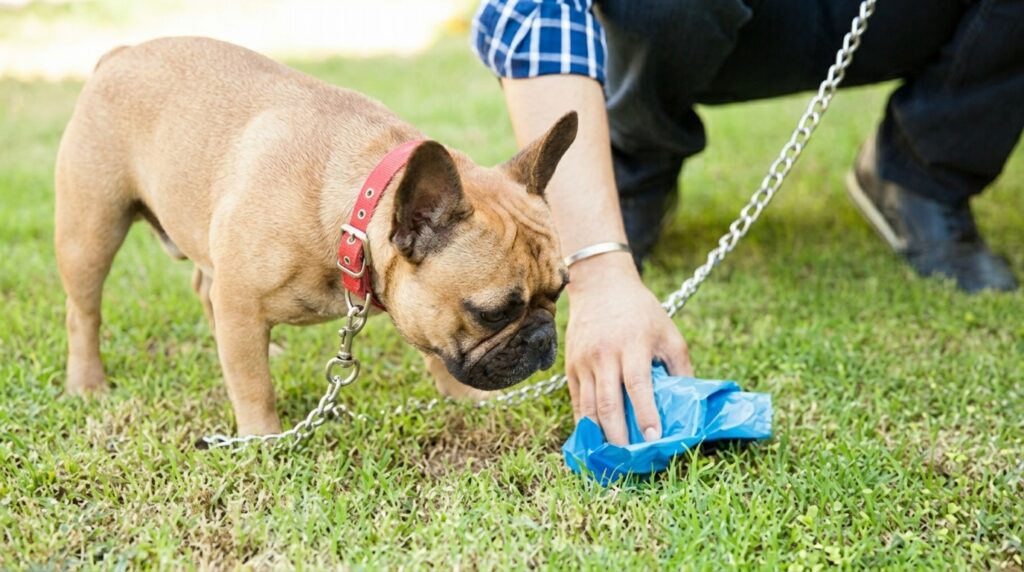
French Bulldog Poop Chart: What Healthy, Soft, and Runny Stools Really Mean
French Bulldog Eye Issues: Common Problems, Warning Signs, and When to See a Vet

Best Dog Food for French Bulldogs: Complete Nutrition Guide 2026