Written by Jinna CAMERON, veterinary medical student and dog health researcher. Reviewed for factual accuracy against trusted veterinary sources by DVM Carla DONTESK
If you’re on your third accident of the day and quietly wondering whether your dog is broken, let me reassure you: your Frenchie is normal, and so is your frustration. House training a French Bulldog is genuinely harder than it is with many breeds, and that’s not a reflection of your effort or your dog’s intelligence. Once you understand why they’re difficult, the whole house training process gets easier, because you stop fighting their nature and start working with it.
I run this site after losing my own French Bulldog, Pearly, and I’d rather tell you the honest truth than sell you a five-day miracle. This will take months, not days, and that’s completely normal. I’m a veterinary medical student and dog-health researcher, not a certified trainer, so for a dog that’s genuinely stuck, a good trainer is worth every penny. But the method here is exactly what works for this breed, and if you stick with it, you’ll get there.
Are French Bulldogs Hard to House Train?
Yes, and it helps enormously to hear that plainly. French Bulldogs are widely considered harder to house train than average, taking noticeably longer than breeds like Labradors or German Shepherds that often grasp the basics in a couple of weeks. Understanding exactly why house training is such a struggle comes down to their temperament, and it’s genuinely useful to know.
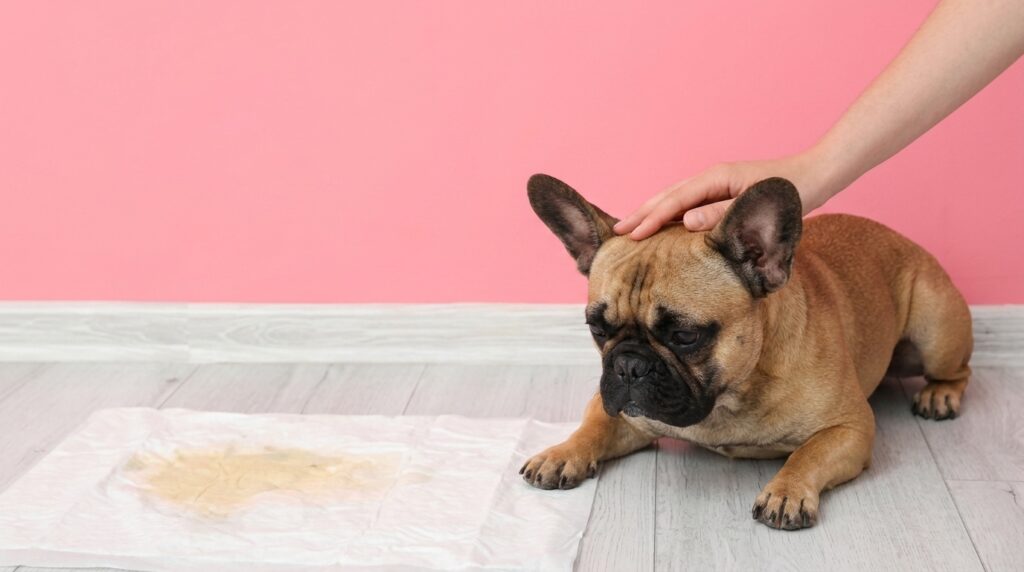
The core issue is that Frenchies are smart but not especially eager to please. A Labrador will work hard simply to make you happy; a French Bulldog wants to know what’s in it for them. They’re intelligent and naturally clean dogs, but they have a stubborn, independent streak, which means training that isn’t rewarding gets ignored. If going to the toilet in the right place doesn’t reliably pay off, your Frenchie will simply decline to participate. On top of that, they’re easily distracted and overstimulated, which creates one of the most common frustrations you’ll face, and they have small bladders with limited early control. None of this makes house training impossible. It just means house training a French Bulldog rewards a specific, patient, reward-based approach rather than raw repetition or, worst of all, punishment.
How Long Does It Take? And at What Age?
Set your house training expectations here and you’ll save yourself a lot of anguish, because unrealistic timelines are where most owners lose heart. Most French Bulldogs need around four to six months of consistent training to become reliably house trained, with a realistic range that stretches to eight months and, for some dogs, a bit longer. Full, trust-them-anywhere reliability often lands somewhere between six and nine months. That’s markedly slower than many breeds, and comparing your Frenchie to the neighbour’s quick-learning retriever will only demoralise you.
You can start house training the moment you bring your puppy home, usually around eight weeks old. Bladder control develops gradually: expect very little in the early weeks, noticeably better control around four to six months, and the ability to hold it for a couple of hours by the eight-to-twelve-month mark. The single best measure of progress isn’t a calendar, it’s the trend. If accidents are getting fewer week by week, house training a French Bulldog is going exactly as it should, however slow it feels. If they’re not decreasing at all after several weeks of genuinely consistent effort, that’s your cue to consult a trainer or your vet rather than to push harder.
The Method That Works
Successful house training a French Bulldog rests on four things working together: a crate, a consistent schedule, active supervision, and immediate reward. Skimp on any one and house training drags on far longer than it needs to. Miss one and the whole thing wobbles, so it’s worth understanding how they fit.
The crate is the backbone. Dogs have a strong instinct not to soil the place they sleep, so a correctly sized crate teaches bladder control in a way nothing else quite matches, and it’s the single most effective house-training tool you have. If you haven’t set one up yet, our full guide to crate training a French Bulldog walks through doing it kindly and gradually, which matters, because a crate only helps if your dog feels safe in it. Alongside the crate, active supervision means keeping your puppy where you can see them whenever they’re loose, so you catch the pre-potty signals, the circling, sniffing, and sudden restlessness, before an accident rather than after. Baby gates and restricting access to hard-to-clean rooms make this manageable, keeping your Frenchie in easy-clean, supervised areas until they’ve earned more freedom.
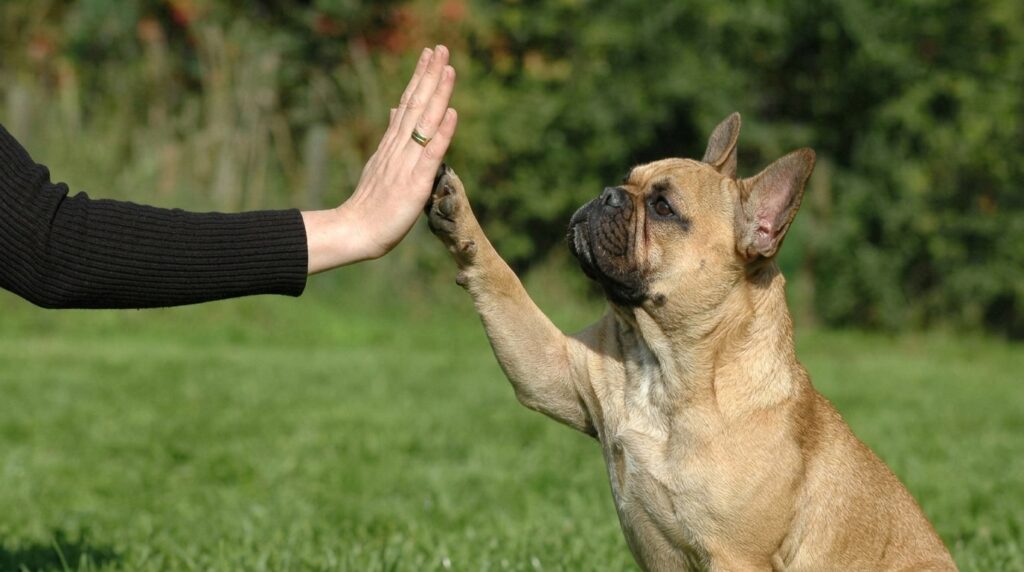
Then there’s the reward, and this is where the breed’s temperament makes or breaks you. The instant your dog finishes in the right spot, and I mean immediately, not once you’re back inside, mark it with excited, high-pitched praise and a small treat, paired with a consistent phrase like “good potty” — a core positive-reinforcement principle that applies to any dog but matters doubly for this breed. That immediacy is everything: a reward thirty seconds later teaches nothing, because your dog can’t connect it to what they did. For a dog that only participates when it pays, making the right behaviour reliably and instantly rewarding is the entire game.
A Realistic Potty Schedule
Structure is what turns four scattered good intentions into an actual house training routine, and Frenchies thrive on predictability. The foundation of house training is simple: take your puppy out often, at the moments they’re most likely to need it, and reward every success.
Take your Frenchie to their designated potty spot after they wake from any sleep, after every meal, after drinking, and before and after play, since excitable Frenchies often need to go around activity. Beyond those anchor points, a young puppy generally needs a trip outside every one to two hours while awake. The classic mistake is expecting far too much too soon: a ten-week-old puppy simply cannot hold their bladder for five hours, and a rough guide is that a puppy can manage about one hour per month of age. Establishing regular feeding and drinking times helps enormously here, because predictable input makes for predictable output, and you’ll quickly learn your own dog’s rhythm.
One breed-specific safety note that matters more than people realise. Because French Bulldogs overheat so easily, keep potty trips short in hot weather and never leave your dog sitting in the sun waiting to go, which can tip a brachycephalic dog toward genuine heat exhaustion. If you’d like the full picture on that risk, our guide to French Bulldog breathing problems explains why this breed handles heat so poorly. A quick, focused potty trip is safer than a long, hot vigil in every sense.
The “Pees the Moment We Come Back Inside” Problem
This one deserves its own section, because it’s the single most common house training frustration Frenchie owners describe, and it feels maddening: you stand outside for fifteen minutes, your dog does nothing, you come in, and thirty seconds later there’s a puddle on the floor.
Here’s what’s actually happening. Your Frenchie spent their outdoor time sniffing, exploring, and being thoroughly stimulated by the world, rather than focusing on the one job you took them out for. Then they come back into the calm, familiar house, finally relax, and their bladder catches up. It isn’t defiance, it’s distraction. The fix is to make outdoor potty trips boring and focused: go to the same designated spot, keep things low-key with no play or exploring until after they’ve gone, give them a few quiet minutes, and only then reward and let the fun begin. Save the walk, the sniffing, and the play as the reward for eliminating, not as the thing that derails it. Once your dog learns that going is what unlocks the good stuff, the after-the-fact accidents fade fast.
Handling Accidents Without Making Things Worse
Accidents aren’t failures, they’re an unavoidable part of house training, and how you respond to them genuinely affects how fast your dog learns. The most important rule is the hardest to follow in the moment: never punish.
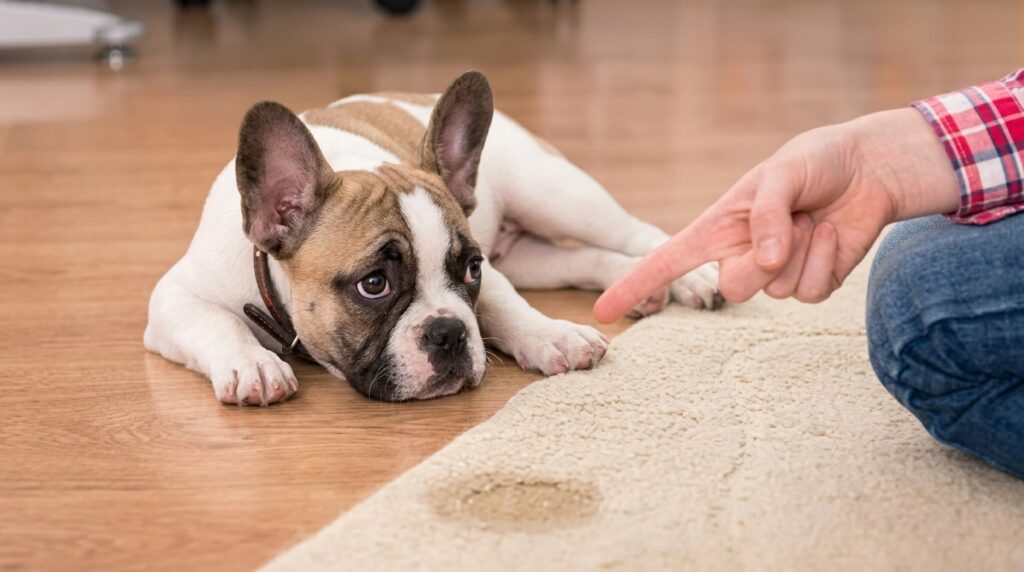
Yelling, scolding, or the old nonsense of rubbing a dog’s nose in it does real harm. It creates stress and anxiety, which actually increase accidents rather than reduce them, and it damages the trust between you and your dog, which for a Frenchie is the very thing motivating them to cooperate. A frightened dog doesn’t learn where to go; it learns to hide from you and to be nervous about eliminating at all. So if you catch your dog mid-accident, calmly interrupt, a cheerful “oops, outside” rather than a shout, and take them straight to their spot. If you only find the mess afterward, there’s nothing to do but clean it up and tighten your supervision, because punishing after the fact means nothing to the dog.
How you clean matters more than you’d think. Dogs have a sense of smell around ten thousand times more sensitive than ours, so if any trace of scent lingers, your Frenchie will read that spot as an approved toilet and return to it. Ordinary household cleaners don’t remove the odour they can detect, so an enzymatic cleaner made for pet accidents is genuinely essential rather than optional, and stubborn spots sometimes need two or three passes to fully eliminate the smell. Getting the scent out is honestly half the battle in house training a French Bulldog.
Pee Pads: Helpful or a Hindrance?
Pee pads are a reasonable house training tool in the right situation, but they come with an honest trade-off worth understanding before you commit to them. They genuinely help apartment dwellers, owners without quick outdoor access, and very young puppies who can’t yet make it outside in time, giving you a designated indoor spot rather than a random one.
The catch is that pads teach your dog it’s acceptable to eliminate indoors, which can slow the eventual transition to going fully outside, since you’re effectively training two locations. If your goal is an outdoor-only dog, pads can add a step rather than remove one. If you do use them, cleanliness is critical, and this is very much a Frenchie trait: these dogs are particular about cleanliness and will refuse a soiled pad, going hunting for fresher ground instead, so change disposable pads as soon as they’re used or at least twice a day. Used deliberately, as a stepping stone or a genuine necessity, pads are fine. Used as a lazy default, they can quietly stall your progress.
Regression and When to Call the Vet
Here’s a scenario that panics owners: your Frenchie was doing brilliantly, and then suddenly the accidents come back. Take a breath, because house training regression is common and usually temporary. It shows up most often during adolescence, when a young dog tests boundaries, and around stress or changes in routine like a house move or a new schedule. The fix is simple: go back to the two-hour house training schedule and tighter supervision for about a week, and normal service usually resumes.
But there’s an important exception that’s easy to miss. Sometimes what looks like a training problem is actually a medical one. Urinary tract infections in particular cause sudden accidents in a previously reliable dog, and other health issues can too. So if regression persists beyond a few days despite you going back to basics, or if it’s accompanied by signs like straining, frequent tiny wees, or blood, see your vet to rule out a medical cause before assuming it’s behaviour. In fact, a vet check early in the whole process is sensible anyway, to confirm there’s nothing physical standing in the way of productive training. A dog can’t be trained out of a problem that needs treating.
A Quick Word on Frenchie Hygiene
One small breed-specific thing owners ask about while house training: do you need to wipe a French Bulldog after they poop? For most dogs it’s not routinely necessary, but this breed’s folds and, in some dogs, a tail pocket can trap moisture and debris, so a gentle wipe and keeping those areas clean and dry is good general hygiene. If your Frenchie has a deep tail pocket that gets messy or smelly, that’s worth staying on top of, and our guide to tail pocket care covers how to keep it healthy. It’s a minor point next to the training itself, but it’s a genuine part of living with the breed.
Frequently Asked Questions
The Bottom Line
House training a French Bulldog is a test of patience more than technique, and knowing that upfront changes everything. These dogs are stubborn, distractible, and slow to fully train, not because anything is wrong, but because that’s the breed. Meet that with a crate, a steady schedule, close supervision, instant rewards, and an enzymatic cleaner for the inevitable accidents, and house training a French Bulldog ends in a reliably trained dog, just on Frenchie time rather than Labrador time.
Having lost a Frenchie myself, I know how much these dogs give back for the patience they ask of us. The messy months pass, and what you’re left with is a clean, confident dog and a stronger bond for having done it kindly. Skip the punishment, keep the faith, celebrate every success like it’s a triumph, and trust that your stubborn, wonderful little dog will get there. They always do.
This article is educational and is not a substitute for professional training or veterinary advice. If accidents persist or you notice signs of illness, consult your veterinarian to rule out a medical cause.

French Bulldog Cost in 2026: Price, Vet Bills, and the True Lifetime Cost
French Bulldog Temperament: Personality, and Are They Good Family Dogs?
Best Dog Toothpaste for French Bulldogs: A Vet-Guided Guide
Do French Bulldogs Shed? Coat, Grooming, and When to Worry
Why Your French Bulldog Chews Everything (and How to Stop It)