Written by Jinna CAMERON, veterinary medical student and dog health researcher. Reviewed for factual accuracy against trusted veterinary sources by DVM ,Carla DONTESK
French Bulldog skin infection is one of those topics that sound simple at first, but in practice they often sit on top of a bigger pattern. An owner may notice redness, odour, crusting, or a damp patch of skin and assume it is a one-off problem. In French Bulldogs, though, these skin changes are often linked to folds, itching, allergies, ear disease, or repeated moisture that makes the skin barrier break down more easily.
As a veterinary medical student, what stands out to me most in the literature is not just that French bulldogs get skin problems often, but that the breed tends to get them in the same predictable places and for the same predictable reasons. That makes this issue easier to understand once you look at the underlying pattern rather than only the visible lesion.
This article focuses on what a French Bulldog skin infection can look like, why the breed is prone to it, how bacterial and yeast patterns can differ, what owners can safely do while waiting for a vet appointment, and when the situation becomes urgent. It is educational only and not a substitute for veterinary care.
Why French Bulldogs are so prone to skin infections
French Bulldogs have a few breed traits that make a French Bulldog skin infection more likely than in many other dogs. The biggest one is confirmation. Their facial folds, neck folds, tail folds, and smaller areas of skin-on-skin contact create warm, moist pockets where bacteria and yeast can thrive. When the skin stays damp, even briefly and repeatedly, the barrier becomes irritated and easier to infect.
Large primary-care studies have shown how strong this predisposition can be. Skin fold dermatitis is markedly over-represented in French bulldogs compared with other dogs, and one study reported very high odds ratios for the breed when compared with crossbreds and non-French bulldogs. Cutaneous disorders were also one of the most common disease groups in French Bulldogs overall. That does not mean every dog will develop a French Bulldog skin infection, but it does explain why owners of this breed often deal with skin care as an ongoing part of life rather than an occasional issue.
Moisture is only part of the story. French Bulldogs are also predisposed to allergic skin disease, and itching is one of the fastest ways to turn irritation into a French Bulldog skin infection. Dogs that are constantly licking, scratching, or rubbing one area damage the skin surface and create an opening for bacteria to take hold. If your dog already has a history of chronic itch, our guide on French Bulldog Allergies explains the allergy side of that cycle in more detail.
Another important factor is that French Bulldogs can show skin disease early in life. Atopic dermatitis often appears young in this breed, and it commonly affects the lip folds, tail folds, and paws. In the data you shared, those areas showed up repeatedly: lip folds in 64% of cases, tail folds in 27%, and paws in 73%. That pattern matters because those same sites are where a French Bulldog skin infection often starts.
There are also secondary factors to keep in mind. French Bulldogs are predisposed to otitis externa, so a dog that scratches at an ear can create a sore around the head or neck that later becomes infected. Some dogs also have juvenile-onset demodicosis, which can be complicated by secondary bacterial infection. In other words, a French Bulldog skin infection is often not the first problem. It is the result of something else already happening underneath.
What a French Bulldog skin infection can look like
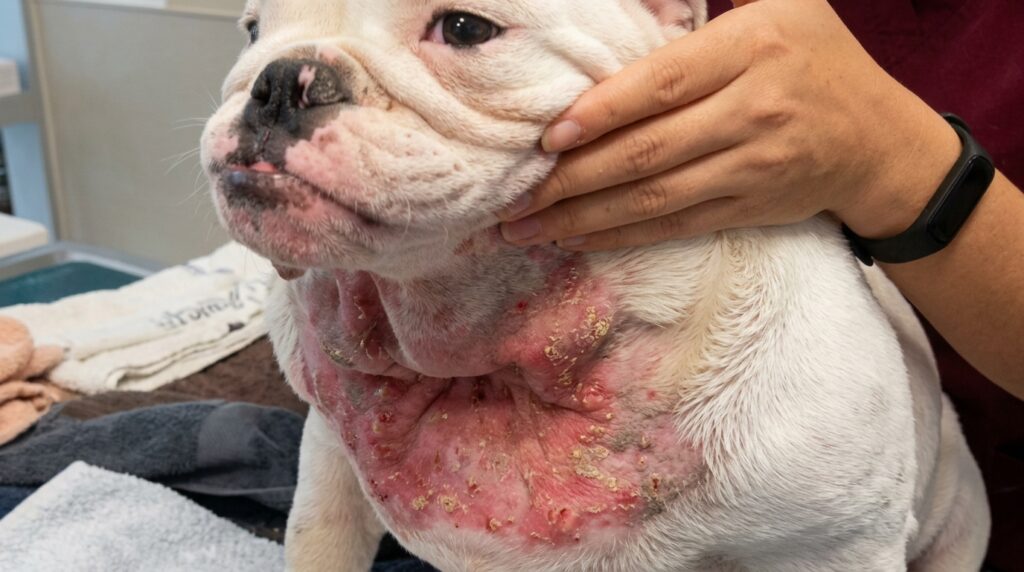
A French Bulldog skin infection can look different depending on whether bacteria, yeast, or both are involved. That is one reason owners often find the condition confusing at first. The skin may look irritated in a way that could also fit allergies, hot spots, or simple moisture-related dermatitis.
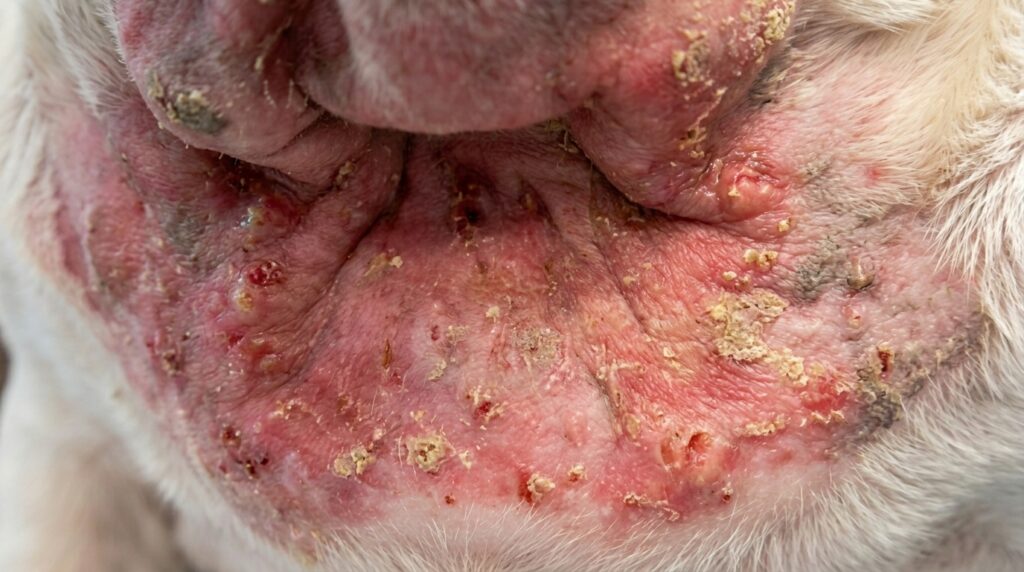
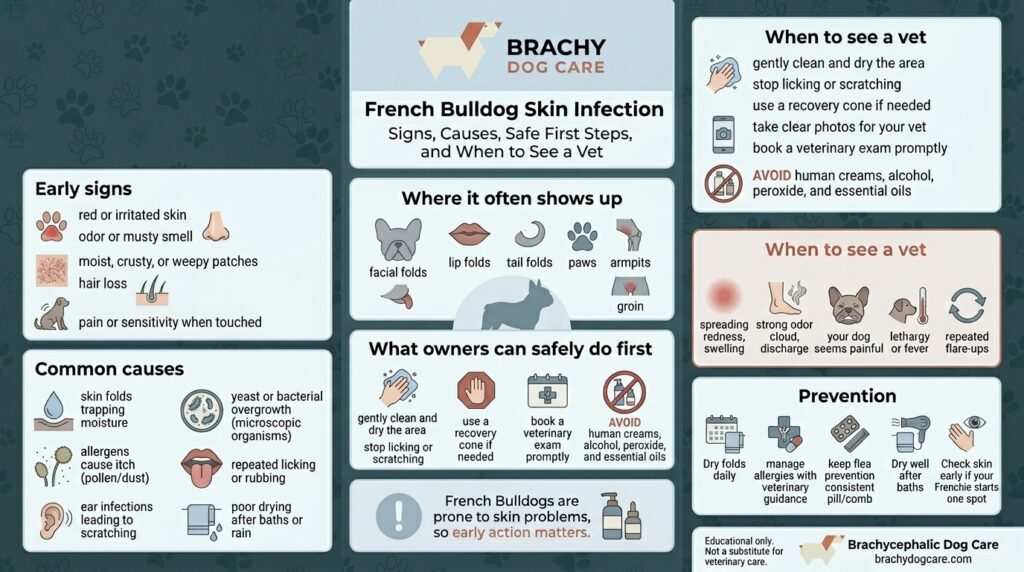
Common signs of bacterial skin infection in dogs include:
- redness
- small bumps or pustules
- crusting
- hair loss
- darker or thickened skin over time
- a musty or unpleasant odor
- pain or sensitivity when touched
In a French Bulldog skin infection, those signs often show up around the folds, paws, belly, groin, armpits, tail base, or neck. If the skin is hidden inside a fold, it can be easy to miss until the odour or discharge becomes obvious. That under-recognition is common in fold disease, which is one reason a visible photo is not enough to know what is really happening.
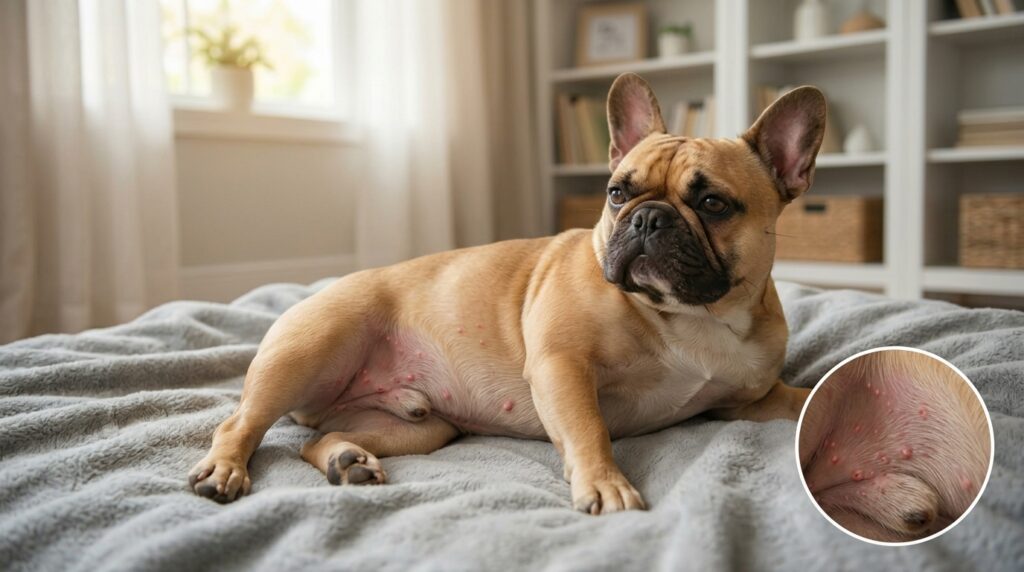
If you were searching for pictures, that makes sense. Visual comparison can help owners notice that something is off. But pictures online cannot confirm diagnoses, because different problems can look very similar. A red, moist patch might be bacterial pyoderma, yeast dermatitis, a hot spot, or a combination of all three. For a related example of how quickly skin trauma can become more serious, see our article on French Bulldog Hot Spots.
Yeast-related skin infections often look a little different. Malassezia dermatitis tends to create greasy buildup, odor, darkened skin, and sometimes lichenification, which is thickening of the skin from chronic irritation. Bacterial infection more often shows pustules, dry crusts, and patchy hair loss. In reality, both can overlap. Many French Bulldogs do not have a neat “bacterial only” or “yeast only” picture.
The most common locations are usually the places owners forget to check carefully:
- facial folds
- lip folds
- tail folds
- paws
- armpits
- groin
- neck folds
If a dog keeps licking one paw or rubbing at the face, that can be an early clue that a French Bulldog skin infection is forming before it becomes obviously visible. For that reason, our article on French Bulldog Itchy Skin is a useful companion piece, because itching is often what starts the whole process.
One more point that matters clinically: skin fold dermatitis can be easy to overlook because the lesion sits inside the fold, where the owner may not see it clearly. In one large study, diagnosis was supported by laboratory testing in only 4.21% of skinfold dermatitis cases, which suggests that many problems are under-investigated until they become more chronic. That is not a reason to panic. It is simply a reminder that hidden skin disease is easy to underestimate.
French Bulldog skin infections vs allergies: why the distinction matters
Many owners want a simple answer to whether the problem is “just allergies” or a true infection. The honest answer is that the two often happen together. Allergies can cause itching, and itching can damage the skin, and damaged skin can then become infected. So the question is not always whether the dog has one or the other. Sometimes the more useful question is whether the infection is sitting on top of an allergic problem.
That matters because the visible skin changes may improve temporarily with generic cleaning, but if the itch is still there, the French Bulldog skin infection may come back. In dogs with atopic dermatitis, secondary bacterial or yeast infection is common. In the research you shared, concurrent yeast infection was reported in about 28–33% of dogs with atopic dermatitis, and bacterial infection in about 55–66%. That is a big part of why repeated flare-ups are so frustrating for owners.
This is also why comparing a French Bulldog skin infection with allergies is not just an academic exercise. It changes the plan. If the underlying itch is ignored, the skin keeps getting re-traumatised. If the infection is ignored, the dog stays uncomfortable and the skin barrier keeps breaking down. The best outcomes usually come from treating both parts of the problem, with a veterinarian deciding what belongs in each case.
If the dog already has allergy signs like paw licking, face rubbing, recurrent ear problems, or seasonal itching, it is worth looking at the broader pattern rather than only the current lesion. When allergies are driving the process, a French Bulldog skin infection is often the secondary event, not the root cause.
When a skin problem becomes urgent
Not every French Bulldog skin infection is a true emergency, but some signs should move the problem from “watch closely” to “see the vet soon”. The main red flags are deep infection, rapid spread, significant pain, or signs that the dog is feeling unwell.
Call your veterinarian promptly if you notice:
- draining tracts or nodules
- swelling that is getting worse
- rapidly spreading redness
- strong pain or crying when touched
- fever, lethargy, or inappetence
- a foul odor that is getting stronger
- the dog refusing to eat or drink normally
- the skin is open, raw, or bleeding
- the lesion is near the eye, ear, or mouth
Deep pyoderma and furunculosis are more serious than simple surface irritation. A dog already prone to skin disease deserves fast attention. In the research you shared, severe complications of demodicosis with deep and extensive pyoderma were highlighted as potentially serious and even life-threatening. That is not the usual outcome, but it is why we do not want owners trying to guess their way through a worsening lesion at home.
A French Bulldog skin infection can also spread into the surrounding tissues if it is ignored, especially when the skin folds remain moist or the dog keeps scratching. In the case of recurrent fold disease, infection may also contribute to ear trouble or deeper inflammation. This is one of those areas where waiting too long usually makes the final treatment harder.
What to do while waiting for a vet appointment
If your French Bulldog skin infection is mild and you already have a vet visit scheduled, there are a few safe steps you can take while you wait. The goal is to keep the area from getting worse, not to “treat” it yourself.
You can:
- gently clean accessible folds with a soft, damp cloth
- dry the area thoroughly afterward
- prevent licking or scratching with a recovery cone if needed
- take clear photographs of the lesion for your veterinarian
- keep the dog from swimming or staying damp
- contact your vet sooner if the lesion spreads or becomes more painful
Some owners find it helpful to keep a veterinarian-approved, fragrance-free chlorhexidine wipe on hand for routine fold cleaning between visits. If your veterinarian says that product is appropriate for your dog, this can be a practical item to have in the home. If you later recommend a product on your site, this is a logical place for that recommendation.
What not to do is just as important:
- do not use human creams unless your vet told you to
- do not put on essential oils
- do not use hydrogen peroxide
- do not use alcohol
- do not delay veterinary consultation
These products can irritate the skin, slow healing, or be unsafe if licked. The most useful thing an owner can do is stop the licking, keep the area dry, and get a proper exam. That is especially true when the problem may really be a French Bulldog skin infection plus an underlying allergy or ear issue.
Not every French Bulldog skin infection looks the same. Some cases are more greasy, smelly, and itchy than others, especially when yeast is part of the picture. If you want to understand that version of the problem more clearly, see our guide on French Bulldog yeast skin infection.
How veterinarians usually diagnose and treat it
When a veterinarian examines a French bulldog’s skin infection, they usually start with a close physical exam and a good history. They want to know where the lesion started, how quickly it changed, whether there is an itch, whether the ears are involved, and whether the dog has had similar problems before.
Common diagnostic steps include:
- skin cytology
- skin scraping when mites are a concern
- ear exam if the dog is scratching the head or face
- culture in more complicated or recurrent cases
- allergy workup if the pattern suggests chronic itch
- assessment for concurrent skin fold disease
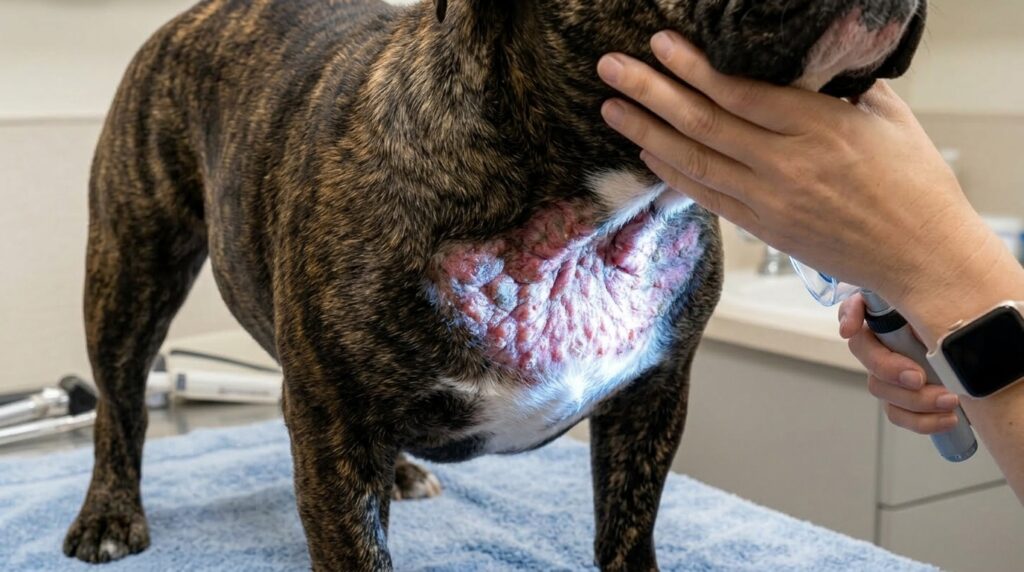
Cytology is especially useful because it can show whether bacteria, yeast, or both are present. That matters a lot in a French bulldog’s skin infection, because a dog with an itchy fold problem may need more than just a generic antimicrobial. If the infection keeps coming back, the vet may need to look deeper for allergies, follicular disease, or another chronic driver.
Treatment depends on severity and the underlying cause. Some cases need topical therapy only. Others need oral medication as well. The goal is to calm the infection, reduce inflammation, and stop the cycle that allowed the lesion to start.
For a clinician-focused overview of bacterial skin disease, the Merck Veterinary Manual page on pyoderma in dogs and cats is a solid, verified source: https://www.merckvetmanual.com/skin-disorders/bacterial-skin-diseases/pyoderma-in-dogs-and-cats
One point worth keeping in mind is duration. Superficial bacterial pyoderma often needs at least three to four weeks of appropriate antimicrobial therapy, although the exact timeline depends on the case, and your veterinarian should decide the final duration. If the underlying cause is atopic dermatitis, the dog may also need a longer-term management plan rather than a short course of medication alone.
That is a good reminder that a French Bulldog skin infection may improve before the true problem is fully solved. If the infection is only the visible result of a chronic allergy or fold moisture, the skin can relapse after the surface lesion looks better.
How long it takes to improve
Owners often want a clear timeline, and I understand why. When a French bulldog’s skin infection is uncomfortable, it feels urgent. The truth is that the healing timeline varies a lot depending on how deep the infection is, whether the dog is still licking the area, and whether the root cause is addressed at the same time.
Superficial cases may begin to look better within several days once treatment starts and the area is kept dry. More established infections, especially those involving folds, paws, or chronic itching, usually take longer. If the skin is thickened, darkened, or repeatedly traumatised, the healing process can be slower.
A simple way to think about it is this:
- if the lesion is improving steadily, that is a good sign
- if it is staying wet, spreading, or becoming more painful, the plan may need to change
- if the same spot keeps returning, the cause is probably still active
That last point matters a lot in French Bulldogs. Recurrent disease is common because the breed is predisposed to the same set of triggers over and over again: folds, moisture, itching, allergies, and ear disease. That is why a French Bulldog skin infection can be a one-time problem, but it can also be the first sign that a broader skin-care routine is needed.
How to help prevent future episodes
Prevention is not about perfect skin. It is about making the skin less vulnerable.
The most useful habits are often the simplest:
- inspect folds daily
- dry them thoroughly after drinking, bathing, or play
- keep flea prevention consistent
- address itch early
- monitor the ears
- avoid leaving the dog damp after bathing
- treat recurring licking or rubbing as a clue, not a nuisance
If your French Bulldog already has a pattern of itching, folds, or recurrent lesions, prevention usually means staying ahead of the cycle before it becomes another French bulldog skin infection. That is why owners often need to think about skin care as maintenance rather than rescue care.
The article on French Bulldog Allergies is helpful if the dog has a bigger itch pattern, and French Bulldog Hot Spots is a good follow-up if you are dealing with lesions that start after self-trauma. Those problems often overlap with skin infections rather than existing separately.
FAQs
Final thoughts
A French Bulldog skin infection is rarely just a single skin lesion with no context behind it. In this breed, it often connects back to folds, moisture, allergies, itch, or ear disease. That is why the best approach is usually not to guess, but to look at the pattern.
The good news is that many cases improve well when they are caught early, kept dry, and treated appropriately. The harder part is recognizing that the visible spot may only be the part of the problem you can see. If the infection keeps returning, there is usually a reason.
So if you are dealing with a French Bulldog skin infection right now, the safest next step is a veterinary exam. If your dog is prone to itch or fold irritation, daily skin checks and early intervention can make a big difference over time. And if you want to understand the broader skin cluster around this issue, the related articles on French Bulldog Itchy Skin, French Bulldog Allergies, and French Bulldog Hot Spots fit naturally with this one.
As always, this article is educational and based on veterinary literature and clinical patterns. Your veterinarian is the right person to examine your dog and create a plan that fits their individual needs.

French Bulldog Cost in 2026: Price, Vet Bills, and the True Lifetime Cost
French Bulldog Temperament: Personality, and Are They Good Family Dogs?

Best Dog Toothpaste for French Bulldogs: A Vet-Guided Guide
Do French Bulldogs Shed? Coat, Grooming, and When to Worry

Why Your French Bulldog Chews Everything (and How to Stop It)