Written by Jinna CAMERON, veterinary medical student and dog health researcher. Reviewed for factual accuracy against trusted veterinary sources by DVM Carla DONTESK.
If your dog gets tired quickly, pants hard after a short walk, or stops halfway through normal activity, that can be French Bulldog exercise intolerance. In this breed, that pattern is often not laziness. It is usually a physical limit. Sometimes it comes from airway anatomy. Sometimes heat makes it worse. Sometimes the dog is overweight or out of condition. And sometimes there is another medical problem behind it.
That matters because French Bulldogs are built differently from many other breeds when it comes to breathing and activity. Their shortened skull shape can narrow the airway and make breathing less efficient, especially during exercise. A dog may look bright and energetic indoors, then struggle outdoors once movement, heat, and breathing demand increase. If the dog is suddenly less able to exercise than before, that is worth paying attention to.
Exercise intolerance can also be a sign of something beyond BOAS. Heart disease, spinal disease, neurologic disease, pain, and poor physical condition can all make a dog tire early or stop moving sooner than expected. So even though BOAS is the most likely explanation in many French Bulldogs, it is not the only one. A new change in stamina should not be dismissed.
What French Bulldog exercise intolerance means
French Bulldog exercise intolerance means a dog cannot handle physical activity at the level you would normally expect for that dog, or cannot handle the level it used to tolerate. It is not the same as being lazy, stubborn, or simply not in the mood.
In French Bulldogs, French Bulldog exercise intolerance often shows up as a dog that starts a walk normally, then slows down much sooner than expected. Some dogs will stop and sit. Some pant heavily after only a short outing. Others make obvious breathing noises during activity and need more recovery time than you would consider normal. The issue is not only that the dog is tired. It is that the dog seems to reach a limit quickly.
Owners often notice it first during everyday activities rather than formal exercise. A dog may struggle with stairs, long walks, rough play, or even just walking at a moderate pace on a warm day. Some dogs are fine at rest but begin to show obvious strain once movement starts. That pattern is a clue.
If you want a more detailed breakdown of the airway side of this, I covered that in the BOAS Ultimate Guide for French Bulldogs. That article goes deeper into why flat-faced dogs can struggle with normal breathing and why exercise brings the problem out more clearly.
This is also why French Bulldog exercise intolerance is such an important phrase to keep in mind. Owners often search for tiredness, panting, slow walking, or reluctance to move, but the pattern behind those signs is the same. The dog is not tolerating exercise the way it should.
Why French Bulldog exercise intolerance happens
The short version is that French Bulldogs are brachycephalic dogs, which means they have a shortened skull and a flattened face. That facial shape is part of the breed standard, but it also changes the way air moves through the upper airway. The most important condition linked to this is BOAS, or brachycephalic obstructive airway syndrome.
BOAS is not one single defect. It is a combination of airway narrowing problems that can include narrowed nostrils, an elongated soft palate, and a smaller airway pathway overall. Some dogs also have a trachea that is narrower than ideal. Together, those changes increase resistance to airflow. The dog has to work harder to breathe. At rest, that strain may be mild. During exercise, it can become much more obvious.
That is why French Bulldog exercise intolerance can appear so easily. The dog can want to move and still not be able to sustain it safely. The body is demanding more oxygen, but the airway may not be able to keep up.
There is also a heat component. Dogs rely on panting to cool down. If breathing is already inefficient, cooling is less effective too. That makes French Bulldogs more vulnerable to heat stress and overheating during exercise. Warm weather, humidity, and excitement can all make the problem worse.
A lot of owners first come to the phrase French Bulldog exercise intolerance because they notice a dog that tires too quickly, but in practice what they are seeing is a breathing problem that becomes obvious only when the dog has to work. That is why the symptom matters. It is not just a fitness issue.
If you already saw panting as the main sign, the related article on French Bulldog Panting is useful too, because panting can be normal, or it can be one of the earliest signs that exercise is too much.
What French Bulldog exercise intolerance looks like in real life
Most owners do not notice this because of one dramatic episode. It is more often a pattern.
A French Bulldog with French Bulldog exercise intolerance may slow down much earlier than expected, lag behind repeatedly, or stop and sit during a walk that should not be that demanding. The dog may start panting hard after only mild activity. It may make louder breathing sounds when moving, especially if the air is warm or the dog is excited. Some dogs recover slowly after exercise and stay noisy or panting for longer than expected. Others act as if they want to continue but simply cannot keep up.
Sometimes the signs are subtle. The dog may just seem reluctant to move, lose interest halfway through a walk, or prefer to lie down after very little effort. The owner might think the dog is being stubborn. In some cases, that is a mistake. These dogs are not always choosing to stop. They may be reaching a physiologic limit.
Heavy panting after exercise is especially worth paying attention to. I covered that topic in more detail in French Bulldog Panting, because panting can range from normal recovery breathing to something that suggests strain or overheating.
It also helps to think about the rhythm of the problem. French Bulldog exercise intolerance is often not constant from minute to minute. A dog may seem fine, then a small increase in pace, excitement, humidity, or incline suddenly brings out the issue. That stop-start pattern is very common in brachycephalic dogs.
Some of the most common things owners notice are:
- the dog tires faster than expected
- the dog slows down before the walk should feel hard
- the dog pants heavily after mild activity
- the dog stops and wants to rest often
- the dog lags behind on walks
- the dog seems to recover slowly
Those signs are not proof of one diagnosis by themselves, but they are very consistent with French Bulldog exercise intolerance.
Normal tiredness versus concerning exercise intolerance
Not every tired French Bulldog has a medical problem. Dogs do get tired. They do have slower days. Some are not as fit as others. That part is normal.
The harder question is when the tiredness is too much.
Normal tiredness usually has some context. Maybe the walk was longer than usual. Maybe the weather was warm. Maybe the dog played harder than it normally does. In those cases, the dog should still recover fairly quickly once it rests. Breathing should settle. The dog should not look distressed. It should not seem weak or unsteady.
Concerning exercise intolerance is different. The dog tires after a short or easy walk. The breathing is loud, strained, or heavy. The recovery is slow. The dog may stop abruptly, hesitate to move, or look like it is working too hard for the amount of activity involved. If the dog used to handle the same routine with no issue and now cannot, that is especially important.
A useful rule is this. If a French Bulldog repeatedly struggles with activity that should be manageable for its age and condition, do not assume it is just lazy. Assume something is limiting it until proven otherwise.
Here are a few signs that make me more concerned about French Bulldog exercise intolerance rather than normal tiredness:
- the dog tires after a short or easy walk
- panting is heavy or does not settle normally
- breathing sounds loud, harsh, or strained
- the dog needs to stop repeatedly
- recovery takes longer than usual
- the dog seems weak, stiff, or hesitant to move
- the dog suddenly cannot do what it used to do
That list is not meant to scare owners. It is meant to help them notice the difference between a normal low-energy day and French Bulldog exercise intolerance that deserves attention.
If your Frenchie has started limping, refusing stairs, or acting strangely sore through the back, it is not always “just a pulled muscle.” In this breed, those changes can be early signs of intervertebral disc disease, or IVDD – a slipped disc pressing on the spinal cord. To help you tell the difference between a minor strain and a real emergency, we’ve put together a full, breed‑specific guide that covers early symptoms, emergency red flags, diagnosis, treatment options, and recovery. You can read it here: French Bulldog IVDD: Early Signs, Emergency Red Flags, and Treatment Options.
Common causes of French Bulldog exercise intolerance
BOAS is the main breed-related cause, but it is not the only one. A careful owner should think more broadly.
The most common reason is still airway-related. With BOAS, the dog may struggle to move enough air during exertion. That leads to faster fatigue, noisy breathing, and poor stamina. In some dogs, the issue becomes obvious when the dog is excited, hot, or pulling on a leash. In others, the signs are present even during a simple walk.
Heat stress is another major factor. French Bulldogs do not handle heat the same way many other dogs do. Their ability to cool down is less efficient, which means even a moderate outing can become too much in hot or humid weather. A dog may start out okay and then suddenly slow down, pant hard, or want to stop. That does not mean the dog is being dramatic. It means the body is struggling to keep up.
Obesity and poor conditioning can add to the problem. Extra weight increases the effort required for every step and can make breathing work harder too. A dog that is not used to regular activity may also seem to tire fast. In French Bulldogs, those issues can stack on top of BOAS and create a much lower exercise threshold than the owner expected.
Pain can also look like exercise intolerance. A dog with joint pain, back pain, knee issues, or another orthopedic problem may stop moving early because moving hurts. That is especially worth considering if the dog seems stiff, reluctant to jump, or uncomfortable when picked up. Sometimes the dog is not out of breath first. It is in pain first.
Neurologic problems should stay on the list too. If the dog is wobbly, stumbling, or uncoordinated, this is not simple tiredness. Ataxia, spinal disease, and conditions such as IVDD can change how a dog moves and can make it seem like the dog cannot tolerate exercise. That is one reason sudden changes in movement should not be guessed at from home.
Heart disease is less common than BOAS in this breed, but it is still important. If the cardiovascular system cannot meet the body’s demand during exercise, the dog may weaken, tire, cough, or struggle to continue. The Merck Veterinary Manual notes that exercise intolerance can reflect a range of underlying problems, not just one diagnosis, and that broader view is the right one here.
When you are trying to understand French Bulldog exercise intolerance, the main thing to remember is that the visible sign is usually only the surface of the issue. The real cause may be airway limitation, but it may also be heat, body condition, pain, or another disease process.
How much exercise is too much for a French Bulldog
There is no perfect number of minutes that works for every French Bulldog. That is the honest answer. Some dogs can handle short daily walks without much issue. Others need much tighter limits. The amount that is too much depends on the dog’s airway severity, weight, age, overall fitness, weather, humidity, and whether any other health issue is present.
That is why rigid rules can be misleading. A French Bulldog that seems fine for ten minutes one day may struggle sooner another day if the weather is warmer or the dog is more excited. A dog that is overweight or already noisy at rest will usually have a lower threshold. A leaner, well-managed dog may tolerate slightly more, but even then there are limits.
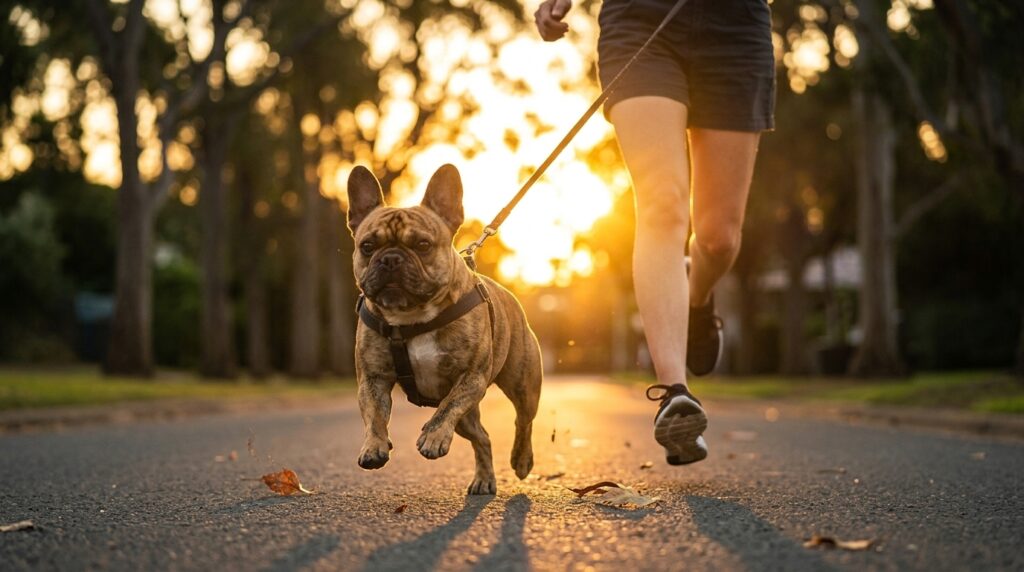
In practice, I would think in terms of short, calm, closely watched activity. Flat ground is better than hills. Cooler weather is better than heat. Gentle walking is safer than running or intense fetch. And the dog should always be allowed to stop before it gets into a struggle.
You may see people mention the “10-minute rule” online. That is not a formal veterinary standard. It is just an informal way owners try to keep exercise short and manageable. It can be a useful starting point, but the dog’s actual response matters more than the clock.
When I say French Bulldog exercise intolerance is not about one single time limit, I mean that literally. The same dog can have a good day and a bad day. The same dog can handle five minutes in cool weather and struggle after three minutes in heat. The body condition, the airway, the pace, the excitement level, all of that matters.
This is also where owners need to think in terms of patterns. One short walk with heavy panting does not always mean a crisis. Repeated episodes of French Bulldog exercise intolerance after routine activity are much more meaningful.
Tiring quickly is one of the clearest signs that an airway is working harder than it should, and it’s also one of the signals vets weigh when deciding whether a Frenchie might benefit from surgery. If your dog’s exercise tolerance keeps slipping despite careful management, it’s worth reading what BOAS corrective surgery involves so you can have an informed conversation with your veterinarian about whether it’s the right step.
What to do if your French Bulldog tires quickly after exercise
If your Frenchie starts showing signs of exercise intolerance during a walk or play session, stop the activity. Do not push through it. Do not try to finish the route just because it is almost over. In this breed, that can make a mild problem worse very quickly.
Move the dog to a cool, quiet place and let it rest. Shade or air conditioning is better than staying outside in the sun. Offer water in small amounts, but do not force it. Watch the breathing pattern carefully. The rate should start to slow once the dog is calm. The effort should ease. If it does not, that is a concern.
Do not restart exercise too soon. If the dog is already struggling, more activity can push it further into distress. If this happens often, or after very mild activity, the dog should be examined by a veterinarian.
A one-off episode on a hot day is one thing. Repeated episodes after short walks are another. That kind of pattern suggests the dog’s normal exercise tolerance is lower than it should be, or that something has changed.
For more context on breathing changes during activity, the article on French Bulldog Breathing Problems is useful too, because some owners first notice exercise intolerance as a breathing issue rather than a stamina issue.
A simple practical response looks like this:
- stop the activity
- move to a cool place
- let the dog rest quietly
- offer small amounts of water
- monitor breathing recovery
- do not restart too quickly
- contact a vet if it keeps happening
That approach is boring, but boring is good here. It reduces the chance of turning French Bulldog exercise intolerance into something more serious.
When French Bulldog exercise intolerance needs a veterinarian
A French Bulldog that struggles with exercise does not always need emergency care, but it does deserve a real veterinary assessment if the pattern is recurring or getting worse.
A routine veterinary visit is reasonable if the dog tires much faster than usual, has noisy breathing during mild exercise, recovers slowly after activity, coughs or gags after walks, or clearly seems to have lost stamina. Sudden decreases in exercise ability are especially important, even if the dog looks okay once it is back home.
Urgent care is needed if the dog collapses, cannot stand properly, has blue, gray, or very pale gums, or seems severely short of breath. Wobbliness, disorientation, severe weakness, or inability to rise are also red flags. Those signs go beyond ordinary fatigue.
Here is a simple way to think about it:
- mild tiredness that resolves quickly can be normal
- repeated early fatigue needs a veterinary exam
- collapse, blue gums, or severe breathing effort is urgent
The biggest mistake owners make is normalizing a change that is actually important. French Bulldogs do have breed-related limits, but that does not mean every limitation should be accepted without question. If the dog is changing, there is a reason.
This is the point where French Bulldog exercise intolerance stops being a casual observation and becomes a health concern. If the dog’s stamina is clearly worse than before, that deserves an exam even if the dog seems okay between episodes.
Practical ways to exercise a French Bulldog more safely
The goal is not to make the dog do more. The goal is to lower the risk of making the dog struggle.
Short, calm sessions are usually better than long ones. The dog should be watched closely rather than judged by a timer. A French Bulldog can look okay for a while and then hit a wall quickly, so the first signs of slowing down matter more than the planned route.
Weather matters a lot. Hot or humid conditions are a poor time for exercise in this breed. Early morning or later evening is often safer than midday. Flat routes are easier than hills. Pulling on a collar is not a great idea either, because airway pressure is not helpful in a dog that already has breathing limitations.
Weight control is also important. A leaner dog usually has less respiratory strain and less heat burden. This is not a quick fix, but it is one of the most useful long-term management steps.
Play should be managed with the same caution. Excited running, hard fetch, and rough play can push a French Bulldog past its limit. That does not mean the dog should never play. It means the play needs supervision and common sense.
A few practical habits help a lot:
- keep exercise short and calm
- avoid heat and humidity
- use flat routes
- watch breathing, not just time
- stop at the first sign of struggle
- keep body weight in a healthy range
The most useful habit, though, is learning your own dog’s normal baseline. If you know what normal looks like for your Frenchie, you will spot change sooner. That is often how an airway problem, pain issue, or neurologic issue gets noticed early.
When owners ask how to reduce French Bulldog exercise intolerance, this is usually where the real work starts. Not with a strict minute limit, but with better pacing, better weather choices, and closer observation.
Why sudden change matters so much
Owners often ask whether the dog has always been like this. That is a fair question, and in French Bulldogs some limitation may indeed be long-standing. But a sudden change is different.
If your dog used to handle a walk reasonably well and now tires after only a short distance, that is not something to ignore. If the panting is louder than usual, if the dog refuses to continue, or if the recovery is taking longer than it used to, a medical cause needs to be considered. The same is true if the dog becomes unsteady or weak.
A sudden change can mean worsening BOAS, but it can also mean pain, heart disease, or a neurologic problem. That is why this is not a guessing game. The pattern matters.
Alongside pacing walks and avoiding heat, bringing an overweight French Bulldog back toward their ideal body condition is one of the best gifts you can give their lungs and joints. If you’re not sure where your dog stands, the overweight French Bulldog article takes you through body condition scoring, safe calorie cuts, and gentle, realistic activity ideas.
FAQ about French Bulldog exercise intolerance
Final thoughts
French Bulldog exercise intolerance is common enough that many owners assume it is just part of the breed. Sometimes it is related to BOAS and body shape. Sometimes it is made worse by heat, weight, or low fitness. Sometimes it points to a separate medical issue that needs attention.
The important thing is not to guess too early. If your Frenchie gets tired quickly, pants hard after a short walk, or has a clear drop in stamina, watch the pattern closely and talk to a veterinarian. If there is collapse, blue gums, severe breathing effort, wobbliness, or inability to rise, that is urgent.
A French Bulldog should not have to struggle through normal activity. If the dog is showing you that it cannot keep up, take that seriously.
French Bulldog exercise intolerance is not a detail to brush past. It is a useful warning sign, and when owners notice it early, they are in a much better position to protect the dog.

French Bulldog Cost in 2026: Price, Vet Bills, and the True Lifetime Cost
French Bulldog Temperament: Personality, and Are They Good Family Dogs?

Best Dog Toothpaste for French Bulldogs: A Vet-Guided Guide
Do French Bulldogs Shed? Coat, Grooming, and When to Worry

Why Your French Bulldog Chews Everything (and How to Stop It)