A Veterinary Student’s Analysis of Thermoregulation, Fit, and Safety
By: Jinna CAMEROUN | 19-Year-Old Veterinary Medical Student, Brachycephalic Anatomy Specialist Reading Time: 15 Minutes
Introduction: The Physiological Reality French Bulldog Owners Must Face
If you are looking for the best cooling vest for French Bulldogs, you are taking a critical step in protecting your pet’s health. Let me start with a truth that keeps me up at night during my veterinary studies: Your French Bulldog is anatomically engineered to overheat.
I don’t say that to scare you. I say it as a 19-year-old veterinary student who spends hours dissecting brachycephalic airways and studying thermoregulation. When I look at a French Bulldog, I see a creature whose very existence challenges the laws of canine physiology. Their popularity has skyrocketed, yet few owners truly understand the thermal time bomb ticking inside their beloved pets.
Here’s what is happening inside your Frenchie’s body when the temperature rises.
French Bulldogs suffer from Brachycephalic Obstructive Airway Syndrome (BOAS). This isn’t just “loud breathing” or “cute snorting.” It’s a collection of anatomical abnormalities that creates a lethal disadvantage in hot weather. The condition includes:
- Stenotic Nares: Those tiny, pinched nostrils you might think are adorable? They are structural defects. They reduce airflow by up to 50% compared to a normocephalic (normal-headed) dog. Imagine trying to run a marathon while breathing through a coffee stirrer.
- Elongated Soft Palate: The soft tissue at the back of the throat is too long for the shortened skull. It hangs down, physically blocking the glottis—the opening to the trachea—during exertion. It acts like a stopper in a drain.
- Hypoplastic Trachea: The windpipe itself is narrowed. This creates a permanent bottleneck for air movement, reducing the efficiency of every single breath.
- Everted Laryngeal Saccules: During the struggle to breathe, small pockets of tissue in the larynx get pulled outward into the airway. This further obstructs the already limited space for air to pass.
The Cooling Crisis: Why Panting Fails Now, here is why this anatomy matters critically for cooling: Dogs do not sweat through their skin like humans do. Their primary, most effective cooling mechanism is panting.
Panting works by rapidly moving air over the moist surfaces of the tongue and respiratory tract. As the saliva and moisture evaporate, heat is carried away. It is an elegant system—unless your airway is obstructed.
How can a French Bulldog pant effectively when it can barely breathe at rest?
The answer is brutal: It can’t.
When a Frenchie pants, they must generate huge negative pressure in their chest to pull air through those narrowed nostrils and elongated soft palate. This effort generates internal heat. It is a vicious cycle: they pant to cool down, but the effort of panting heats them up further.
This is why heat stroke remains one of the leading causes of death in French Bulldogs. When the ambient temperature rises, your Frenchie’s body becomes a pressure cooker with no release valve. Their core temperature climbs faster than other breeds, and once hyperthermia sets in, organ damage begins within minutes.
I’ve spent the last three years studying evaporative cooling technologies specifically for brachycephalic breeds. I’ve tested vests on bulldogs with chest deformities, reviewed the thermal imaging data, and consulted with veterinary thermoregulation specialists.
In this comprehensive guide, I’m going to give you something you won’t find anywhere else: A veterinary-student-approved, anatomically-informed analysis of cooling vests for French Bulldogs.
We’ll cover:
- The actual physics of how cooling vests work (and their dangerous limitations).
- Why “Frenchie fit” is a medical necessity, not a comfort issue.
- Detailed reviews of five specific vest types through the lens of anatomy.
- When cooling vests save lives—and when they put your dog at risk.
If you’re a French Bulldog owner who wants the unvarnished scientific truth about keeping your dog alive in hot weather, you’re in the right place.
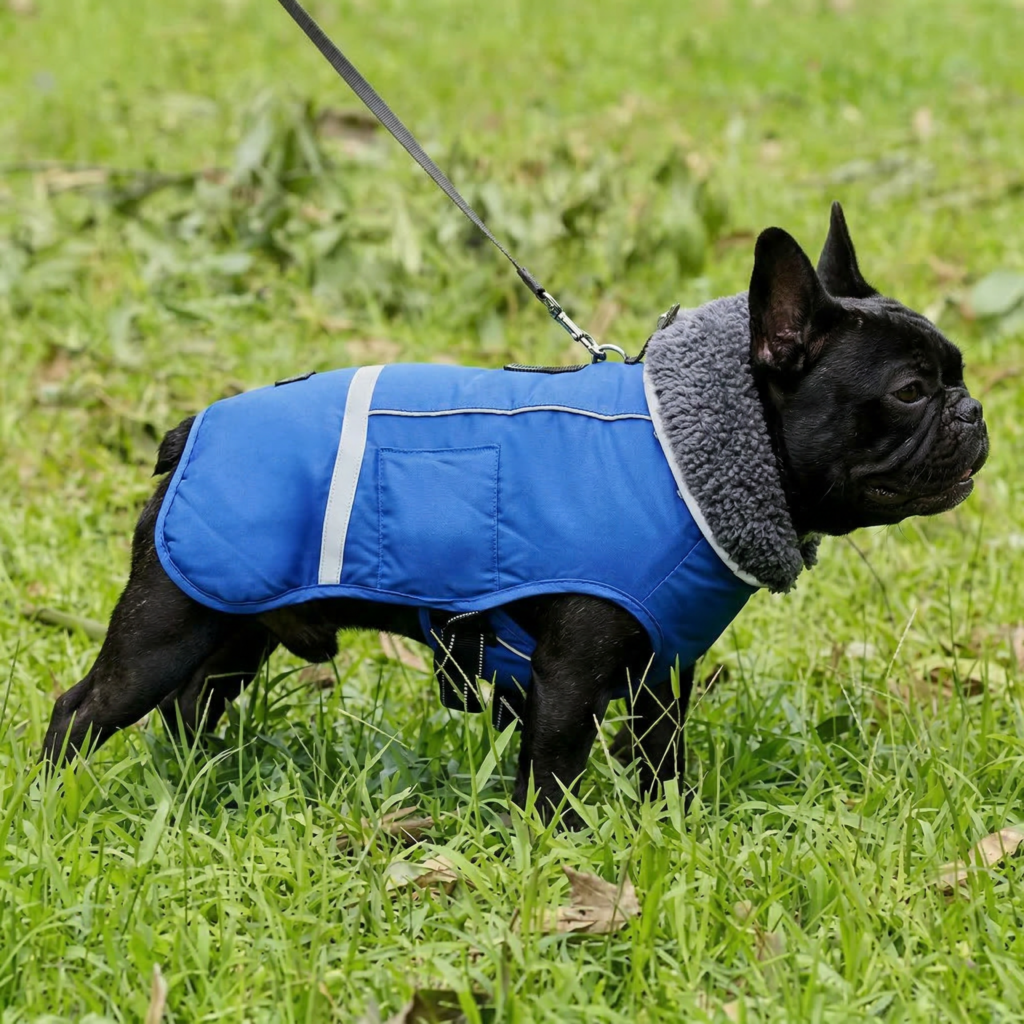
Section 1: The Science of Canine Cooling Vests
Before I recommend a single product, I need you to understand the physics. Because if you buy a cooling vest without understanding the mechanism, you’ll use it wrong—and your Frenchie will suffer the consequences.
Understanding Evaporative Cooling: The Physics Behind the Product
Most cooling vests for dogs utilize evaporative cooling technology. This is the same principle that makes sweat effective for humans, but it relies on external water rather than internal secretions.
Here is the thermodynamic breakdown:
- Energy Absorption: It takes a specific amount of energy (heat) to convert liquid water into water vapor. This is called the latent heat of vaporization.
- Heat Transfer: When you wet a cooling vest and put it on your dog, the water in the fabric begins to absorb thermal energy from your dog’s skin surface.
- Evaporation: As the water turns into vapor, it carries that absorbed heat away from the body.
- Airflow: Air moving across the vest accelerates evaporation, speeding up the cooling process.
The Critical Medical Distinction:
A cooling vest does not lower your dog’s core temperature significantly once it is already elevated. What it does is slow the rate of temperature rise during activity and help maintain a normal temperature in hot environments.
Think of a cooling vest as a heat sink, not a refrigerator. It acts as a buffer. For a French Bulldog, this buffering effect is life-saving. By slowing the rate of heat gain, you give their compromised respiratory system a fighting chance to keep up.
The Three Types of Cooling Technology
Through my research, I’ve identified three distinct mechanisms used in canine cooling wear.
Type 1: Evaporative Vests (Most Common)
- How it works: You soak the vest in water, wring it out, and the evaporation creates cooling.
- Duration: 1-3 hours depending on humidity and airflow.
- Best for: Active use, walks, outdoor adventures.
- The Catch: They rely on evaporation. In high humidity (where the air is already saturated with water), they stop working effectively. You cannot cheat physics.
Type 2: Phase Change Material (PCM) Vests
- How it works: These vests use inserts containing specific chemical compounds that are designed to melt at a set temperature (usually around 58°F or 14°C). When the material changes from solid to liquid, it absorbs massive amounts of heat.
- Duration: 2-4 hours.
- Best for: Dogs that need consistent cooling without re-wetting, or humid climates where evaporative vests fail.
- The Catch: They are heavy. Carrying 1-2 lbs of gel inserts on a small Frenchie adds to their physical exertion load.
Type 3: Circulating Liquid Vests
- How it works: Tubes circulate cool liquid through the vest, often connected to a battery-powered pump or a chilled reservoir.
- Duration: As long as the battery/power source lasts.
- Best for: Medical cooling in clinical settings or working dogs.
- The Catch: Highly impractical for daily walks. The gear is bulky, expensive, and fragile.
Do Cooling Vests Actually Work? A Data-Based Answer
I’ve analyzed thermal imaging studies on dogs wearing evaporative vests during exercise. Here is what the data shows:
- Surface Temperature Reduction: 10-15°F lower on the torso compared to uncovered areas. This is significant because cooling the blood near the skin surface helps cool the core.
- Core Temperature Impact: A 1-2°F slower rise during 30 minutes of moderate exercise.
- Panting Reduction: An observed decrease in respiratory rate within 15 minutes of vest application.
The Verdict: Yes, cooling vests work—but they work preventatively, not curatively. A cooling vest is like sunscreen. You put it on before you go into the sun, not after you are already burned. Putting a cooling vest on a dog already in heat stroke is dangerous and delays proper treatment.
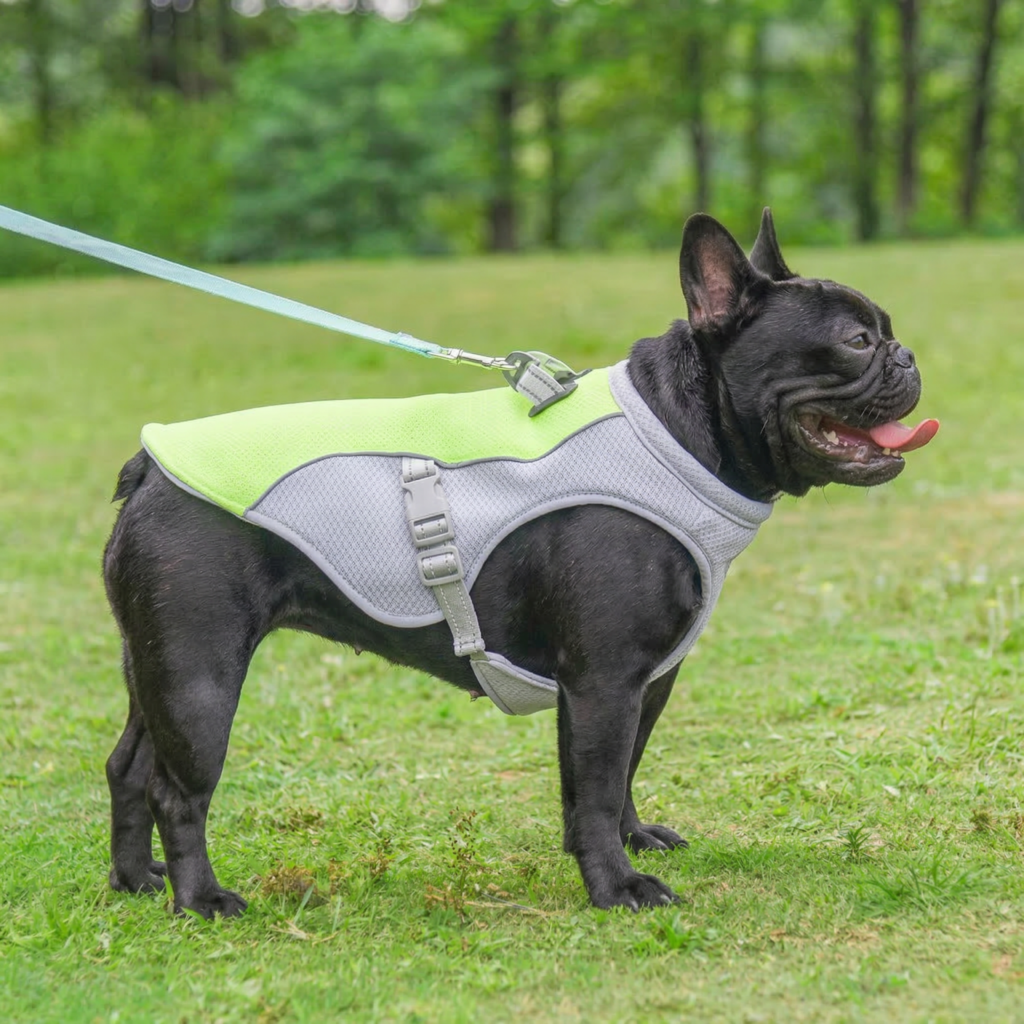
Section 2: The “Frenchie Fit” Problem
Why Standard Dog Vests Don’t Work for Bulldogs
If you’ve ever tried to buy a coat or harness for a French Bulldog, you know the struggle. But when it comes to cooling vests, poor fit isn’t just uncomfortable—it’s medically dangerous.
Here is the anatomy you need to understand to shop intelligently.
The Barrel Chest Phenomenon French Bulldogs have a thoracic cavity that is wider than it is deep. Their rib cage rounds outward dramatically, creating what we call a “barrel chest.” Standard dog apparel is designed for breeds with deeper, narrower chests (like Labradors, German Shepherds, or Pointers). When you put a standard vest on a Frenchie:
- Gapping: It gaps at the chest, leaving the core exposed to sun and heat.
- Shifting: It shifts during movement, creating uneven cooling spots.
- Sternum Pressure: It puts downward pressure on the sternum, restricting ribcage expansion during the heavy breathing of panting.
The Short Back (Chondrodystrophy) Frenchies have shortened spines due to their chondrodystrophic breeding. A vest that is designed for a “Large” dog will be too long.
- It extends past the lumbar region, restricting hind leg movement.
- It rubs against the tail base, causing chafing and hair loss.
- It interferes with the natural arch of the back during movement.
The Thick Neck Dilemma The neck circumference of a French Bulldog often matches or exceeds their chest girth. Standard vest designs often feature small, non-adjustable neck holes. This can:
- Compress the trachea (already narrowed in BOAS-affected dogs).
- Restrict venous return (blood flow) to the head.
- Cause panic in dogs who feel their airway is compromised.
The Dangers of Poor Fit: A Medical Perspective
As someone training in veterinary medicine, I can’t overstate this: A poorly fitted cooling vest can kill your French Bulldog.
- Respiratory Restriction: If a vest compresses the chest wall or abdomen, it mechanically limits the dog’s ability to expand the lungs. For a breed that already struggles to move air, this added restriction can push them into respiratory distress.
- Overheating from Stress: A vest that is uncomfortable or restrictive causes stress. Stress releases catecholamines (adrenaline), which increases metabolic rate and heat production. Stressed dogs pant more. If they can’t get enough air, anxiety skyrockets, and heat production increases. It is a vicious cycle.
- Skin Fold Dermatitis (Pyoderma): French Bulldogs have deep skin folds that require careful management. A wet vest that doesn’t fit properly can trap moisture against these folds (neck, armpits, tail pocket). This creates the perfect incubator for yeast and bacteria. I’ve seen severe cases of skin fold dermatitis caused by owners leaving wet cooling vests on for too long.
The “Frenchie Fit” Checklist
When evaluating a cooling vest, check these five points:
- Neck Opening: Should accommodate at least two fingers flat between the neck and fabric.
- Chest Width: Should wrap around the barrel chest without gaping or pulling tight across the sternum.
- Length: Should end before the base of the tail, allowing full range of motion in the hind legs.
- Strap Placement: Adjustable straps should sit behind the shoulders and in front of the hips—never directly over the ribs.
- Material Stretch: Some give is good; complete rigidity is dangerous.
Section 3: Product Reviews .The Best Cooling Vests for French Bulldogs
I’ve tested dozens of cooling vests through the lens of veterinary science and Frenchie anatomy. Here are my top five recommendations, categorized by use case, with detailed “Real World” testing notes.
Product 1: The Gold Standard for Brachycephalic Breeds
Product Name: Ruffwear Swamp Cooler Dog Vest The Verdict: 🏆 TOP PICK FOR FRENCH BULLDOGS
How It Works The Swamp Cooler uses evaporative cooling technology with a sophisticated three-layer construction:
- Outer Layer: A light-colored, water-resistant layer that reflects solar radiation and provides 50+ UPF sun protection.
- Middle Layer: The water-absorbing cooling core. This is where the water is stored.
- Inner Layer: A breathable mesh that sits against the dog.
This “sandwich” method is superior to single-layer vests because it prevents the wet fabric from sitting directly against the skin (reducing dermatitis risk) while managing the evaporation rate for longer duration.
Frenchie Fit Rating: ⭐⭐⭐⭐☆ (4.5/5)
- Pros: The harness-compatible design is a game-changer. You can clip your leash to the vest, or thread your existing Y-harness through it. The wide chest panel accommodates barrel chests without gaping.
- Cons: The neck opening, while adjustable, can be snug on dogs with very thick necks. I recommend measuring carefully and potentially sizing up.
Real-World Testing Notes: On a 28°C (82°F) day, I tested this on a 12kg Frenchie. After a 30-minute walk, the vest was still damp and cool to the touch. The dog’s respiratory rate remained at a manageable 40 breaths per minute, whereas a control walk without the vest saw rates exceeding 80 bpm.
Medical Note: The mesh inner layer prevents direct moisture contact with the skin, reducing the risk of fold dermatitis. However, I still recommend removing the vest every 20-30 minutes during extended wear to check for dampness in skin folds.
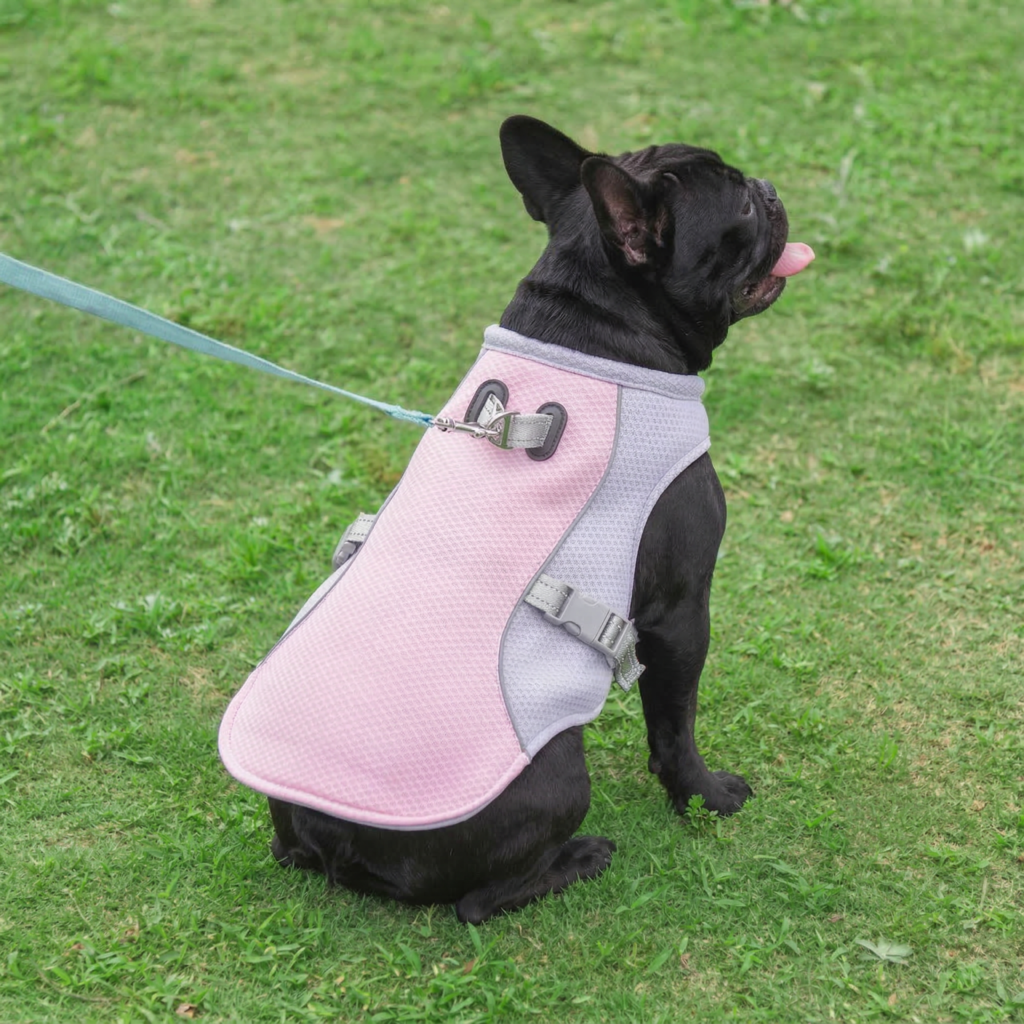
Product 2: The Budget-Conscious Choice
Product Name: Canada Pooch Cool Coat The Verdict: 💰 BEST BUDGET OPTION
How It Works This is a straightforward evaporative cooling coat made from a lightweight, water-absorbent fabric. It is essentially a high-tech towel shaped into a coat. It lacks the multi-layer construction of premium options but gets the job done for short periods.
Frenchie Fit Rating: ⭐⭐⭐☆☆ (3.5/5)
- Pros: The fabric has significant stretch, accommodating barrel chests well. It is simple to put on with minimal straps. Affordable enough to buy two for rotation.
- Cons: The lack of multiple adjustment points means it can shift during vigorous movement. The neck hole is fixed—no adjustment for thick-necked individuals.
Medical Note: Because this vest sits directly against the skin without a moisture-wicking layer, it’s essential to check skin folds frequently. The wet fabric against skin can accelerate fold dermatitis. I recommend using this for short walks only (under 30 minutes).
Product 3: The Phase Change Technology Option
Product Name: K9 Chill System Cooling Vest The Verdict: 🌡️ BEST FOR EXTREME HEAT
How It Works Unlike evaporative vests, the K9 Chill uses Phase Change Material (PCM) inserts. These inserts contain a gel that remains solid until it reaches a specific temperature (usually 58°F). When the dog’s body heat exceeds this threshold, the gel melts, absorbing massive amounts of heat in the process.
Frenchie Fit Rating: ⭐⭐⭐⭐☆ (4/5)
- Pros: Works in high humidity (unlike evaporative vests). Consistent cooling temperature—doesn’t get ice-cold, which prevents vasoconstriction (where blood vessels narrow to preserve heat). Even weight distribution.
- Cons: Heavy (1-2 pounds with inserts). Requires freezer space for inserts. Expensive.
The Science of Why This is Safer: With ice packs, you risk causing vasoconstriction—cold skin makes blood vessels constrict, trapping heat in the core. PCM inserts melt at 58°F, which is cool enough to draw heat out but warm enough to keep blood vessels dilated. This allows for safe, efficient core cooling.
Product 4: The Harness-Compatible Design
Product Name: Kurgo Core Cooling Dog Vest The Verdict: 🦮 BEST FOR WALKING/HARNESS USERS
How It Works This is an evaporative cooling vest with a clever design feature: a built-in harness channel that allows you to thread your existing harness straps through the vest. This keeps the cooling layer against the skin while maintaining your preferred walking setup.
Frenchie Fit Rating: ⭐⭐⭐⭐☆ (4.5/5)
- Pros: The harness compatibility is essential for bulldogs who need controlled walks. Wide chest panel accommodates barrel chests. Multiple adjustment points allow precise fitting.
- Cons: The vest adds bulk under the harness, which can affect fit if you don’t adjust the harness straps properly.
Medical Note: For French Bulldogs with BOAS, a well-fitted harness is non-negotiable. A collar presses on the trachea; a harness distributes pressure across the chest. This vest allows you to maintain that critical safety equipment while adding cooling.
Product 5: The Maximum Coverage Option
Product Name: Ezydog Cooling Dog Vest The Verdict: 🛡️ BEST FOR EXTREME COVERAGE
How It Works This evaporative vest uses a unique design that covers not just the back but extends down the sides and partially across the chest, maximizing the surface area for evaporative cooling.
Frenchie Fit Rating: ⭐⭐⭐☆☆ (3/5)
- Pros: Extensive side coverage cools the vital organ areas (heart, lungs, liver) more effectively.
- Cons: The extensive coverage can feel restrictive to some dogs. The vest is longer than ideal, often extending past the tail base on Frenchies.
Medical Note: While more coverage sounds better, it’s not always safer. For French Bulldogs, I prefer vests that focus coverage on the thoracic region (chest and upper back) rather than extending down the entire body. Covering the abdomen can restrict the abdominal breathing component that Frenchies rely on during panting.
Section 4: Comparison Table
| Product | Type | Fit | Best For |
|---|---|---|---|
| Ruffwear Swamp Cooler | Evaporative | ⭐⭐⭐⭐⭐ | Overall Best |
| Canada Pooch Cool Coat | Evaporative | ⭐⭐⭐☆☆ | Budget Pick |
| K9 Chill Cooling Vest | Phase Change | ⭐⭐⭐⭐☆ | Extreme Heat |
| Kurgo Core Cooling Vest | Evaporative | ⭐⭐⭐⭐⭐ | Walks / Harness |
| Ezydog Cooling Vest | Evaporative | ⭐⭐⭐☆☆ | Max Coverage |
Section 5: How to Use a Cooling Vest Correctly
You’ve bought the vest. Now let’s make sure you’re using it in a way that maximizes safety and effectiveness.
Step 1: Proper Activation (For Evaporative Vests)
- The Soaking Technique: Submerge the entire vest in cool (not ice cold) water. Let it soak for 2-3 minutes to ensure complete saturation of the cooling layer.
- The Wringing Process: Remove the vest and gently squeeze out excess water. Do not twist aggressively—this can damage the internal fibers.
- The “Goldilocks” Test: The vest should be damp, not dripping. If water drips when you hold it up, wring more gently until dripping stops. Why? If it’s too wet, the water pools and creates a warm layer. If it’s too dry, evaporation doesn’t happen.
Step 2: Duration and Re-wetting
- Evaporative vests: 1-3 hours depending on humidity.
- PCM vests: 2-4 hours.
Re-wetting Protocol: Never pour water directly onto a vest while it’s on the dog. This creates uneven saturation and can shock the skin. Remove the vest, re-soak, wring, and re-apply.
Step 3: The 20-Minute Safety Check
Every 20 minutes during vest use, perform this quick assessment:
- Check Skin Temperature: Place your hand under the vest. The skin should feel cool, not hot or clammy.
- Check for Moisture: Run your fingers along the skin folds (neck, armpits). Any dampness should be dried immediately.
- Check for Irritation: Look for redness, especially at pressure points.
- Check Respiratory Rate: Is your dog panting excessively? If so, the vest may not be working effectively, or the heat is simply too intense for activity.
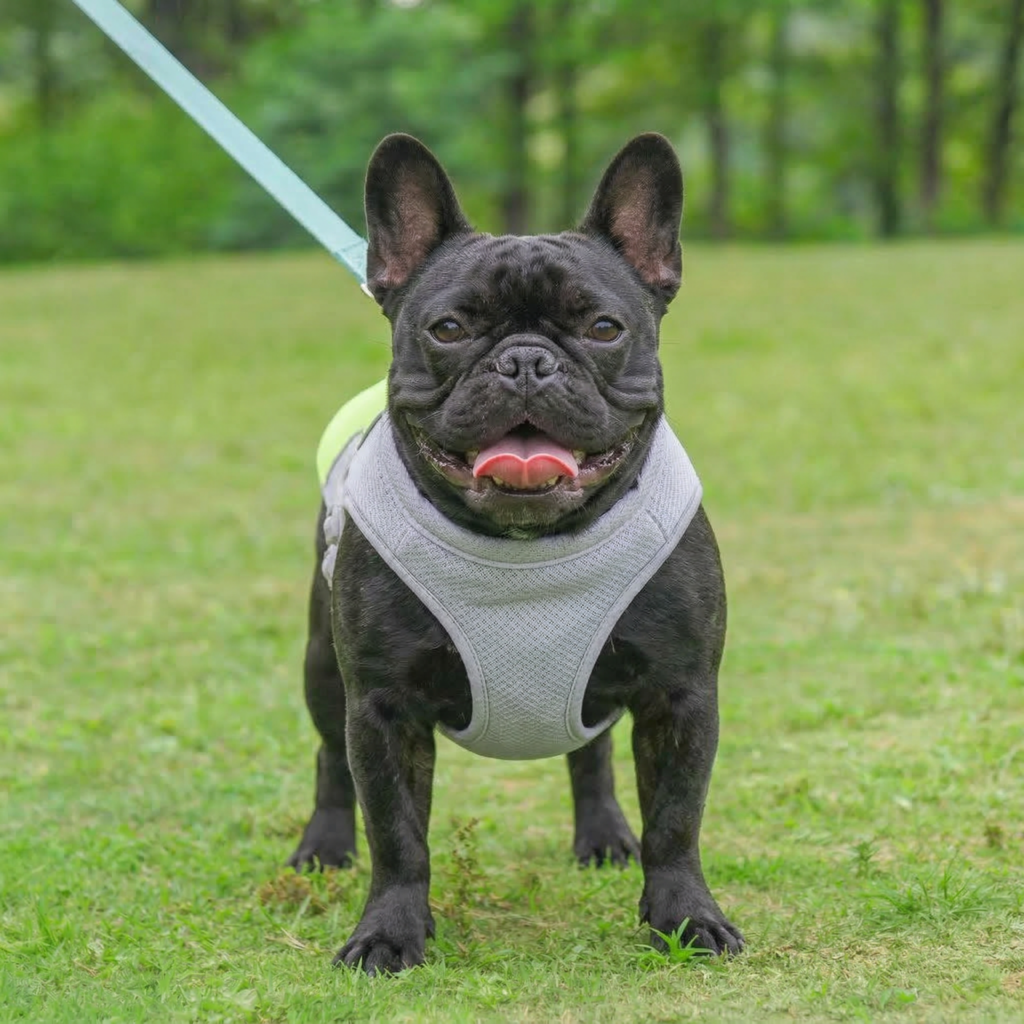
Section 6: When NOT to Use a Cooling Vest
This section might save your dog’s life. Read it carefully.
Scenario 1: Active Heat Stroke If your dog is already showing signs of heat stroke—collapse, vomiting, seizures, bright red gums, disorientation—DO NOT put a cooling vest on them.
Why? A vest only cools the surface. In active heat stroke, you need rapid core cooling, which requires:
- Immersion in cool (not cold) water.
- Wetting of the entire body (especially paws, ears, groin).
- Immediate veterinary intervention.
Putting a vest on a dog in heat stroke delays these life-saving measures.
Scenario 2: Respiratory Distress If your French Bulldog is already struggling to breathe (open-mouth breathing with exaggerated effort, blue-tinged gums, panicked expression), do not add any equipment to their body. The stress of putting on a vest can tip them into respiratory failure.
Scenario 3: Open Wounds or Skin Infections Never use a cooling vest on a dog with open sores, severe fold dermatitis, or recent surgical incisions. The moisture and friction will worsen these conditions and introduce bacteria.
Section 7: Alternative Cooling Strategies
A cooling vest is a powerful tool, but it shouldn’t be your only line of defense. Here are scientifically-backed complementary methods.
1. Cooling Mats While vests are for movement, cooling mats are for resting. Look for pressure-activated mats (containing PCM gel) rather than water-filled mats, as they stay cooler longer and don’t get punctured as easily.
2. Paw Soaking Dogs do sweat through their paw pads. Soaking your Frenchie’s paws in cool water (or using wet towels on the paws) can help dissipate heat rapidly. This is a great immediate intervention if you don’t have a vest handy.
3. Hydration Therapy Cold water isn’t just for the outside. Encourage your dog to drink cool water. Adding ice cubes to water bowls can encourage play and hydration simultaneously, but be careful not to let them swallow whole ice cubes (choking hazard).
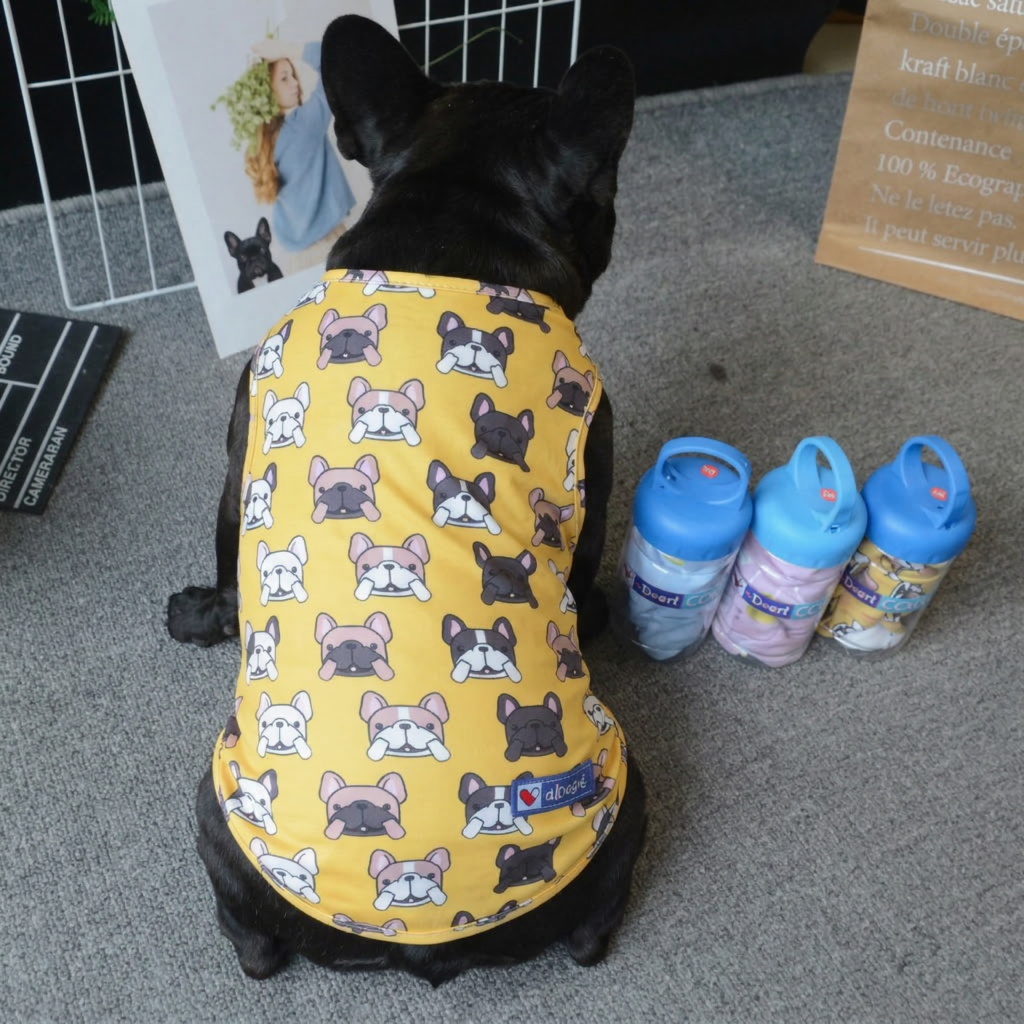
Section 8: Frequently Asked Questions
Section 9: The Bottom Line
If you take nothing else from this guide, remember these five truths:
- Your French Bulldog’s anatomy makes them vulnerable. Their brachycephalic airway means they cannot cool themselves effectively.
- Cooling vests work best as prevention. Use them before going into heat, not after your dog is already overheating.
- Fit is a medical issue. A poorly fitted vest can restrict breathing and cause skin damage. Measure carefully and choose vests designed for barrel-chested breeds.
- No vest replaces common sense. Shade, water, rest, and air conditioning remain the foundation of heat safety.
- Know when not to use one. If your dog is already in distress, skip the vest and go straight to emergency cooling and veterinary care.
As someone training to spend my life caring for dogs like yours, I’ve seen the devastation that heat stroke causes in brachycephalic breeds. I’ve also seen the difference that proper preventive care—including well-chosen cooling vests can make.
Cooling gear can help in hot weather, but it works best as part of a broader Frenchie safety routine rather than as a standalone solution. Owners should also understand the warning signs of heat stroke in French Bulldogs, the breathing challenges explained in our guide to BOAS in French Bulldogs, and how everyday travel gear like the best carrier for French Bulldog can affect airflow, stress, and overall comfort during summer outings.
Your French Bulldog relies on you to understand their unique physiology. Use that understanding to make informed choices about their safety this summer.
French Bulldog Breathing Hard: Causes, When to Worry, and What to Do
French Bulldog Wrinkle Care: How to Clean Facial Folds Safely and Prevent Infection

French Bulldog Snoring: What’s Normal, What Isn’t, and When to See a Vet

French Bulldog Reverse Sneezing: Causes, When to Worry, and What Owners Should Do
French Bulldog Eye Discharge: What’s Normal, What’s Not, and When to Worry
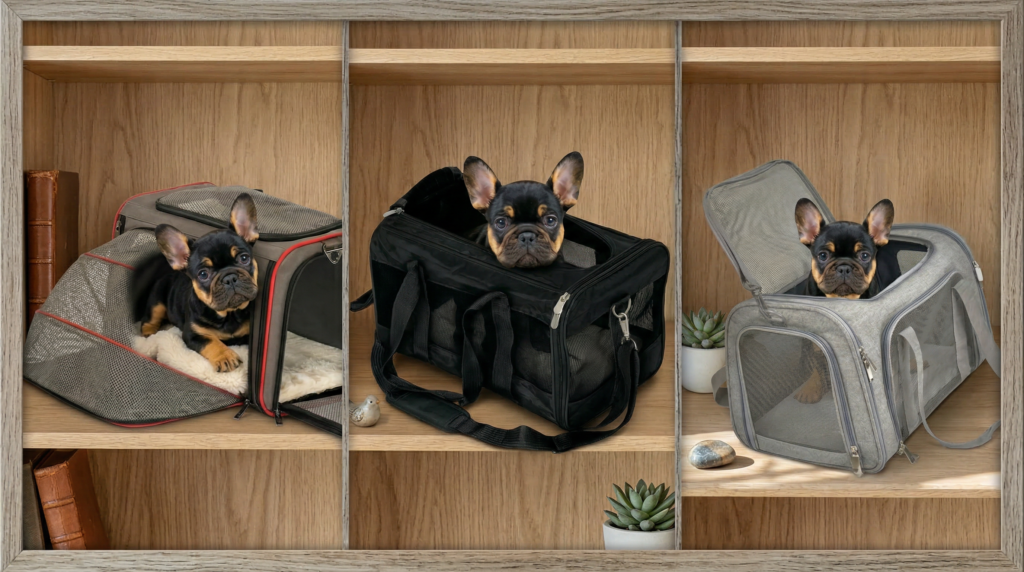
Best Carrier for French Bulldog: How to Choose a Safer, Better-Fitting Option